Set child car seat harness height

The short answer
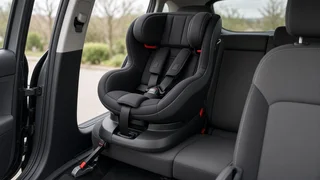
The correct harness height depends on which way the child seat faces. For a rear-facing seat, the shoulder straps should come out of the seat shell at or just below the child's shoulders. For a forward-facing seat, they should come out at or just above the shoulders. These general rules apply to five-point harness seats used in the US. The manual for your specific seat is the final authority, because it sets the slot positions, height range and any direction-specific restrictions for that model.
Why the rule changes with direction
In a frontal crash, a rear-facing child is pushed back into the seat shell and tends to slide upward along it. Straps that start at or below the shoulders help hold the child down in the seat and limit that upward movement.
A forward-facing child is thrown forward against the harness. Straps that start at or above the shoulders hold the upper torso back against the seat. Straps that start well below the shoulders can let the shoulders move forward and slip out of position, and they place the load poorly on the child's body.
How to check and adjust harness height
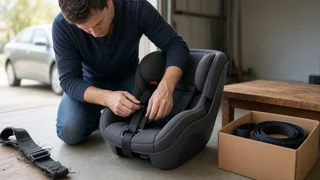
1) Seat the child with their back and bottom fully against the seat, wearing ordinary clothing. Bulky coats can distort where the shoulders sit. 2) Look at where each strap emerges from the seat back, relative to the top of the child's shoulders. 3) If the seat has a no-rethread harness, move the headrest or harness adjuster until the straps are in the correct position for the direction the seat faces. 4) If the seat has a rethread harness, follow the manual to unthread the straps, route them through the correct slots, and reconnect them to the splitter plate or anchor point. Make sure the straps are not twisted. 5) Confirm the position again with the child seated, then tighten the harness.
How seat designs differ
Harness height adjustment works differently from one seat to another. No-rethread designs change strap height with a single mechanism, usually linked to the headrest. Rethread designs use fixed slots, so you have to reroute the straps by hand. Convertible and all-in-one seats can be used in both directions. On some of these seats, the manual limits which slots or headrest positions are allowed rear-facing versus forward-facing, so the general at-or-below and at-or-above rule may be narrowed for that model. Combination seats that convert to booster mode stop using the harness altogether, and the vehicle's seat belt restrains the child instead. Harness height rules no longer apply once the seat is in booster mode.
When the harness height no longer fits
Children outgrow harness positions as they grow, so recheck strap height regularly. Many seat manuals say a child has outgrown a seat in a given mode in these cases: • Rear-facing: the child's shoulders are above the highest usable slot. • Forward-facing: the shoulders are above the top harness position. Manuals also set separate height, weight and head-position limits. Reaching any one of them means the seat no longer fits in that mode. The exact limits differ by model and are not covered here.
Finish with related harness checks
Harness height is one of several checks that work together. Once the height is set: • Tighten the harness until you cannot pinch any slack in the strap at the child's collarbone. • Position the chest clip, if your seat has one, at armpit level. • Make sure the seat itself is installed tightly with the vehicle's lower anchors or seat belt, as the seat and vehicle manuals describe.
Limits of this guide
This guide covers general principles only. It does not include model-specific slot positions, height or weight limits, or adjustment procedures. Those come from your seat's manual and labels. The vehicle owner's manual covers seating positions and anchor locations. A certified child passenger safety technician can inspect the installation and confirm the harness fit in person.