Ram Key Fob Not Working After Battery Change
The Short Answer
When a Ram key fob stops working right after a battery swap, the cause is usually something that happened during the swap rather than a failed fob or a truck that has forgotten the key. The most common culprits are a battery installed upside down, the wrong or weak replacement cell, a bent or dirty battery contact, a protective film left on the new battery, or a fob case that was not fully snapped back together. Replacing the battery normally does not erase the fob's pairing with the truck, so reprogramming is rarely the first thing to try. Work through the physical checks first, then test with a spare fob before assuming a programming or vehicle fault.
Which Function Stopped Working Matters
A Ram fob can do two separate jobs, and they fail in different ways. The remote buttons (lock, unlock, panic, and on some trucks remote start or tailgate release) are part of remote keyless entry, or RKE, which sends a radio frequency (RF) signal and depends on the fob battery. Starting the engine relies on the immobilizer, a security system that checks a coded chip in the key or fob before allowing the engine to run; Chrysler-family vehicles have marketed this as Sentry Key. On trucks with keyless entry and push-button start, the fob is also detected wirelessly when you approach or press the start button.
If the buttons fail but the truck still starts, the problem is almost certainly with the fob's battery circuit or button contacts. If the truck will not start, the cause may still be the fob battery on keyless-start trucks, but it can also be an unrelated issue such as a weak vehicle battery. Which features your fob has, and how keyless start behaves, depends on the model year and trim, so check your owner's manual for your specific truck.
Checks in the Order Worth Doing Them
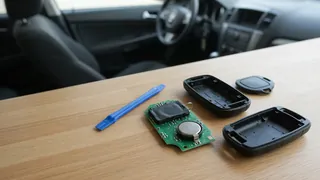
1) Confirm battery orientation. Open the fob and compare the battery's positive side, usually marked with a plus sign, against the marking or diagram inside the case. A reversed cell is one of the most frequent causes. 2) Confirm the battery type. Read the code printed on the old battery or in the owner's manual and make sure the new one matches exactly. A cell with the right diameter but a different thickness may not press firmly against the contacts. 3) Remove any film or sticker. Some new coin cells come with a protective film or label that must be peeled off before the cell can make contact. 4) Try a different new battery. Replacement cells can be weak or dead from long storage, and a fresh cell from another pack rules this out. 5) Inspect the contacts. Look for a metal tab that was bent flat or pushed out of position, and for dirt or corrosion. Gently restoring a bent tab so it presses on the battery often fixes the fault. 6) Check the circuit board and button pad. If the board shifted or the rubber button pad is misaligned, buttons may not register. Make sure the board sits squarely and the pad lines up with the case openings. 7) Close the case fully. Press the halves together all the way around until they seat evenly; a partially closed case can leave the battery loose. 8) Test at close range. Stand near the truck and try each button, watching for the lights to flash or the locks to move.
Use a Spare Fob to Narrow It Down
If you have a second fob, try it. When the spare works normally, the problem is isolated to the fob you just opened, which points back to the battery, contacts or internal damage. When the spare also fails, look at the truck instead: a weak vehicle battery, a blown fuse or a receiver fault can affect every fob at once. Note that if the spare has an old battery of its own, it could also give a misleading result.
If the Truck Will Not Start
On keyless push-button start Ram trucks, the owner's manual describes a backup method for starting when the fob battery is weak or the fob is not detected, typically involving holding the fob in a specific spot near the start button or another designated location. The exact procedure varies by model year, so follow the manual for your truck rather than a general instruction. On trucks that use a traditional ignition key with a fob head, the immobilizer chip usually does not depend on the fob battery, so a no-start after a battery swap on those trucks is more likely to be a separate vehicle issue, or damage to the key itself, than the new battery.
When Reprogramming or Professional Help Makes Sense
Consider a dealer or an automotive locksmith if you have confirmed correct battery type and orientation, tried a known-good new battery, checked the contacts and case, and the fob still does not respond while a spare works. At that point the fob may have internal damage, possibly from handling during the swap, or may have lost its pairing. Whether an owner can re-pair a Ram fob without diagnostic equipment depends on the model year and system, and no confirmed procedure for specific years was available for this guide, so ask a qualified shop for your exact truck.
What This Guide Could Not Confirm
No model-year-specific details were available here, including battery part numbers for particular fobs, backup start locations, owner reprogramming steps or repair costs. Treat the steps above as general diagnostic order, and rely on your owner's manual or a dealer for details tied to your truck's year, trim and key type.