Key Fob Not Working After Battery Replacement: Causes and What to Check
If your key fob is not working with a new battery, the cause is usually something small and fixable: the wrong battery size, a battery installed upside down, a protective sticker left on the cell, a bent contact, or a case that did not snap fully shut. Less often, the fob needs to be resynchronized with the vehicle, the fob itself is damaged, or the problem is on the car's side rather than in the remote. This guide explains why a key fob won't work after replacing the battery and walks through the checks in a sensible order, from quickest to most involved.
The short answer
A new battery only restores power. It does not fix a poor connection, a damaged circuit board, a lost pairing with the car, or a fault in the vehicle's receiver. When a replaced key fob battery is still not working, the most likely explanation is an installation problem, so start there. If installation checks out, look at whether the fob needs to be re-paired, and finally consider the vehicle side and hardware damage.
One distinction matters before you begin. Many modern keys combine two separate systems in one housing. The remote transmitter is the battery-powered part that sends lock, unlock, trunk and panic signals. The immobilizer transponder is a separate chip that lets the engine start; on many vehicles it can work without any battery at all. Knowing which function has stopped working helps narrow down the cause.
Check these first: installation problems
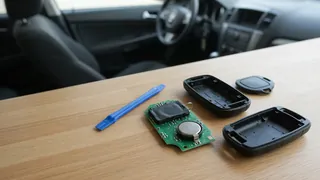
Battery type and size. Coin cells are labeled with codes such as CR2032, CR2025 or CR2016. They can look nearly identical, but the last digits indicate thickness, and a thinner cell may not touch the contacts firmly. Match the code printed on the old battery or stated in the owner's manual. Orientation. Most coin cells must go in with a specific side facing up, usually the positive side marked with a plus sign, but the correct direction varies by fob design. Compare with how the old battery sat or with markings inside the case. Protective film or sticker. Some new batteries come with a clear plastic film or label on one face. If it is left on, the battery cannot make contact. Bent or flattened contacts. The small metal tabs that press against the battery can be bent when the old cell is pried out. A tab that no longer springs up may fail to touch the new battery. Case not fully closed. If the two halves of the housing are not snapped together evenly, the battery or circuit board may sit out of position. Press around the seam until it closes completely. Board or button pad out of place. On some fobs, the circuit board or the rubber button membrane lifts out when the case is opened. If it goes back in misaligned, the buttons may not press the switches underneath.
Is the new battery actually good?
A new battery is not always a fresh one. Coin cells can lose charge in storage, especially if they have been on a shelf for a long time, kept loose in a drawer where they touch metal objects or each other, or bought from an unreliable seller. Handling the flat faces with bare fingers can also leave oils that interfere with contact. If you have a multimeter, you can check that the cell reads close to its rated voltage. Otherwise, trying a second battery from a different package is a quick way to rule out a dead or weak replacement.
Does the fob show any sign of life?
Many fobs have a small LED that blinks when a button is pressed. If yours has one, it offers a useful clue. A light that does not come on at all points toward a power or connection problem inside the fob. A light that blinks normally while the car does not respond suggests the fob is transmitting but the vehicle is not accepting the signal, which shifts attention toward pairing or the vehicle side. Not every fob has an indicator light, so the absence of one tells you nothing on its own.
Resynchronization and key programming
Most remotes keep their pairing with the vehicle when the battery is swapped, especially if the change is done reasonably quickly. On some vehicles, however, the remote can lose synchronization, particularly if buttons were pressed repeatedly while the fob was out of range or without power. Whether this happens, and how it is fixed, depends heavily on the make, model year and key system.
Some vehicles allow a simple resync, such as using the mechanical key in the door or ignition and then pressing a fob button. Others offer an owner-performed programming procedure described in the owner's manual. Many newer vehicles, especially those with push-button start or proximity (keyless entry) systems, require key programming with dedicated diagnostic equipment, which means a dealer service department or an automotive locksmith. Avoid trying procedures intended for a different vehicle, since they may not apply to yours.
Problems on the vehicle side
If a spare fob also fails to work, the fault is more likely in the car than in either remote. Possible vehicle-side causes include:
A weak or discharged vehicle battery, which can cause erratic or unresponsive remote locking. A fault in the vehicle's receiver module, antenna or related wiring. A blown fuse in a circuit associated with the locking or keyless entry system, depending on the vehicle's design. A door lock actuator problem, which may affect only one door while the others respond. Radio interference from nearby transmitters, which can temporarily reduce range in certain locations.
Damage inside the fob
Sometimes the battery change simply coincides with an existing fault. Drops, moisture exposure, worn button contacts and cracked solder joints can all stop a remote from working, and these problems may only become obvious when the case is opened. Look for corrosion on the contacts, a cracked circuit board, or residue from liquid. Minor corrosion on battery contacts can sometimes be cleaned carefully, but a damaged board or failed component usually means the fob needs repair or replacement.
Recommended order of checks
Step | What to check | What it rules out; 1 | Battery code matches the original | Wrong size or thickness; 2 | Battery orientation and any protective film | Installation error; 3 | Contacts, board seating and case closure | Poor connection; 4 | A second new battery from another package | Weak or dead replacement; 5 | LED indicator, if the fob has one | Power versus pairing issue; 6 | Spare fob, if available | Fob fault versus vehicle fault; 7 | Owner's manual resync or programming steps | Lost synchronization; 8 | Dealer or automotive locksmith | Programming, receiver or hardware faults
Getting into and starting the car in the meantime
Most key fobs contain or accompany a mechanical key that opens at least the driver's door, even if the lock cylinder is hidden behind a small cover on the handle. On vehicles with push-button start, there is often a backup method for starting the engine with a weak or unresponsive fob, such as holding the fob against the start button or placing it in a designated spot. The exact method varies by vehicle and is usually described in the owner's manual. If you cannot get in or start the car, roadside assistance through your insurer, vehicle warranty or a membership service may be able to help.
When to get professional help
If you have confirmed the correct battery is installed properly and the remote still does not respond, the next step is usually a dealer or an automotive locksmith. They can test whether the fob is transmitting, reprogram it to the vehicle, or supply and program a replacement. Because programming a key grants access to the vehicle, expect to be asked for proof of ownership, such as the registration or title along with identification. Whether a given locksmith can program your specific vehicle depends on the make, model year and key system.
Key takeaways
Most cases of a key fob not working even with a new battery come down to battery size, orientation, a leftover sticker, bent contacts or an improperly closed case. A new battery can still be weak, so testing a second one is worthwhile. Some vehicles need the remote resynchronized or reprogrammed, and the method depends on the vehicle. If a spare fob also fails, suspect the vehicle rather than the remote. The remote transmitter and the immobilizer chip are separate, so locking and starting problems may have different causes.