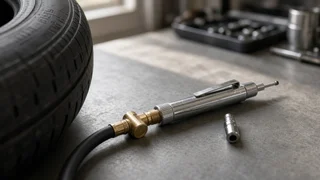
Pencil Tire Pressure Gauge Not Working: Fixes
A pencil tire pressure gauge that no longer extends its numbered rod, sticks partway, or gives a reading that does not match a known-good check is usually suffering from a mechanical or sealing problem rather than a vehicle fault. Because these compact stick gauges rely on a simple sliding indicator and a small internal seal, diagnosing them starts with the connection at the valve stem and the condition of the gauge body itself. Understanding how the mechanism transfers air pressure into visible movement helps separate a gauge failure from a tire that may genuinely be low.
Direct answer
When a pencil tire pressure gauge is not working, begin by pressing it squarely onto the valve stem until the hiss of escaping air stops. A crooked or weak connection allows pressure to bypass the gauge chuck, producing no movement or a weak, inaccurate reading. Remove the gauge, reseat it firmly, and try again. If the rod still does not extend, inspect the opening for debris, damage, or a stuck sliding scale. Many failures are caused by contamination or a poor mechanical connection rather than an internal defect in the gauge itself.
After checking the connection, compare the gauge against another known-working gauge on the same tire. If the pencil gauge gives no reading while the second gauge displays pressure, the problem is inside the pencil gauge. Causes include a clogged inlet, a torn or displaced internal seal, corrosion on the sliding rod, or a broken spring. Because the mechanism is simple but tightly fitted, disassembly is not always practical without risking calibration. Replacing an inexpensive pencil gauge is often the most reliable fix once the connection and tire valve have been ruled out.