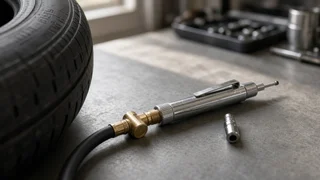
How to Use and Read a Pencil Tire Pressure Gauge
A pencil tire pressure gauge is a compact mechanical tool that uses a sliding indicator stick to show inflation pressure. When you press the pen-style gauge over a tire valve, internal air pressure pushes the graduated rod out of the barrel. The point where the rod stops relative to the scale is your reading. Because these gauges are affordable and portable, many drivers keep one in the glovebox. The main challenge is interpreting the small scale correctly and getting a consistent seal on the valve stem so the measurement is useful.
Direct answer
To use a pencil tire pressure gauge pen, first remove the valve cap from the tire's valve stem and set it aside in a clean spot. Press the open end of the gauge squarely onto the valve stem with a short, firm push. You will hear a brief hiss as the chuck opens the valve core. The sliding stick extends from the barrel and stays at the measured position while the gauge remains sealed against the stem.
Reading a tire pressure gauge stick means looking at the rod's visible length near the barrel. The scale is usually marked in psi on one side and sometimes bar or kPa on another. Hold the gauge in the same orientation you used during measurement, then note the last fully visible graduation line or number closest to the barrel edge. A faint hiss during removal means air escaped from the tire, not from the gauge reading. For repeatable results, check the same tire twice and compare the readings.
How to proceed
Before measuring, move the vehicle to a shaded spot and let the tires cool. Heat from driving raises internal air pressure, which can make a cold inflation reading appear higher than the vehicle specification. Identify the recommended pressure from the driver's door jamb label or owner's manual rather than the sidewall maximum. Keep the gauge's opening clean and free of debris because a blocked chuck can produce a low or unstable reading.
Place the gauge straight onto the valve stem rather than at an angle. An angled connection can depress the valve core only partway, giving a weak or zero reading. Press firmly until the hissing stops, then hold the gauge steady and slide the indicator back only after pulling the tool away from the stem. If the rod does not move, reseat the gauge and try again. Check against a second gauge if the reading seems inconsistent with recent handling or sudden pressure loss.