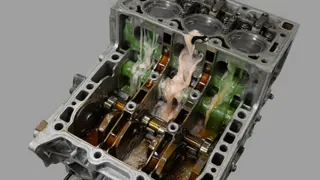
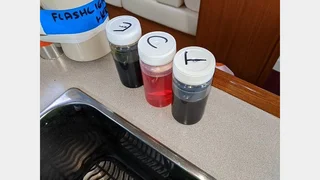
Oil showing up in the coolant
Finding even a little oil in coolant changes how you should read the cooling system. A small slick on the filler neck or a faint oily sheen in the reservoir usually means engine oil and coolant are meeting where they should not, rather than a simple top-off problem. The coolant may also smell like oil before visible contamination appears. Because the cooling system and lubrication system are separate circuits, any crossover deserves prompt attention. The severity can range from a seep at a gasket to internal engine damage, so the appearance and location of the contamination help narrow the likely cause and the proper next step.
Essential answer
A small amount of oil in the coolant is an early warning that two normally isolated fluids have found a shared path. The most common routes are a failing cylinder head gasket, a cracked cylinder head or block, or an internal breach in an oil cooler. Transmission fluid can also enter the radiator on vehicles with an integrated transmission cooler, producing a similar slick. Because the lubrication system runs at higher pressure than the cooling system, oil is usually pushed into the coolant rather than the reverse. A little oil does not necessarily mean catastrophic failure yet, but it means the sealing barrier has been compromised.
Coolant that smells like oil gives the same message in a less visible form. Exhaust gases may pressurize the cooling jacket, and combustion byproducts can carry an oily or fuel-like odor into the expansion tank before a milky emulsion forms. Observing the condition of the coolant on the dipstick, under the oil fill cap, and at the radiator neck helps distinguish an internal head gasket leak from a failed oil cooler. Since manufacturer-dependent designs alter the exact failure points and service approach, the first practical step is to confirm which fluid is present and which shared component the vehicle uses.