Motorcycle Tire Cupping (Scalloping)
Scalloping motorcycle tire cupping is a wear pattern that turns an otherwise round tread into a series of high and low spots around the circumference. Riders usually notice it as a rhythmic vibration, a rumbling feel through the bars or seat, or uneven noise that changes with lean angle. It is not simply normal wear; it reflects how load, inflation pressure, suspension movement, and braking inputs interact at the contact patch. Understanding the condition helps distinguish it from flat spotting or irregular alignment wear and points toward adjustments that may slow further damage.
Essential answer
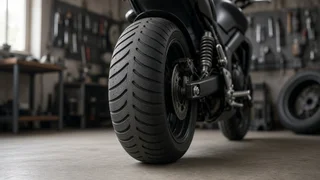
The essential answer is that scalloping, often called cupping on motorcycle tires, is a circumferential wear irregularity in which sections of tread become recessed while adjacent areas remain raised. The pattern commonly appears across the tread face rather than only at the edges, and it can develop on front or rear tires. It matters because the uneven surface changes how the tire contacts pavement, producing vibration and reducing smooth feedback even when tread depth remains partly serviceable.
A cupped tire is evidence of a dynamic problem, not automatically proof that the tire was defective. Inflation pressure, suspension damping, fork or shock condition, steering bearings, and load all affect how the tire is pressed into the road during acceleration, braking, and cornering. When inputs repeat at similar intervals, wear can concentrate in alternating bands. Riders evaluating the condition should inspect the whole tread, check pressure against the vehicle placard, and look for related handling clues before replacing parts.