Mobile Tire Replacement: How the Service Works
What mobile tire replacement is
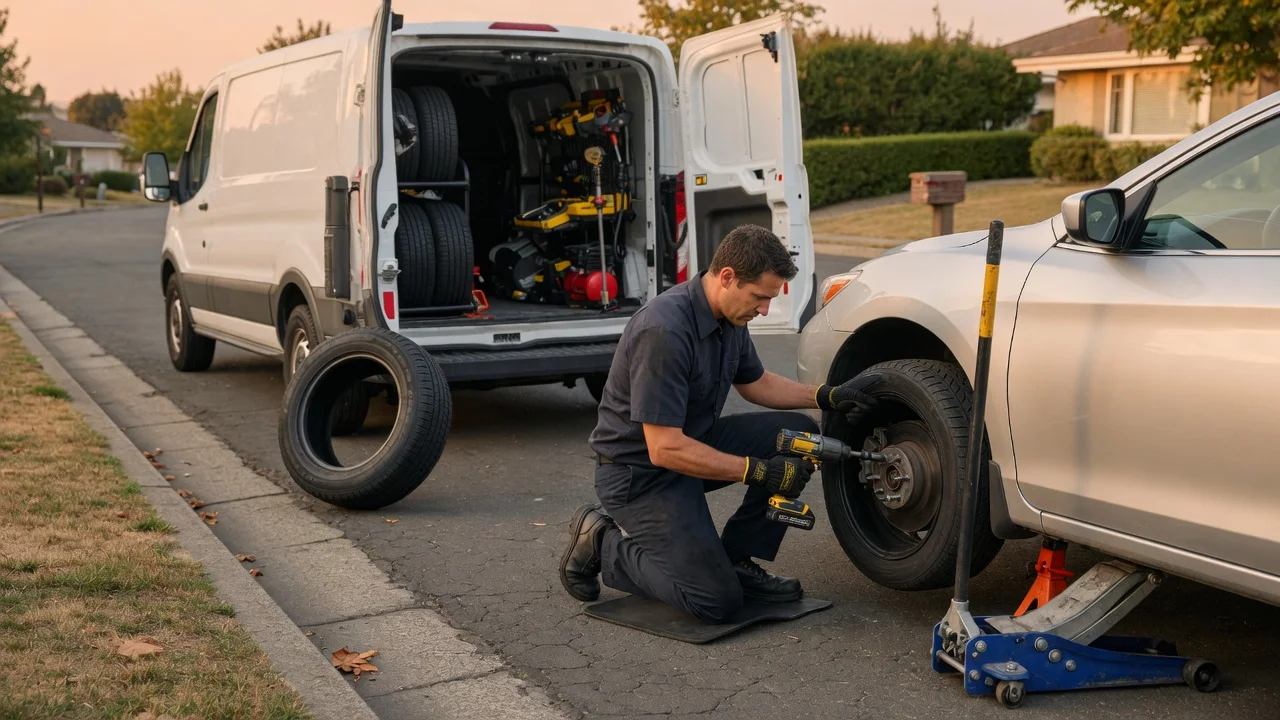
Mobile tire replacement is a service in which an installer travels to your vehicle, usually in a van or truck equipped with tire tools, and replaces one or more tires at your location. That location may be your home, a workplace, a parking lot, or the roadside if the vehicle is in a safe, accessible spot.
The service is best understood as convenience tire work. It removes the need to drive on a damaged spare or have the vehicle towed to a shop. A key condition is that the vehicle must be on a firm, level surface that gives the installer safe access to the wheels. Mobile service is generally offered for standard cars, SUVs, crossovers, and light trucks; it may not be suitable for large commercial tires or unusual fitments.
How the service normally works
A typical mobile tire replacement follows a few basic steps. First, the provider confirms the tire size, vehicle, and service location before dispatch. The installer then arrives with the replacement tire or tires, lifts the vehicle with a portable jack, removes the wheel, and separates the old tire from the rim. The new tire is mounted onto the existing wheel, inflated, and balanced using portable balancing equipment. The installer reinstalls the wheel and torques the fasteners, then checks inflation pressure.
Matching the replacement tire to the vehicle and the remaining tire on the same axle matters. Replacing a single tire can create a tread-depth difference between left and right. On some vehicles, especially all-wheel-drive models, a large difference in tire diameter can place extra load on the driveline. In that situation, a shop or mobile provider may recommend replacing tires in pairs or matching the new tire closely to the existing ones.
What to check before booking
Because availability and service boundaries vary, confirm these details before committing to a mobile tire replacement appointment:
Whether the provider operates in your area and can reach the exact parking or stopping location. Whether the quoted price includes the tire, mounting, balancing, disposal of the old tire, and any travel or call-out fee. The tire brand, model, size, load rating, and speed rating being supplied, not just the tire dimensions. Whether the provider can replace one tire or requires both tires on an axle. The surface and access conditions needed, including clearance for lifting equipment and minimum space around the vehicle. Whether the provider carries the tire to the job or asks you to supply it separately. How the installer will handle the old tire, especially if disposal or recycling is not included.
Also check the condition and age of the existing tires. If the other tire on the same axle is heavily worn, replacing only the failed tire can leave the vehicle with uneven grip. The safest decision is often to replace in pairs, but the appropriate answer depends on measured tread depth and the vehicle manufacturer's recommendations.
When mobile tire replacement is a good fit
Mobile tire replacement is most useful when the vehicle cannot be driven safely to a shop, when a spare is compromised, or when scheduling makes a conventional appointment difficult. It can also make sense for a straightforward single-wheel puncture repair or replacement done at home or at work.
The service is less suitable when the vehicle needs suspension inspection, alignment, multiple tires with a full set of condition checks, or when the work area is unsafe. Mobile equipment is designed for tire mounting and balancing, not for diagnosing steering, suspension, or brake problems. If the tire failure may have been caused by an impact or curb strike, a full inspection may be a better next step than an isolated replacement.
Cost and ownership trade-offs
Mobile tire replacement often costs more than the same service at a fixed tire shop because of the travel charge or call-out fee. The convenience is the main reason to pay the difference, especially when a tow or time away from work would be more expensive. Ask for a total price before dispatch so that the tire, labor, balancing, fees, and disposal are covered in one figure.
Verify that the replacement tire matches the load and speed requirements for your vehicle. Installing a tire with the wrong load rating can affect handling and safety even if the size is correct. The tire information placard on the driver's door jamb or the owner's manual lists the manufacturer's recommended size and inflation pressure; the new tire should meet or exceed the required load rating.
After the installation
After mobile replacement, check the new tire's pressure and visually confirm that the wheel fasteners are present and the tire is seated evenly on the rim. Follow the provider's guidance on re-torquing the wheels after a short distance if that is recommended. If the vehicle pulls, vibrates, or if a warning light appears after the service, stop and have the work checked rather than continuing to drive.
A mobile tire replacement can resolve the immediate problem, but it should not replace a broader tire and wheel inspection when the vehicle's condition calls for one. For a single failed tire with an otherwise sound set, the service is a practical alternative to a shop visit; for uneven wear, repeated pressure loss, or suspected damage, identify the cause before booking.