Mazda CX-30 Engine Malfunction Warning: What It Means and How to Diagnose It
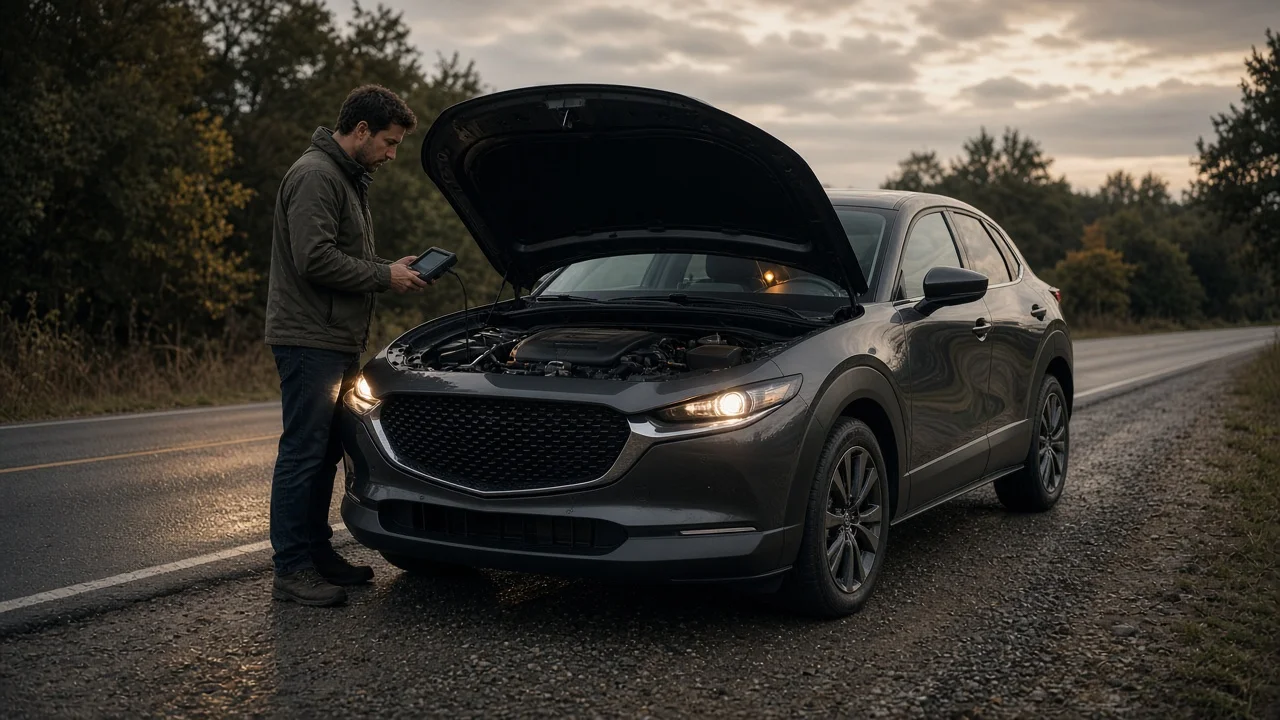
A Mazda CX-30 engine malfunction warning means the engine control module has detected a fault in a monitored engine, emissions or related system. It does not by itself say which part has failed or how serious the problem is. Whether the light is steady or flashing, and whether the vehicle drives differently, matters more than the warning itself. A steady light with normal driving usually allows careful driving to a diagnosis. A flashing light, or a warning combined with overheating, low oil pressure, heavy power loss or unusual noises, calls for reducing load or stopping safely.
What the engine malfunction warning actually is
In US-market vehicles, the amber engine-shaped symbol is the malfunction indicator lamp, often called the check engine light. It is part of the OBD-II (on-board diagnostics) system required on modern cars. When the engine computer sees a sensor reading outside expected limits, a component failing a self-test, or a condition that could raise emissions, it stores a diagnostic trouble code and may turn on the light.
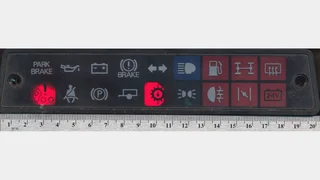
The CX-30 may also show text messages or other indicators on the instrument cluster or center display. Their exact wording and layout vary by model year and trim, so check the warning-light section of the owner's manual for your specific vehicle. Keep in mind that the engine malfunction light is separate from the red warnings for oil pressure, coolant temperature and charging system, which indicate more urgent conditions.
Steady vs. flashing: the first thing to note
Steady light, car drives normally: A fault has been stored, but the system does not see an immediate risk of damage. Plan a diagnosis soon rather than ignoring it. Steady light with rough running, hesitation or reduced power: Something is affecting how the engine runs. Drive gently and get it checked promptly. Flashing light: This typically indicates an active misfire severe enough to send unburned fuel into the exhaust, which can overheat and damage the catalytic converter. Reduce speed and load, avoid hard acceleration, and stop when safe. Towing to a shop is the cautious option. Light came on and then went off: Some faults are intermittent. The code is often still stored in memory and can be read even after the light turns off.
When to stop driving
Pull over safely and switch off the engine if the malfunction warning appears together with any of the following. In these cases, continued driving can turn a repairable fault into serious engine damage, and professional diagnosis or a tow is the sensible next step.
A red oil pressure or coolant temperature warning; A temperature gauge reading in the hot zone, or steam from under the hood; A flashing engine malfunction light; Knocking, rattling or grinding noises from the engine; Severe loss of power or a sudden reduced-power mode at highway speed; Smell of fuel or burning, or visible smoke; Warning lights for braking or steering at the same time
Simple checks you can do first
Before booking a diagnosis, a few observations can narrow down the possibilities and help the technician. None of them replace reading the stored code.
Fuel cap: A loose, damaged or missing cap can trigger an evaporative emissions (EVAP) fault. Tighten it until it clicks. The light usually won't turn off immediately; it may take several drive cycles for the system to retest. Recent refueling or work: Note whether the light appeared right after filling up, a battery replacement, a jump start or any service. These details point toward particular systems. Engine oil level: Check the dipstick on level ground with the engine off and cooled down. Low oil is worth correcting regardless of the warning. Coolant level: Check the reservoir only when the engine is cold. Never open a hot cooling system. Symptom conditions: Write down when the light appeared and what the car was doing: cold start, warm idle, highway cruising, acceleration, hot or wet weather. Intermittent faults often depend on these conditions. Drivability: Note any shaking at idle, hesitation, poorer fuel economy, rough shifting or unusual smells.
Reading the diagnostic codes
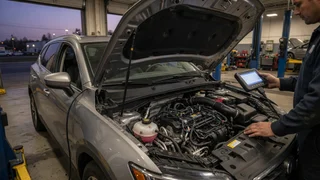
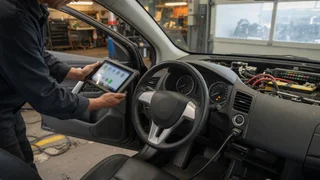
The most useful next step is reading the stored diagnostic codes. Any OBD-II scan tool plugged into the diagnostic port under the dashboard can retrieve generic powertrain codes, and many auto parts stores offer basic code reading. Repair shops and dealers use more capable tools that can also access manufacturer-specific codes, live sensor data and system tests.
Treat a code as a clue, not a verdict. A code names the circuit or condition that failed a test, not necessarily the part to replace. For example, an oxygen sensor code can be caused by an exhaust leak, a wiring fault or an engine running too rich or too lean, not only by a failed sensor. Replacing parts based on the code name alone often wastes money.
Record every code, including pending codes, before anything is cleared. Save the freeze-frame data if your tool shows it. It captures engine speed, temperature, load and other values at the moment the fault was set. Avoid clearing codes just to make the light go out. Clearing erases useful information and resets the readiness monitors, which can matter for emissions inspections. If the same code returns after clearing, the underlying condition is still there.
Common cause categories and what they suggest
The codes below are generic OBD-II examples used across many vehicles, not a list of known CX-30 defects. They show how a code family points toward a system that still needs inspection.
Code family or symptom | System involved | What it may indicate | Typical next check; P0300–P0304 (random or cylinder-specific misfire) | Ignition, fuel, compression | Worn spark plug, failing ignition coil, injector problem, vacuum leak or mechanical issue | Check whether the misfire follows a coil or plug when swapped; inspect plugs; compression test if needed; P0440–P0456 range (EVAP) | Evaporative emissions | Loose fuel cap, leaking hose, faulty purge or vent valve | Inspect cap and seal; smoke test of the EVAP system; P0171 / P0172 (lean or rich) | Air-fuel mixture | Intake air leak, airflow sensor contamination, fuel delivery issue | Inspect intake ducting and hoses; review fuel trim data; P0130–P0167 range (oxygen or air-fuel sensors) | Exhaust sensors and wiring | Sensor fault, wiring damage, exhaust leak or mixture problem | Check wiring and connectors; compare live sensor data; P0420 (catalyst efficiency) | Catalytic converter and downstream sensor | Aging converter, sensor fault, or damage from earlier misfires or oil burning | Rule out misfires and sensor issues before replacing the converter; P0010–P0025 range (variable valve timing) | Valve timing system | Low or dirty oil, faulty control solenoid, timing component issue | Verify oil level and condition; test the solenoid; P0560–P0563 range (system voltage) | Battery and charging | Weak battery, poor connections, charging fault | Test battery and charging output
How engine configuration affects diagnosis
The CX-30 has been sold with different gasoline engines depending on market and model year. In the US, versions use a 2.5-liter four-cylinder engine, either naturally aspirated or turbocharged depending on trim. Other markets have offered different powertrains, including mild-hybrid systems. Diagnostic guidance from forums or videos should match your exact engine configuration, model year and market before you act on it.
Naturally aspirated 2.5-liter: Some versions use cylinder deactivation to improve efficiency. Faults in this system can produce their own codes or contribute to rough running, and oil level and quality matter because these systems rely on oil pressure. Turbocharged 2.5-liter: In addition to the usual causes, boost leaks, turbo control faults or intercooler piping problems can produce power loss, underboost or overboost codes, and sometimes a reduced-power mode that protects the engine. All versions: Direct fuel injection, variable valve timing and multiple exhaust sensors are monitored continuously, so a single fault can sometimes set several related codes. A technician should identify which code came first.
When professional diagnosis is the right call
DIY code reading is useful, but some situations warrant a qualified technician or Mazda dealer: repeated or multiple codes, misfires that persist after basic checks, any turbocharger or internal engine concern, codes pointing to the transmission or other control modules, and anything that involves fuel system pressure. A proper inspection can include live data review, component tests, smoke testing for leaks and checks for software updates the manufacturer may have released.
If the vehicle is still under warranty, have the dealer diagnose it before paying for outside repairs. Emissions-related parts may also carry separate federal emissions warranty coverage. Your warranty booklet explains what is covered for your model year, and a dealer can check whether any recalls or service campaigns apply to your vehicle identification number.
What to bring to the shop
All stored and pending codes, with freeze-frame data if available; A description of symptom conditions: when, how often, temperature, speed and load; Whether the light was steady or flashing; Service history, including recent oil changes, spark plug replacement, battery work and fuel quality; Any aftermarket parts or modifications, especially to the intake, exhaust or electrical system
Good records help the technician separate a one-time event from a developing fault, and a clear service history shows whether maintenance items such as spark plugs or oil changes are due according to the manufacturer specifications for your vehicle.
After the repair
Once the cause has been fixed, the light may go off on its own after the system retests over one or more drive cycles, or the technician may clear it. Watch for its return over the following days. If you need an emissions inspection, ask whether all readiness monitors have completed, since recently cleared codes can cause a temporary inspection failure even when the car is repaired.
The bottom line
A CX-30 engine malfunction warning is a request to investigate, not proof of a major failure. Note whether the light is steady or flashing, watch for other warnings or drivability changes, perform the basic checks, and read the diagnostic codes before replacing anything. Stop driving if the light flashes or appears alongside overheating, oil pressure warnings, severe power loss or abnormal noises, and use professional diagnosis whenever the code or symptoms point beyond simple causes.