Diagnose Mazda CX-30 engine malfunction warning
The short answer
An engine malfunction warning on a Mazda CX-30, usually shown as the amber engine-shaped check engine light (also called the malfunction indicator lamp, or MIL), means the engine control system has detected a fault that affects emissions or engine operation. It does not identify the failed part. The light's behaviour is the most important first clue. A steady light usually allows careful driving to a workshop or a place where the stored fault code can be read. A flashing light generally signals an active misfire severe enough to damage the catalytic converter, so you should reduce load and stop driving as soon as it is safe to do so.
One qualification changes how you should read this. The CX-30 has been sold with different powertrains depending on model year and market. These include naturally aspirated petrol Skyactiv-G engines, a turbocharged petrol engine in some markets, Skyactiv-X and mild-hybrid versions in others, and diesel in certain regions. Some causes and checks apply only to particular engines. Your owner's manual for your specific model year and market is the authoritative reference for what each warning lamp means on your vehicle. This article covers general diagnostic logic and does not include model-year-specific service bulletins or recall data.
Steady or flashing: what each means
Light behaviour | What it generally indicates | Recommended action; Steady, car drives normally | A stored fault, often emissions-related, that is not causing obvious running problems | Check simple causes, then have the code read soon; Steady, with rough running, hesitation or power loss | A fault affecting engine performance; the car may be in a reduced-power mode | Drive gently and only a short distance, and arrange diagnosis promptly; Flashing | Active misfire that can overheat and damage the catalytic converter | Reduce speed and load, stop when safe, and avoid further driving until diagnosed; On together with other red warnings, such as oil pressure or coolant temperature | A potentially serious mechanical problem | Stop safely and switch off; do not continue driving
First checks you can make yourself
Fuel cap: on CX-30 versions with a screw-on cap, check that it is present, undamaged and tightened until it clicks. A loose cap can trigger an evaporative emissions (EVAP) fault. The light may take several drive cycles to go out after the fix, so it will not necessarily clear immediately. Recent refuelling or work: note whether the light appeared right after filling up, a battery disconnection, or a repair. This context helps narrow the cause. How the engine runs: listen and feel for rough idle, shaking, hesitation, stalling or reduced power. Any of these makes a performance-related fault more likely than a purely emissions-related one. Other warning lamps: check for oil pressure, coolant temperature, charging system or transmission warnings shown at the same time. Fluids and smells: check engine oil and coolant levels when the engine is cold, and note any fuel smell, burning smell or visible leak. Exhaust: note unusual smoke, popping or a sulphur-like smell, which can accompany misfire or catalytic converter problems.
Reading the fault code
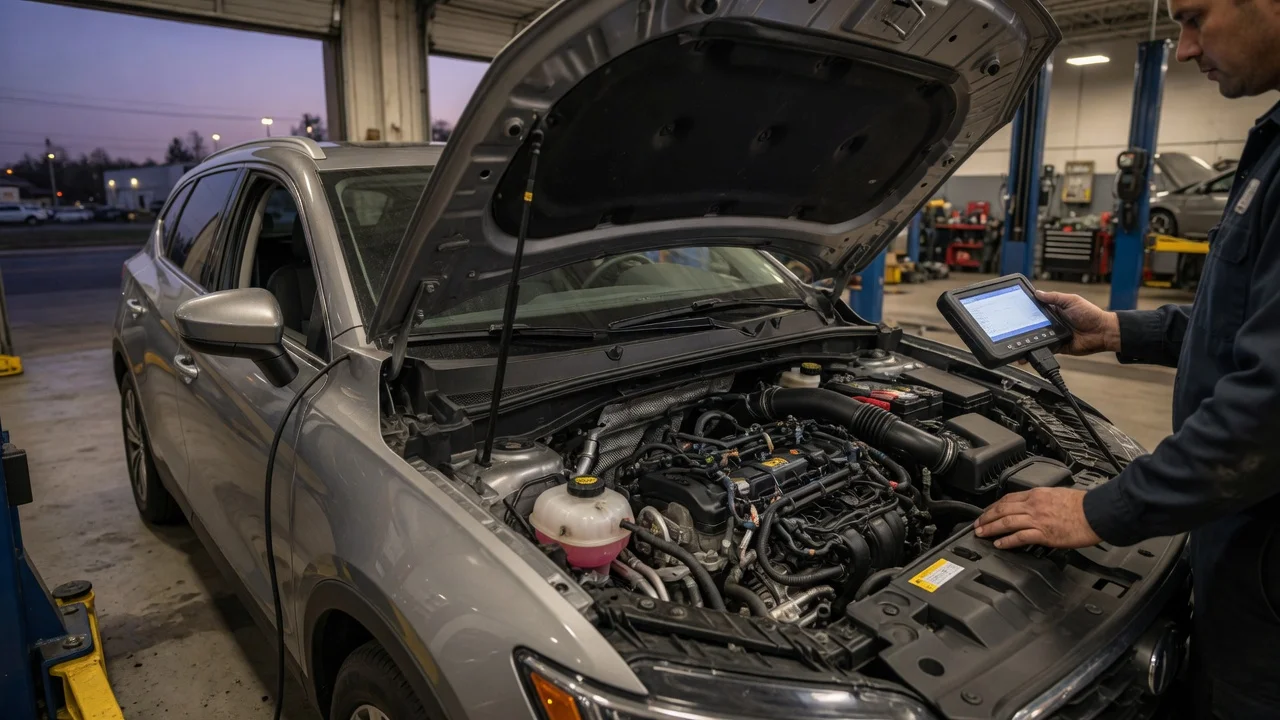
The CX-30 stores diagnostic trouble codes that can be read through the standard OBD-II diagnostic port under the dashboard. A basic scan tool, a workshop or some parts retailers can retrieve them. A code such as P0300 (random or multiple cylinder misfire) or P0455 (large EVAP leak) tells you which system or condition the computer flagged. It does not prove that a specific part has failed. For example, a misfire code can result from an ignition coil, a spark plug, a fuel injector, a vacuum leak or a mechanical problem. Treat the code as a starting point for testing, not as a parts list.
Record the code and any freeze-frame data before clearing anything. Freeze-frame data is a snapshot of engine conditions when the fault was set. Clearing codes erases this information and can make diagnosis harder. A code that returns soon after being cleared indicates an ongoing fault.
Common categories of cause and how to tell them apart
Evaporative emissions faults: usually a steady light with normal driving. They are often linked to the fuel cap or a leak in the fuel vapour system. A cap fix that clears the light over several drives points here; a code that persists needs a smoke test or similar workshop check. Misfire: rough running, shaking at idle or under acceleration, and possibly a flashing light. Cylinder-specific codes help locate the problem. Ignition components and spark plugs are common suspects, but mechanical causes need to be ruled out. Sensor or air-metering faults: hesitation, poor fuel economy or uneven idle. Possible culprits include oxygen sensors, airflow sensors and intake leaks. Sensor codes can reflect a wiring or connector problem rather than a failed sensor. Catalytic converter efficiency faults: often a steady light. These are frequently a consequence of another problem, such as prolonged misfire or a faulty oxygen sensor, so the underlying cause should be found before replacing the converter. Turbocharger or boost faults (turbocharged versions only): reduced power or a limp mode. These apply only to CX-30 variants fitted with a turbocharged engine. Hybrid or advanced combustion system faults (mild-hybrid or Skyactiv-X versions only): diagnosis of these systems typically requires dealer-level tools and information.
When to stop driving or seek professional diagnosis
The check engine light is flashing. The engine is shaking badly, losing significant power or stalling. The light appears together with oil pressure, coolant temperature or charging warnings. You notice smoke, a strong fuel smell or a burning smell. The temperature gauge rises abnormally or steam is visible. The light returns after the fuel cap has been checked and codes have been cleared. The vehicle is under warranty. In that case, dealer diagnosis is usually advisable before any independent repair, and you should check your warranty terms for your market.
Gaps to be aware of
This guide does not cover CX-30 model-year-specific technical service bulletins, recalls or known failure patterns, because no verified data on those was available for it. A Mazda dealer can tell you whether open recalls or service campaigns apply to your vehicle identification number. The dealer can also say whether any manufacturer updates, such as engine software revisions, are relevant to the code your car has stored.