Mazda CX-30 Engine Malfunction Light: What It Means and What to Check

The short answer
The engine malfunction light on a Mazda CX-30, often called the check engine light, is an amber engine-shaped symbol in the instrument cluster. It means the engine control module has detected a fault in the engine, fuel, ignition or emissions control systems and has stored at least one diagnostic trouble code. It does not identify the problem by itself. The cause can be as minor as a fuel cap that was not tightened or as serious as an engine misfire.
The most important qualification is how the light behaves. A steady light generally means the car can be driven carefully while you arrange a diagnosis soon. A flashing light generally indicates a misfire severe enough to risk overheating and damaging the catalytic converter, so you should reduce load, avoid hard acceleration and stop driving as soon as it is safe. Confirm the exact guidance in the owner's manual for your vehicle, because wording and warning behaviour can vary by model year and market.
This guide applies to the CX-30 broadly, but the car has been sold with different petrol engines depending on market and model year, including naturally aspirated and turbocharged Skyactiv-G engines, Skyactiv-X in some markets, and diesel versions in others. Some checks and likely causes differ between these powertrains, so treat any engine-specific detail as something to verify for your exact vehicle.
First, confirm it is the engine malfunction light
Several CX-30 warnings can be confused with one another. The engine malfunction light is amber and shaped like an engine outline. A red warning, such as low oil pressure, high coolant temperature or a charging system fault, is a different matter and usually calls for stopping the engine promptly in a safe place. If you are unsure which symbol is lit, compare it with the warning light section of the owner's manual before deciding whether to keep driving.
Steady or flashing: what each means
Light behaviour | What it usually indicates | Recommended action; Steady amber, car drives normally | A stored fault, often emissions-related, without obvious drivability problems | Drive gently and have the code read soon; Steady amber with rough running, hesitation or poor power | A fault affecting engine operation, such as ignition, fuel delivery or sensor input | Limit driving and arrange diagnosis promptly; Flashing amber | An active misfire that can overheat the catalytic converter | Reduce speed and load, stop when safe, and avoid further driving until diagnosed; Amber light accompanied by a red warning, smoke, burning smell or overheating | A more serious mechanical or electrical problem may be present | Stop safely, switch off the engine and seek professional help
Checks you can make before a diagnosis
Check the fuel cap. A loose, damaged or missing cap can let fuel vapour escape and trigger an evaporative emissions fault. Tighten it until it clicks, inspect the seal for cracks, then drive normally. The light will not usually go out immediately; the system needs to rerun its self-tests over several drive cycles. Note recent events. Refuelling just before the light appeared points towards the fuel cap or evaporative system. Recent work under the bonnet, such as an air filter change or battery disconnection, can point towards a disturbed connector or hose. Observe how the engine runs. Rough idle, shaking, hesitation, stalling or a noticeable loss of power suggest an ignition, fuel or air-metering problem rather than a purely emissions-related fault. Look for other warnings and messages. Additional lights or messages on the display can narrow down the affected system. Check the oil level and look for leaks. These checks will not explain most codes, but low oil or visible fluid leaks change the urgency. Listen and smell. A hissing sound at idle may indicate a vacuum leak, while a strong fuel or burning smell is a reason to stop and seek help.
Reading the fault code
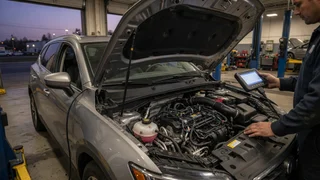
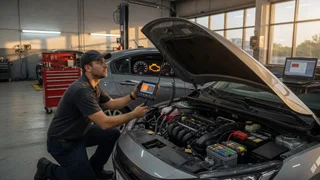
Because the CX-30 uses standard on-board diagnostics, the stored code can be read through the diagnostic port under the dashboard on the driver's side using an OBD-II scanner. Many parts retailers and independent workshops will read codes, and inexpensive handheld or app-based scanners are widely available. Record the full code, any freeze-frame data showing the conditions when the fault was set, and whether the code is current or pending.
Treat the code as a starting point rather than a verdict. A code describes what the control module observed, not necessarily which part has failed. For example, a code reporting a sensor reading out of range can be caused by the sensor itself, its wiring or connector, or a genuine engine condition that the sensor is correctly reporting. Replacing parts based on the code alone often wastes money.
Common code families and what they point towards
The examples below use generic OBD-II code definitions, which apply across manufacturers. Mazda also uses manufacturer-specific codes, and the likely cause on any individual CX-30 depends on its engine, mileage and history.
Generic code range | Meaning | Plausible causes to investigate; P0300 to P0304 | Random or cylinder-specific misfire | Spark plugs, ignition coils, injectors, vacuum leaks, low compression; P0171 or P0172 | Fuel mixture too lean or too rich | Vacuum or intake leaks, mass airflow sensor contamination, fuel delivery, oxygen sensor readings; P0420 | Catalytic converter efficiency below threshold | Converter wear or damage, oxygen sensor faults, exhaust leaks, an earlier misfire; P0440 to P0457 | Evaporative emissions system faults or leaks | Fuel cap, purge or vent valves, cracked hoses; P0130 to P0167 | Oxygen or air-fuel ratio sensor circuit or performance | Sensor failure, wiring, exhaust leaks upstream of the sensor; P0010 to P0025 | Variable valve timing circuit or performance | Low or degraded oil, control solenoid, wiring, timing components
Swapping a suspected ignition coil to another cylinder is a common way to test a cylinder-specific misfire: if the misfire code follows the coil, the coil is the likely cause; if it stays with the original cylinder, look at the spark plug, injector or engine mechanics instead. This is a reasonable check only if you are comfortable working on the engine and your specific powertrain allows easy access.
When to stop driving or get professional diagnosis
The light is flashing. The engine runs roughly, loses significant power or stalls. A red warning light appears alongside it, especially oil pressure or coolant temperature. You notice smoke, a strong fuel smell, a burning smell or overheating. The light returns after the fuel cap has been checked and the code cleared. The code relates to variable valve timing, misfires that persist, or anything you cannot confidently interpret. The car is still under warranty, where a Mazda dealer can check for applicable service bulletins or recall campaigns.
Should you clear the code yourself?
Clearing a code with a scanner turns the light off but does not fix the underlying fault, and it erases the freeze-frame data a technician would use to diagnose it. Clearing codes also resets the emissions readiness monitors, which can cause a vehicle to fail an emissions inspection until enough driving has been completed. If you clear a code, write it down first and watch whether it returns.
Gaps in this guide
No model-specific data on recalls, technical service bulletins, known failure patterns or repair costs for the CX-30 was available for this article, so none are claimed here. If you suspect a recurring issue on your model year, ask a Mazda dealer to check the vehicle identification number for open campaigns and bulletins, and confirm warning light behaviour against the owner's manual for your car.