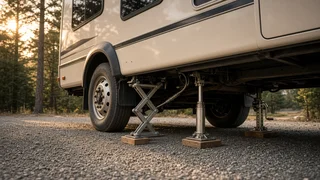
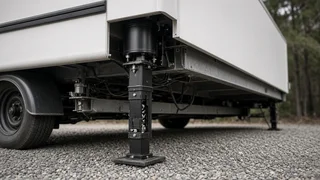
HWH Leveling Jacks Slow to Retract or Won’t Retract
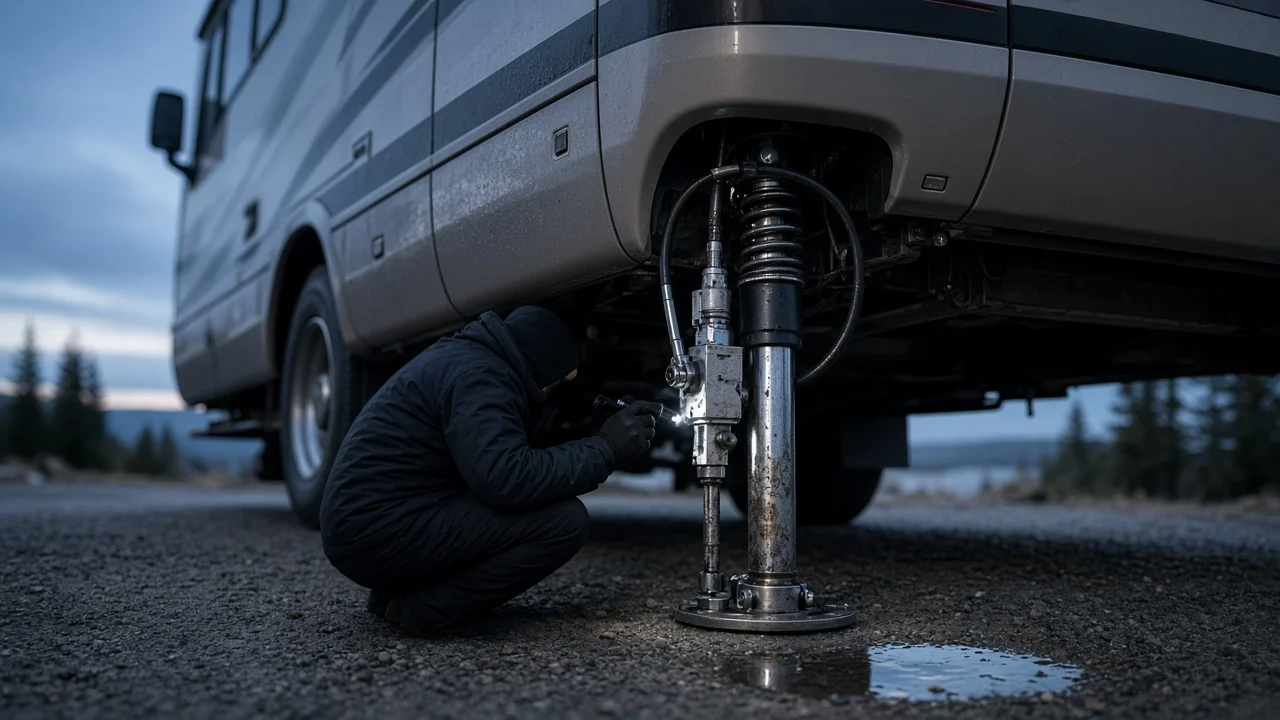
When HWH leveling jacks are slow to retract or won't come up at all, the cause is usually something resisting the jack's return or stopping fluid from leaving the cylinder. The most common culprits are a dirty or corroded jack rod, a weak or broken retract spring, low or contaminated hydraulic fluid, cold temperatures, a valve that isn't opening, or an electrical fault such as low battery voltage or a poor ground. The right fix depends on which HWH system your coach has, because systems and jack types differ in how they retract. The owner's manual for your specific system is the authority on procedures and specifications.
How HWH Jacks Retract and Why It Matters
HWH builds hydraulic leveling systems for motorhomes and other large RVs. A pump pushes hydraulic fluid into each jack cylinder to extend the jack and lift the coach. Retraction works differently depending on the jack design. Many HWH jacks use internal or external springs to pull the jack back up once a retract valve opens and lets fluid return to the reservoir. Other configurations use hydraulic pressure to drive the jack up, either alone or alongside springs. This difference changes the diagnosis. On a spring-return jack, the pump may play little or no part in retraction, so slow retraction points toward springs, rod friction or fluid flow. On a hydraulically retracted jack, the pump, its electrical supply and the fluid level all become likely suspects. If you don't know which type your coach has, check the manual or the system label before working on it.
Common Causes of Slow Retraction
Dirty, rusty or pitted jack rods: Grime and corrosion on the exposed chrome rod create drag against the seals. On spring-return jacks the springs may not overcome that drag quickly. Weak, stretched or broken retract springs: Springs lose tension over time. A broken spring can leave a jack partly down or make it retract much more slowly than the others. Cold weather: Hydraulic fluid thickens as it cools, so it flows back to the reservoir more slowly. Slow retraction that only happens on cold mornings often points to fluid viscosity rather than a mechanical failure. Low, old or contaminated fluid: Low fluid can starve a hydraulic-retract system. Contaminated or degraded fluid can also restrict valves and passages. Use only the fluid type specified for your system. Air in the hydraulic system: Air can make jack movement uneven or sluggish. Restricted valves or lines: A partly sticking retract valve, a kinked hose or debris in the manifold can slow the flow of fluid back to the reservoir. Low voltage: Valves and pumps need adequate battery voltage. A weak battery or a corroded connection can cause sluggish or inconsistent operation.
When a Jack Won't Retract at All
If a jack stays fully down, look for a complete interruption rather than added friction. Typical causes include a retract valve that isn't opening because of a failed coil, blown fuse, broken wire or bad ground, a control panel or controller fault, a fully broken spring, or a bent jack or rod that has jammed. A pump that won't run is also a possibility on systems that retract hydraulically. Outside conditions can contribute too. A jack foot sunk into mud, frozen to the ground or wedged against a rock or block can resist retraction until the obstruction is cleared. If only one jack is affected, the fault is more likely at that jack, its valve or its wiring. If every jack is affected, a shared component is more likely, such as the power supply, controller, pump or fluid supply.
Symptoms and Where to Look
Symptom | Likely causes | What to check; All jacks slow, worse in cold weather | Thickened fluid, low fluid | Fluid level and type; whether behavior improves as temperatures rise; One jack slower than the others | Dirty or corroded rod, weak or broken spring, sticking valve | Rod condition, spring condition, that jack's valve and wiring; One jack won't retract | Failed valve or coil, wiring fault, broken spring, bent jack, obstructed foot | Fuse and connections for that circuit, jack and foot for damage or obstruction; No jacks retract | Power, controller, pump (hydraulic-retract systems), fluid supply | Battery voltage, main fuses and grounds, control panel indications, fluid level; Jacks move unevenly or jerkily | Air in system, contaminated fluid, rod drag | Fluid condition, bleeding procedure in the manual, rod cleanliness
Safe First Checks
Never get under the coach while it is supported only by leveling jacks, and never drive with any jack down or with a warning light showing. Confirm battery voltage is healthy and the engine or charging source is running if your manual calls for it during retraction. Check fuses, ground connections and visible wiring at the pump, manifold and jacks for corrosion or damage. Check the reservoir fluid level using the procedure in your manual. On many systems the jacks must be in a specific position for an accurate reading. Inspect each jack rod for dirt, rust or pitting, and clean exposed rods with a soft cloth. Rough or pitted chrome may need professional attention, because it can damage seals. Look at the springs on jacks that have external springs, checking for breaks or detached ends. Make sure the jack feet aren't stuck in soft ground, frozen in place or trapped against an obstruction. In cold weather, give the system time and see whether retraction improves as conditions warm.
If a Jack Is Stuck Down
Many HWH systems include a manual way to release hydraulic pressure so jacks can retract when the electrical controls fail. This is often a release or override fitting on the manifold. The location and procedure vary by system and model year. Releasing pressure can move the jacks and the coach, so follow the exact steps in your system's manual, keep people clear of the jacks and the coach, and confirm that every jack is fully up before moving the vehicle. If a jack doesn't rise after pressure is released, suspect a mechanical problem such as a broken spring or a bent jack. Don't force it or drive with it down. Contact roadside assistance or a mobile RV technician instead.
When to Call a Technician
Get professional help if the basic electrical, fluid and cleanliness checks don't fix the problem. You also need a technician if a jack is visibly bent or leaking, if springs need replacing, if the system needs bleeding or a fluid change you aren't equipped for, or if the control panel shows fault codes you can't interpret. Hydraulic systems hold stored pressure and support heavy loads, so repairs to cylinders, valves and springs are best handled by a technician familiar with HWH equipment.
What This Guide Doesn't Cover
No model-specific evidence was available for this article. It doesn't give retraction times, fluid capacities, pressure figures, part numbers, costs or procedures for individual HWH systems or model years, and it doesn't reflect hands-on testing. HWH has produced several system generations and jack designs, and coach manufacturers install them in different ways. Treat the causes above as general starting points, and confirm specifications and procedures in the documentation for your coach and leveling system.