How to Test a Glow Plug Relay on a Diesel Engine
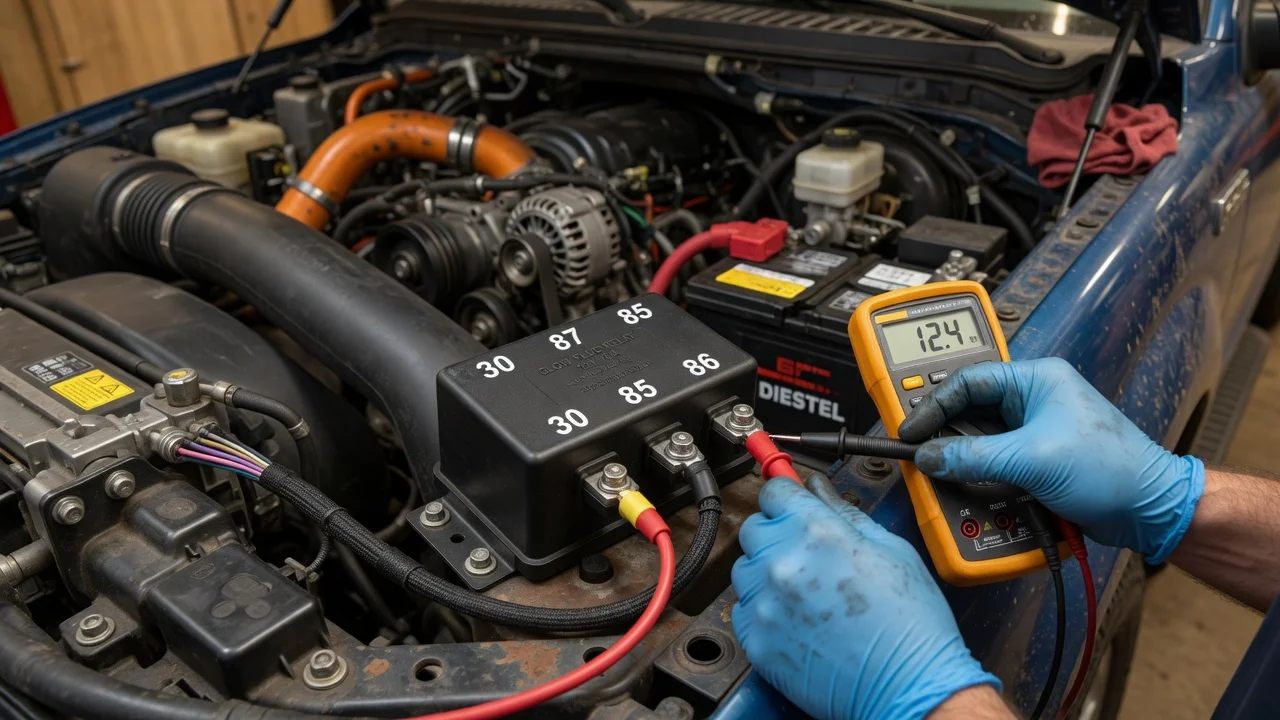
A glow plug relay switches the heavy current that warms a diesel engine's glow plugs before and just after a cold start. If it fails open, the engine cranks long and smokes. If it sticks closed, it can drain the battery or overheat the plugs. Testing the relay mostly means checking voltage at the right moment. Do that only after you confirm the complaint points to the preheat circuit rather than to fuel delivery.
Establish the symptoms
Start by confirming the fuel type and engine configuration. Glow plugs belong to diesel engines. Gasoline engines use spark plugs and have no glow plug relay, so a hard start on a gasoline vehicle needs a different diagnosis. Many newer diesels have also replaced the simple relay with an electronic glow plug control module that pulses current to each plug. The general logic still applies, but the test points and expected readings come from the service information for that specific engine.
Write down exactly when the problem occurs. Note whether it happens only on cold mornings or after the vehicle sits overnight, and whether warm restarts are normal. Look for associated signs: long cranking, white or blue-white smoke at startup, rough running that smooths out as the engine warms, and a battery found weak after parking. Also note how the wait-to-start lamp behaves, whether it stays on, never lights, or flashes. Finally, record recent changes such as a new battery, a jump start, glow plug replacement, wiring repairs, a fuel filter change, or a switch to different fuel as the weather turned cold.
Distinguish plausible causes
A relay that fails open stops power to all glow plugs at once. The usual result is hard starting and smoke on cold starts while warm starts stay normal. A relay with welded contacts does the opposite. It keeps the plugs powered, which can drain the battery, shorten plug life, and make the relay or its cables unusually hot. Failing glow plugs are a competing explanation. One or two bad plugs tend to cause roughness or misfire on particular cylinders rather than a total loss of preheat. A blown fuse or fusible link, corroded terminals, or a loose bus bar can mimic a dead relay. A faulty coolant temperature reading can also make the controller believe the engine is already warm, so it never commands preheat even though the relay itself is fine.
Fuel delivery problems produce similar cold-start complaints, so weigh them honestly. Air drawn in through a loose fitting or filter housing, a restricted or waxed fuel filter in cold weather, a weak lift pump, leaking injectors, or low rail pressure can all cause long cranking. Some clues point toward fuel rather than preheat: hard starting that persists when the engine is warm, stalling right after it starts, or loss of power under load. Slow cranking speed points first to the battery or starter, because low cranking speed weakens both compression heat and fuel delivery.
Checks in a useful order
Begin with observations that need no disassembly. Confirm the battery is charged and the engine cranks at normal speed. Watch the wait-to-start lamp with the engine cold. Have a helper turn the key while you listen and feel for the relay clicking on and, after the preheat period, clicking off. Inspect the related fuse, cables, and connectors for corrosion, heat discoloration, or looseness. If you have a scan tool, read stored codes. Many modern diesels log glow plug circuit faults, sometimes for each cylinder, and these narrow the search considerably.
The core relay test uses a multimeter or a test light rated for automotive use, with the engine fully cold. Check that the relay's main input terminal has battery voltage and that its ground is sound. Then have a helper switch the ignition on. During the preheat cycle you should see the control signal arrive at the relay coil and the output terminal rise close to battery voltage. The output should drop when the cycle ends. A clamp-type ammeter on the glow plug supply cable shows whether the plugs are actually drawing current. Coil resistance can be compared against the published specification. This circuit carries very high current, so disconnect the battery before removing the relay or loosening its terminals. Never bridge the relay terminals with a jumper wire unless the service procedure calls for it, because that can overheat plugs and wiring.
Fuel system tests belong in a separate category. Diesel injection systems, and common rail designs in particular, run at extremely high fuel pressure. Do not loosen injector lines or rail fittings to check for flow, because escaping fuel can penetrate skin and cause serious injury. Keep any leak check to a visual inspection with the engine off and cool. Leave fuel pressure readings, lift pump output, and injector return or balance tests to a qualified technician with the correct gauges and scan tool functions. Fuel additives are not a substitute for diagnosis and should not be treated as a repair.
Interpret the findings
Each result points to a different part of the circuit. If the output has voltage during the preheat cycle but the engine still starts as though the plugs are cold, the relay is doing its job. Look next at the glow plugs and the wiring between the relay and the plugs, checking each plug against its specification. If the input, ground, and control signal are all present but the output stays dead, the relay is the likely fault. If the output stays live after the cycle ends or with the key off, check whether the control signal is still present. A persistent command implicates the controller, while a missing command means the relay contacts are stuck. If no control signal ever arrives, investigate the coolant temperature reading, the controller, and its wiring before blaming the relay.
Before replacing parts, remember that a click proves only that the relay coil moved. It does not prove the contacts can carry the load, so confirm with a voltage or current reading under real conditions. A stored code tells you where to look, but it does not by itself condemn a component. After any repair, verify the fix with a genuine cold start. If preheat now works correctly and the engine still starts poorly, move the diagnosis to the fuel side. That means the fuel filter, lift pump, fuel pressure, and injector performance.
Urgency and next action
Stop using the vehicle and disconnect the battery if you notice any of these signs: a burning smell, smoke from the harness, a relay or cable that is too hot to touch, or melted insulation. A relay stuck on can also discharge the battery while the vehicle sits. Treat fuel odor or wet fuel near high-pressure components as a reason not to run the engine. A relay that has simply failed open usually makes cold starts difficult rather than dangerous. However, repeated long cranking strains the starter and battery, so arrange a repair rather than relying on how many more starts it might manage.
Give the repair shop the engine, model year, and fuel type. Describe the temperatures and conditions when the problem appears and how the wait-to-start lamp behaves. Pass along any stored codes and every measurement you took, noting whether the engine was cold. Mention any recent work on the battery, the glow plug circuit, or the fuel system. Clear records let a technician confirm the fault quickly instead of repeating your checks.