How to Test Diesel Glow Plugs: Symptoms, Checks and Results
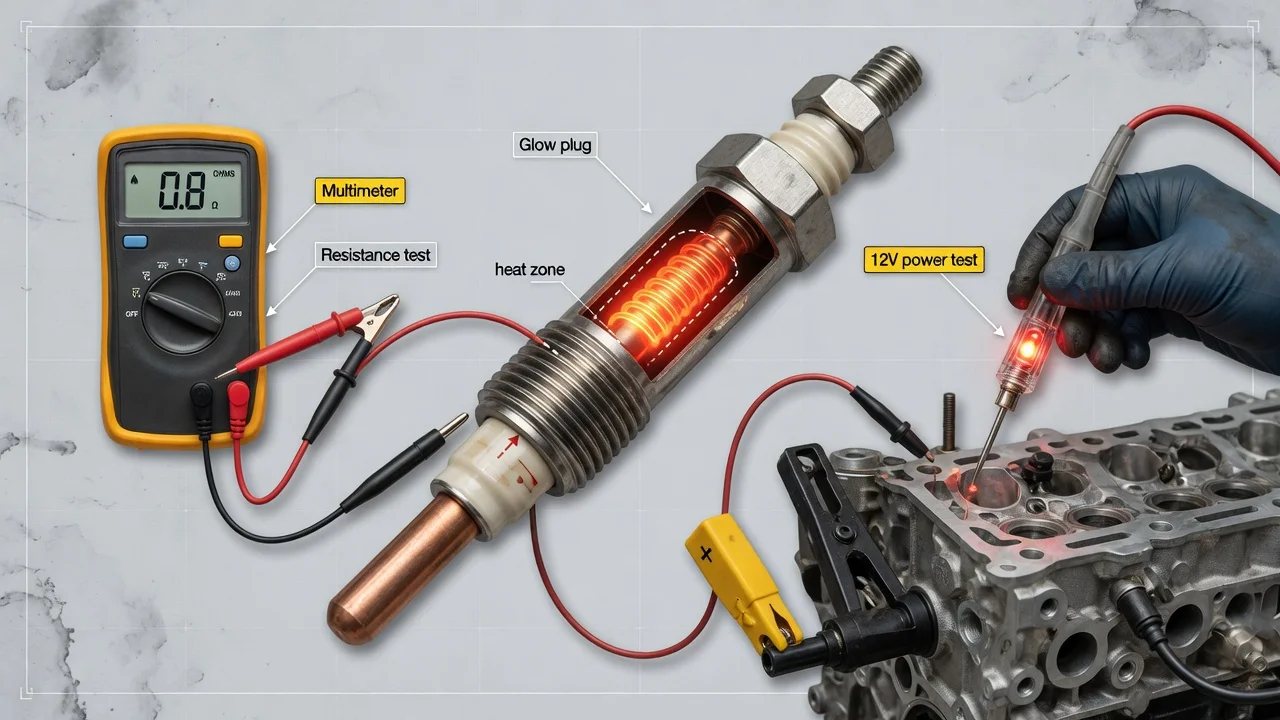
Glow plugs heat the combustion chambers so a cold diesel can ignite its fuel by compression alone. When one or more fail, the engine usually still runs once warm, which makes the fault easy to misread. Testing diesel glow plugs is mostly about proving the electrical side, meaning the plugs, wiring, relay or control module, before you blame fuel delivery or compression. This guide covers what to record, which causes compete with a glow plug fault, and how to read each result.
Establish the symptoms
Start by recording when the problem appears. Glow plug faults show up mainly on cold starts: long cranking, an engine that catches and then stumbles, rough or uneven running for the first minute, white or blue-white smoke that clears as the engine warms, and sometimes a harsh knock at a cold idle. Note the outside temperature, whether the vehicle sat overnight, how long you waited for the glow indicator before cranking, and whether that indicator stays on, flashes or never lights. On many vehicles a flashing indicator means the engine computer has stored a fault code, which may concern the glow system or something else.
Then list recent changes: a new battery, jump starts, wiring or intake work, a new fuel filter, a fill-up at a different station, or a sudden drop in temperature. Record whether the engine runs normally once warm and whether any warning appears while driving. Many modern diesels keep the plugs powered for a while after starting to reduce smoke and noise, so a fault can show up as rough running just after start rather than as a no-start. These details are what separate a heating problem from a fuel supply or compression issue.
Distinguish plausible causes
Within the glow system, the usual suspects are one or more open-circuit plugs, a failed glow plug relay or control module, a blown fuse or fusible link, corroded connectors, or a damaged bus bar or harness. One dead plug typically produces a cold misfire and extra smoke from that cylinder while the engine still starts. Several dead plugs cause hard starting that gets worse as temperatures fall. A control-side failure tends to affect all plugs at once, and many control modules log a code that identifies the affected circuit.
Fuel problems can look similar. Air in the lines, a restricted fuel filter, water contamination, or summer-grade diesel waxing in cold weather all cause hard starting. So can a weak lift pump, a high-pressure fuel pump that cannot build enough rail fuel pressure at cranking speed, or a leaking or sticking injector. The key difference is persistence: fuel faults often continue after warm-up as hesitation, power loss under load or trouble starting a hot engine, while glow plug faults fade once the engine is warm. Diesels do not use gasoline-style fuel trim, but a capable scan tool on a common-rail engine can show desired versus actual rail pressure and injector correction values, which help point toward or away from the fuel side.
Finally, consider cranking speed and compression. A diesel depends on heat generated by compression, so a weak battery, poor cable connections or a tired starter can mimic glow plug failure. Low compression from worn rings or valves also makes cold starting difficult and usually shows on one or more cylinders consistently. Incorrect replacement plugs, such as the wrong voltage rating or heat range for the engine, are another possibility after previous repair work.
Checks in a useful order
Begin with observations that need no special skills: indicator behavior, stored codes read with a scan tool, battery condition and cranking speed, the glow plug fuse or link, and the visible condition of wiring and connectors at each plug. Work with the engine off and the key removed, because glow plug circuits carry high current. Do not loosen fuel lines or injector fittings to look for air or check delivery. Common-rail systems operate at very high pressure, fuel under that pressure can penetrate skin, and pressure may remain after shutdown. Any test that opens the fuel system, including a proper leak check of high-pressure components, belongs to a technician following the manufacturer's procedure.
With a digital multimeter, you can test plugs in place. Disconnect the battery as the vehicle procedure specifies, remove the supply wire or bus bar from each plug, and measure resistance from the plug terminal to a clean engine ground. Touch the meter leads together first and subtract that reading, since glow plug values are small. Compare each plug with the manufacturer's specification and with the other cylinders; an open-circuit reading means a failed element. An inductive clamp meter on each supply lead during the glow cycle shows current draw, which tests both the plug and the control output. Checking for voltage at the plug terminals during the glow cycle confirms whether the relay or module is delivering power. Engine configuration affects access: on V engines or where plugs sit under the intake manifold, reaching them may require removing other parts.
Removing plugs is a step with real risk. Plugs that have been in place a long time can seize and snap, and carbon around the tip can make extraction difficult; a broken plug may need specialist extraction or even cylinder head removal. Follow the specified removal and installation torque, and leave this to a technician if you are unsure. Do not bench test a removed plug directly on battery voltage unless its specification says it is designed for that, because many modern plugs run at a lower voltage under module control and can be destroyed instantly. Compression testing, rail pressure measurement and injector leak-back testing also require proper tools, adapters and specifications.
Interpret the findings
An open-circuit plug confirms that plug has failed, but it does not explain why. If a removed plug has a swollen, cracked or missing tip, look for an underlying cause such as an injector with a poor spray pattern or excessive voltage from a faulty controller, and resolve it before fitting new plugs. If every plug measures within specification but no voltage reaches them during the glow cycle, the fault lies in the fuse, relay, control module or wiring. If voltage is present and the plugs measure normally, the heating system is probably working, and attention should move to cranking speed, fuel supply and compression.
Keep the limits of each test in mind. A normal resistance reading does not fully prove a plug reaches working temperature, which is why current draw comparison is more informative. A fault code names a circuit, not always the root cause, so confirm it with a measurement before buying parts. Replacing all plugs at once is common on high-mileage engines, but new plugs will fail again if a control fault is overpowering them. If cold-start symptoms remain after the glow system is confirmed good, the next candidates are fuel filter condition, fuel quality and grade, lift pump performance, rail pressure and compression.
Urgency and next action
A single failed glow plug is rarely an emergency, but repeated long cranking strains the battery and starter, and a plug tip that breaks off can fall into the cylinder and cause serious engine damage. Stop driving and arrange inspection if you hear a new metallic knock, smell raw diesel, see a fuel leak, notice smoke or a burning smell from the engine bay, or the engine runs badly once warm. Fuel additives are not a repair for glow plug or injector faults; a cold-weather anti-gel treatment only helps prevent waxing in suitable fuel and does nothing for a failed electrical component. No particular distance can be promised as safe while a fault remains undiagnosed.
When you hand the vehicle to a technician or order parts, bring the year, engine and any known glow plug part details, the stored codes, outside temperatures when the problem occurred, indicator behavior, resistance or current readings for each cylinder, and recent changes such as fuel filter service or battery replacement. That information lets a shop confirm the diagnosis quickly and replace only what the evidence supports.