How to Keep Travel Documents Easy to Find in a Car
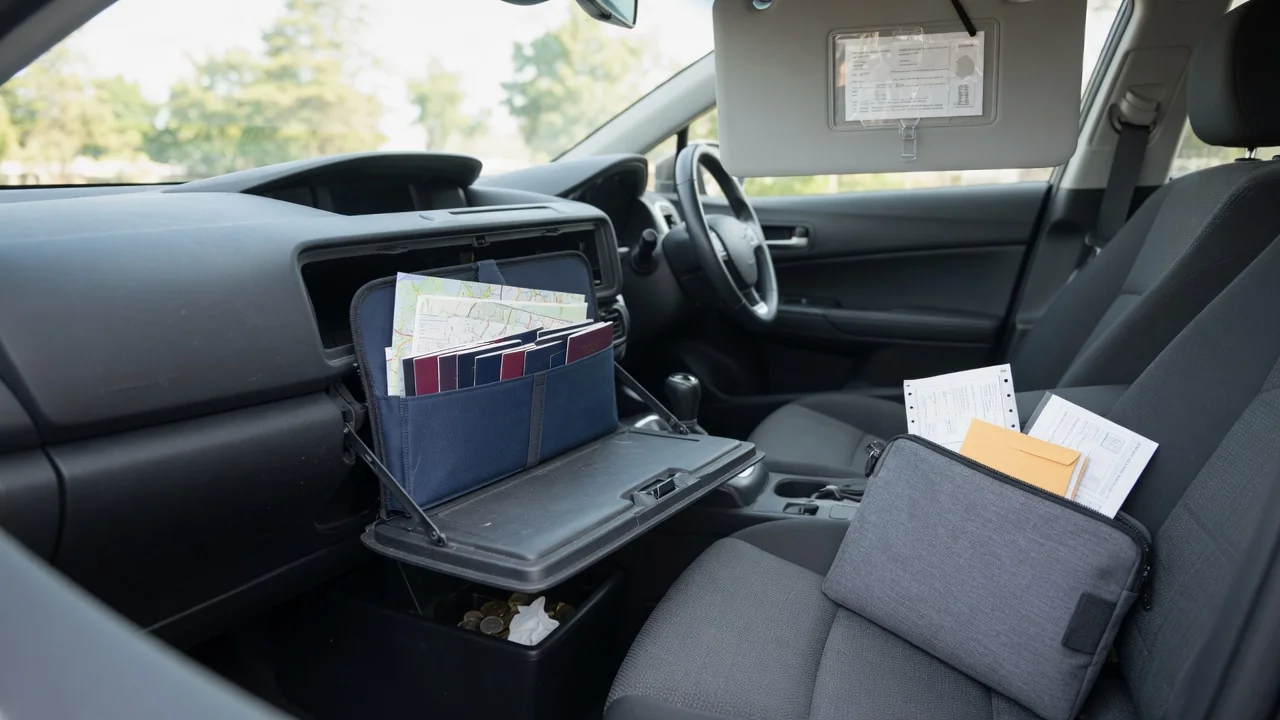
Knowing how to keep travel documents easy to find in a car comes down to two competing goals: reaching the right paper quickly and keeping personal details away from anyone glancing through a window. A consistent storage spot, a small organizer, and a habit of clearing things out after each trip handle both without adding clutter to the cabin.
Choose secure location
The glovebox is the obvious choice, and in many vehicles it locks with the mechanical key or a valet setting, which helps when the car is handed to a parking attendant or a shop. A center console bin with a lid works similarly and sits closer to the driver's hand. What matters most is that the spot closes fully, stays out of sight from outside, and does not share space with loose items that bury a folder under napkins, chargers, and tire gauges.
Storage layouts differ widely, so look at what your own cabin offers. Some trucks have a lockable compartment under the rear seat, some crossovers have a drawer beneath the front passenger seat, and many compact cars have only a shallow glovebox largely filled by the owner's manual. Avoid the sun visor, door pockets, and the seatback pouch for anything showing a name or address, since those areas are visible through glass and are the first places a thief checks during a quick break-in.
Keep essentials handy
Separate what you may need to hand over at a traffic stop or a rental counter from what you only need occasionally. Registration and proof of insurance belong in a slim, plainly labeled envelope or a zippered pouch at the front of the compartment, so you can retrieve them without unpacking everything else. Reservation printouts, toll receipts, parking passes, and roadside assistance details can sit behind them in a second sleeve, ordered by the sequence in which the trip will call for them.
Documents that prove identity deserve different treatment. Passports, a driver's license, and border-crossing paperwork are better carried on your person or in a bag that leaves the car with you, rather than left in a console overnight. Many owners also keep the title at home rather than in the vehicle, because it serves no purpose on the road. A neutral pouch with no outward labeling of its contents keeps the system quick for you while giving a passerby nothing worth reading.
Clean out afterward
A trip leaves a paper trail: fuel receipts, hotel folios, rental agreements, boarding passes, and printed directions marked with a home address. Left in the cabin, these pile on top of the documents you actually need and slow down every later search. They also reveal more than most people expect, including partial card numbers, loyalty account details, and travel dates. Emptying the pouch on the day you return keeps the next retrieval as quick as the first.
While clearing paper, check the electronic traces as well. Navigation systems often store recent destinations and a home location, and a phone paired by Bluetooth may have synced contacts to the infotainment unit. This matters most in a rental or a borrowed vehicle, where the next driver inherits whatever remains. Menu names and reset options vary by manufacturer and model year, so the owner's manual or the on-screen settings menu is the right place to confirm how to delete that data.
Everyday Use and Observations
A good arrangement passes a simple test: seated and belted, with the engine off, you can produce the registration and insurance card in a few seconds without leaning far across the cabin or spilling other items. If the glovebox door drops open and papers slide toward the floor, the compartment is overfilled or the pouch is too large. Thick owner's manual packs can be moved to a seatback pocket or trunk cubby, since they carry no personal information.
Conditions inside a parked car also affect paper. Summer heat can fade thermal-printed receipts and insurance cards until they are unreadable, and a leaking door seal or a spilled drink in a console can leave documents stuck together. A water-resistant sleeve addresses both problems cheaply. Check the pouch occasionally, perhaps when you check tire pressure or wash the car, to confirm that insurance and registration papers are current and that nothing expired is taking up space.
Limits and Next Steps
No in-car storage spot is truly secure. A locking glovebox slows a casual intruder but will not stop a determined one, and a registration slip typically shows a name and address that cannot be hidden if the document has to stay in the vehicle. Rules on what must be carried, and whether a digital insurance card or a photocopy is accepted, differ by state and by country, so confirm the requirements for the places you will drive before relying on phone copies alone.
A sensible follow-up is to keep backups outside the car: scanned copies in a password-protected account and a note of policy and roadside assistance numbers stored at home. If a break-in does occur, knowing exactly which papers were in the pouch makes it easier to notify the insurer and the motor vehicle agency promptly. Revisit the setup whenever you change vehicles, because a new cabin layout, a different locking arrangement, or a shared family car can call for a different spot.