How to Exit a Tight Parking Space Safely
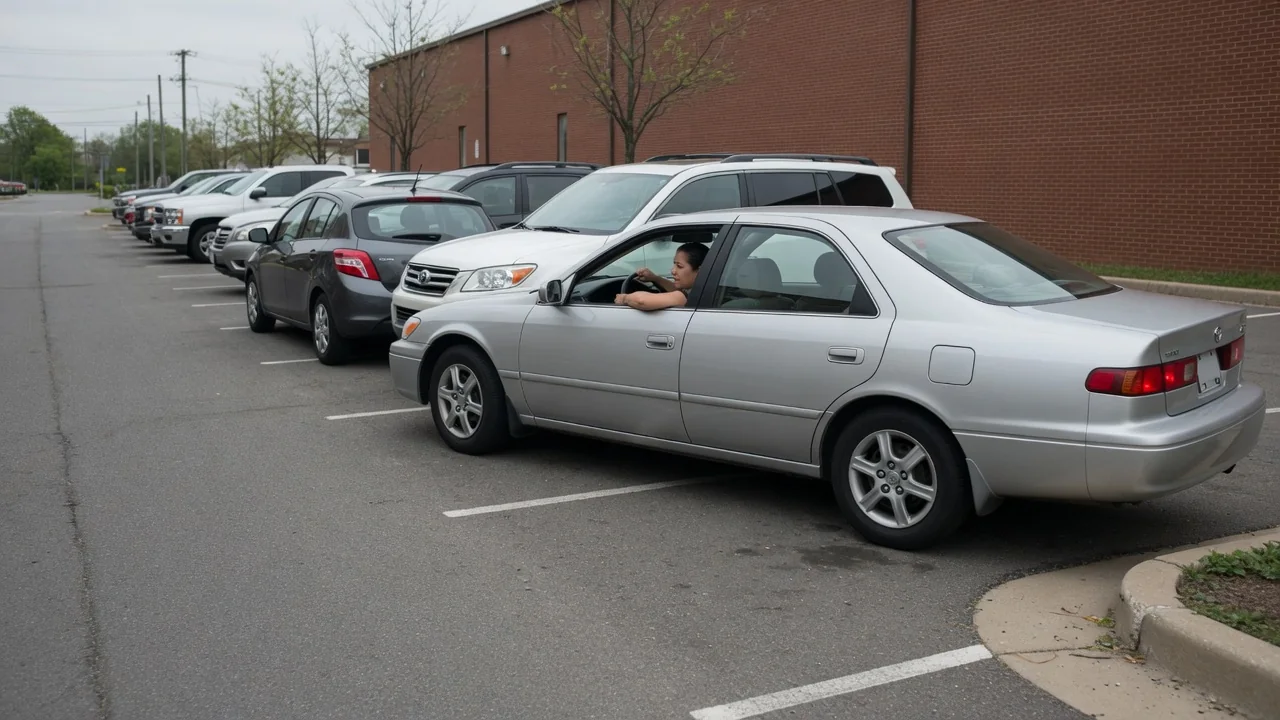
Learning how to exit a tight parking space safely comes down to two habits: looking in a deliberate order and moving the car along a gradual path instead of one sharp turn. With neighboring vehicles inches away, slow speed and small corrections give you time to notice a closing gap, a pedestrian, or approaching traffic before any contact occurs.
Survey sides
Before starting the engine, walk around the car and look at the space on each side. Note how close the neighboring vehicles sit, whether their mirrors are folded or extended, and whether one is parked at an angle so the gap narrows toward the front or rear. Check for low obstacles that disappear from the driver's seat, such as curbs, wheel stops, bollards, shopping carts, and tow hitches protruding from trucks. This short survey tells you which side has the most room to work with.
Once seated, repeat the survey through the glass and mirrors. Adjust the side mirrors so you can see the lower flanks of the adjacent cars, and compare what the mirrors show with what you saw on foot. Tall SUVs, vans, and pickups beside you can block the view of the aisle entirely, so plan to creep until your line of sight clears. Vehicles differ here: some have wide pillars or small rear windows, while others offer cameras that supplement, but do not replace, direct looks.
Small steering changes
In a narrow space, large steering inputs made early are the usual cause of scraped doors and bumpers. Begin by rolling straight at walking pace or slower, keeping the wheels pointed ahead until part of the car has cleared the neighboring vehicles. Then add steering a little at a time, checking the gap on both sides after each change. A gradual arc keeps the body of the car moving mostly lengthwise through the space instead of pivoting sideways into the car beside you.
If the gap on one side begins to shrink, stop, straighten slightly, and pull forward or back a short distance to reset the angle. Several short moves are safer than forcing one tight turn. Steering only while the car is rolling slowly also reduces strain on the tires and steering components compared with cranking the wheel at a standstill. How quickly a car responds depends on its wheelbase and steering ratio, so a long sedan or pickup needs more straight travel than a compact hatchback.
Watch front swing
When reversing with the wheel turned, the rear of the car follows a tight path while the front swings wide in the opposite direction. Turn the wheel to the right while backing up, and the left front corner sweeps outward toward the vehicle parked on that side. Drivers who stare only at the backup camera or rear window often miss this, and the front fender or bumper corner touches the neighboring car. Glancing forward at the leading front corner should be part of every reversing sequence.
The same geometry applies when driving forward out of a space, though here the rear wheels cut inside the path of the front ones, bringing the rear quarter panel close to whatever sits on the inside of the turn. Waiting until the mirrors or front doors have passed the adjacent bumper before steering firmly usually leaves enough margin. Vehicles with long hoods, extended front overhangs, or wide mirrors swing farther, so the right moment to turn varies, and judging it takes practice in each car.
Everyday Use and Observations
A dependable observation sequence in daily driving runs like this in practice: check both side mirrors, look over each shoulder, glance at the camera display if fitted, then look at the front corners before moving. Repeat the cycle every few feet, because parking lots change quickly. A child, a cart, or a car hunting for a space can appear in the seconds between checks. Keeping a foot covering the brake and the windows slightly open helps you react to movement and hear warnings such as horns or voices.
Conditions alter what you can see. Rain, fogged glass, dirty camera lenses, low sun, and dim garages all reduce detail, so clear the windows and mirrors before setting off. Parking sensors may beep continuously when cars are close on both sides, which makes their tone less useful for judging the last few inches. In angled spaces the exit path naturally follows the aisle direction, while perpendicular bays demand more straight travel first. Parallel spaces usually need a short reverse to gain room before pulling out.
Limits and Next Steps
Some spaces simply leave too little margin for one driver to judge alone. If you cannot see the clearance on one side, stop and get out to look, or ask a passenger to stand in a safe position and guide you with clear hand signals. Folding the mirrors can gain a little width on some vehicles, though it also removes part of your view. When a neighboring car is parked so close that exiting risks contact, waiting for its driver or asking lot staff for help is the sensible choice.
Driver aids have boundaries worth knowing. Cameras distort distance, sensors can miss thin posts or low curbs, and cross-traffic alerts or automated parking features behave differently between manufacturers, so the owner's manual is the right reference for what your own vehicle detects. Practicing the gradual path in an empty lot, using cones or boxes as stand-ins for other cars, builds a feel for where your corners really are. If contact does happen, stop, check for damage, and leave your details for the other owner.