How to Carry Fragile Items in a Car Without Damage
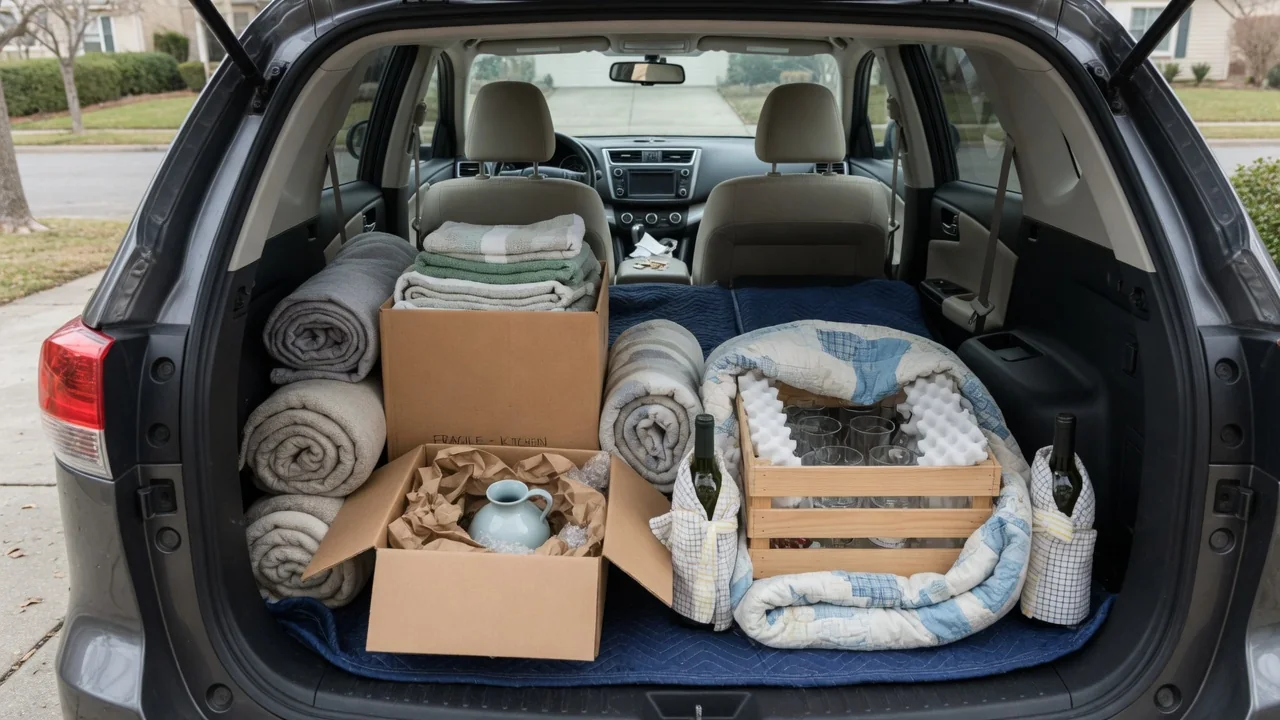
Learning how to carry fragile items in a car without damage comes down to two ideas: cushioning that absorbs vibration and restraint that stops movement. Glassware, ceramics, electronics and framed art rarely break from the drive itself. They break when they slide, tip or collide during braking, cornering and bumps. A few minutes of planning before loading prevents most of that.
Choose a stable area
The best place for a delicate load is low, flat and close to the center of the vehicle. A rear footwell is often ideal because the seat base and the front seatback form walls on two sides, and the floor sits near the car's center of gravity, where body roll and pitch are felt least. The cargo floor directly behind the rear seatback is another good choice, since the seatback acts as a bulkhead that resists forward movement when you brake.
Seats themselves are less stable than they look. Most cushions slope rearward and are contoured, so a box placed on one tends to lean or rock. If a seat is the only option, level the base with a folded towel and run the seat belt through or around the container. Layouts differ widely: some vehicles have a flat load floor with tie-down rings, others have a raised lip, a sloping hatch or underfloor storage, so check what your own car offers before loading.
Pad gaps
Empty space is what turns an ordinary stop into an impact. If a box can slide even a short distance, it gathers speed before hitting whatever stops it, and the contents absorb that shock. Fill the voids around a container with soft, compressible material such as blankets, towels, pillows or folded moving pads until the box cannot shift in any direction. Pressing lightly on each side should produce no movement, only a firm, cushioned resistance.
The same principle applies inside the container. Wrap each piece individually so that glass never touches glass, and fill the remaining room with paper or foam until nothing rattles when you gently shake the box. Give extra attention to the gap between the load and hard surfaces such as wheel arch trim, seat rails and the tailgate, because these transmit road vibration directly. A non-slip mat under the container adds grip on carpeted or plastic cargo floors, which can be surprisingly slick.
Avoid stacking
Stacking raises the center of gravity of the load and concentrates weight on whatever sits at the bottom. A carton that feels solid while parked can crush or lean once the car starts moving, because every bump briefly multiplies the force pressing down on the lower box. Fragile items travel best in a single layer, with each container resting directly on the vehicle floor where its weight is supported evenly and nothing can topple onto it.
When space forces a second layer, put heavy, sturdy items at the bottom and only light, well-padded ones on top, and keep the stack below the height of the seatback so nothing can travel forward into the cabin. Flat objects such as mirrors, picture frames and sheets of glass are an exception to laying things down. They are generally stronger standing on edge, padded on both faces and braced between soft surfaces, than lying flat with weight resting on them.
Everyday Use and Observations
The same habits apply to ordinary errands. A cake box, a potted plant, a bag with eggs or a bottle of wine all behave like miniature fragile loads. Setting them in a footwell or wedging them in a corner of the cargo area with a jacket or reusable bag keeps them upright far better than leaving them loose on a seat. Cargo nets, hooks and dividers, where fitted, are useful for exactly this kind of light, tippable item.
Your driving and your ears provide useful feedback. Smooth braking, gentle acceleration and wider, slower turns reduce the forces acting on the load, and extra following distance gives room to slow down gradually. Listen during the first few minutes: a clink, thud or scraping sound means something is moving and deserves a stop to repack. Temperature matters too, since a closed car in sun can soften adhesives, candles and chocolate, while cold can make some plastics brittle.
Limits and Next Steps
Careful packing reduces risk, but it cannot overcome every situation. A sudden emergency stop or a collision produces forces that padding alone will not manage, which is why restraint matters as much as cushioning and why heavy objects should never sit loose above seatback height. Avoid placing rigid items where an airbag deploys, and never let cargo block your mirrors, your view through the rear window or your access to the pedals and shifter.
Some loads simply exceed what a passenger car handles well. Very large panes of glass, tall furniture, heavy antiques or valuable instruments may call for a van with proper tie-down points, purpose-made crates or a professional carrier. Check your owner's manual for the vehicle's load capacity and the location and rating of cargo anchor points, since these vary by model. For anything irreplaceable, a short test drive around the block before the real trip is a sensible final check.