How to Carry Long Items Inside a Car
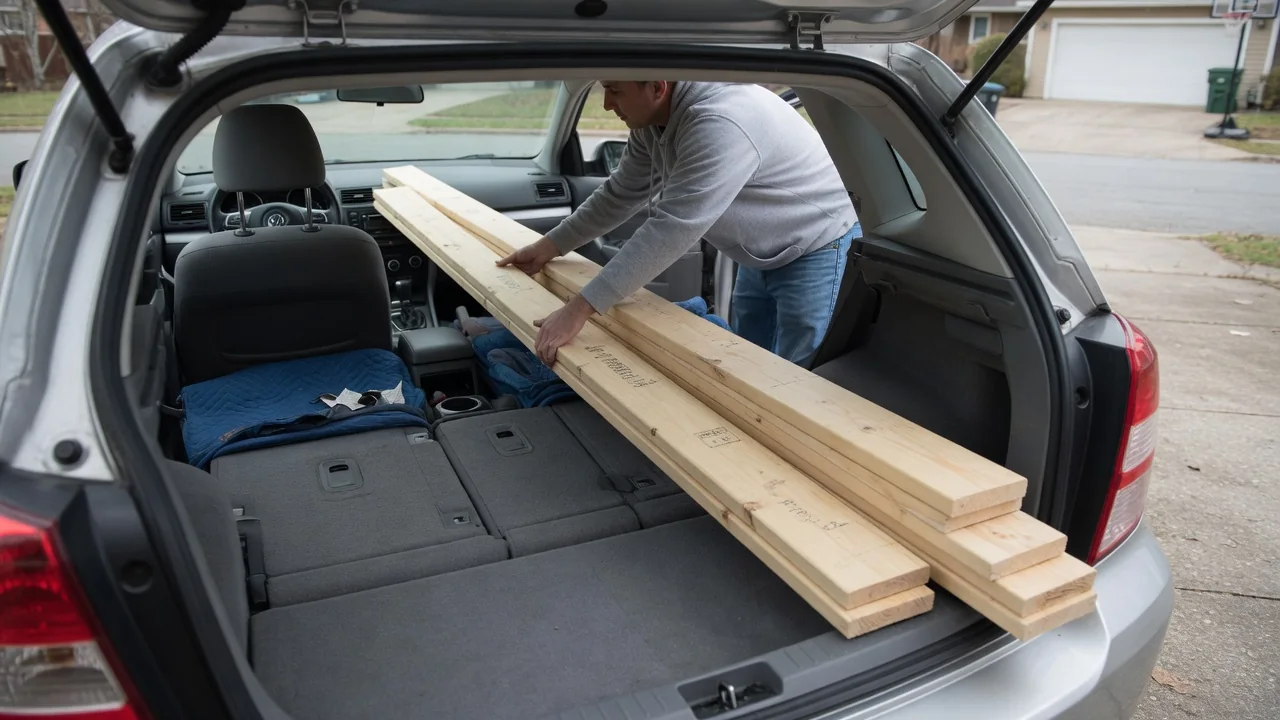
Lumber, curtain rods, skis, flat-pack furniture and rolled rugs often look as if they should fit in a passenger vehicle, then prove awkward at the curb. Learning how to carry long items inside a car comes down to three things: measuring before loading, restraining the load so it cannot slide or fly forward, and keeping the driver's view, mirrors and controls completely clear.
Measure item and opening
Start with the item itself. Measure its full length, including any packaging, end caps or brackets, and note its widest and thickest points, because a boxed bookshelf behaves very differently from a bundle of trim boards. Then measure the vehicle with the seats arranged the way you intend to drive. The useful figure is the straight-line distance from the closed tailgate or trunk lid to the point where the load will stop, not the overall cabin length quoted in a brochure.
The opening matters as much as the space behind it. A sedan with a folding rear seat usually has a pass-through narrower and lower than the trunk itself, so a wide box may fit the trunk yet refuse to pass into the cabin. Hatchbacks and SUVs offer a taller opening, but the hatch slope and struts can steal room near the top. Some vehicles also have a fold-flat front passenger seat or a ski hatch behind the rear armrest; the owner's manual shows which arrangements your model supports.
Protect surfaces
Long objects concentrate their weight and sharp edges on a few contact points, and those points are usually soft trim. The ends of boards, pipes or metal rails can gouge a dashboard, tear a headliner, crack a plastic console lid or chip the inside of a windshield. Wrapping both ends with a moving blanket, thick towels or foam pipe insulation spreads the pressure and dulls the corners. A blanket laid over folded seatbacks also keeps splinters, dirt and grease out of the upholstery.
Look at the loading path as well as the resting place. The bumper top, the trunk sill and its weatherstrip, and the door seals are easily scuffed while an item is being slid in, so a towel draped over the sill is worth the few seconds it takes. Glass deserves particular care: a heated rear window has thin defroster lines that scratch easily, and a windshield should never serve as a stop for the load. Leather, light-colored cloth and gloss-black trim show marks most readily, so padding needs vary by interior.
Secure movement
An unrestrained load keeps moving when the car stops. Under hard braking, a bundle of lumber or a steel pole slides forward with considerable force, and in a collision it can strike occupants or the windshield. The aim is to prevent movement in every direction: forward, backward, sideways and upward. Butting the front end against a padded, solid surface such as the back of a front seatback or the footwell floor helps, but friction and a single contact point should not be the only restraint.
Many cargo areas have tie-down loops in the floor or side panels, and ratchet or cam-buckle straps running to these anchors hold a load far more reliably than stretchy cords, which let heavy objects surge. Bundle loose pieces together first so that they act as one unit, then strap the bundle down. A fastened seat belt across an item lying on a folded or upright seat adds a useful second restraint. Anchor locations and their rated capacity differ between vehicles, so check the manual rather than hooking straps to seat frames or trim.
Everyday Use and Observations
With the load in place, sit in the driver's seat and check what you can actually see and reach before starting the engine. The item should not cross the driver's line of sight to the windshield, the side windows or either door mirror, and it must leave the shifter, parking brake, steering wheel and pedals untouched through their full travel. If the interior mirror is blocked, the door mirrors have to give a complete rearward view. Laying the item along the passenger side, low and below window level, usually preserves the most visibility.
The first few minutes of driving reveal a lot. Rattles, a creeping bundle, or a thump under gentle braking all mean the restraint needs tightening, and it is better to pull over than to steady a load by hand while driving. Passengers should not sit where a shifting item could reach them, and nothing should rest in front of an airbag cover on the dashboard, seat side or roof rail. On longer trips, rechecking strap tension at a fuel stop is sensible, since webbing settles and packaging compresses.
Limits and Next Steps
Some items simply do not belong inside the cabin. If the trunk or hatch cannot close and latch, exhaust gases can be drawn into the car, and an open lid that is tied down blocks the rear view and may obscure lights or the license plate. Rules on how far a load may project, and whether it needs a flag or light, vary by state, so local requirements are worth confirming. Heavy loads also count against the vehicle's payload rating, shown on the door-jamb placard.
When the measurements do not work, the better choices are outside the cabin or outside the car altogether. Roof crossbars with proper straps suit long, light items, provided the roof load limit in the manual is respected. A hitch-mounted carrier, a small trailer, a rented pickup or van, or store delivery handles anything heavier or longer. Having the store cut lumber or pipe to shorter lengths is often the simplest fix. Whatever the route, a load that compromises sight lines, controls or restraint is one to leave behind.