How Is a Forged Car Wheel Made? Forming, Machining and Strength
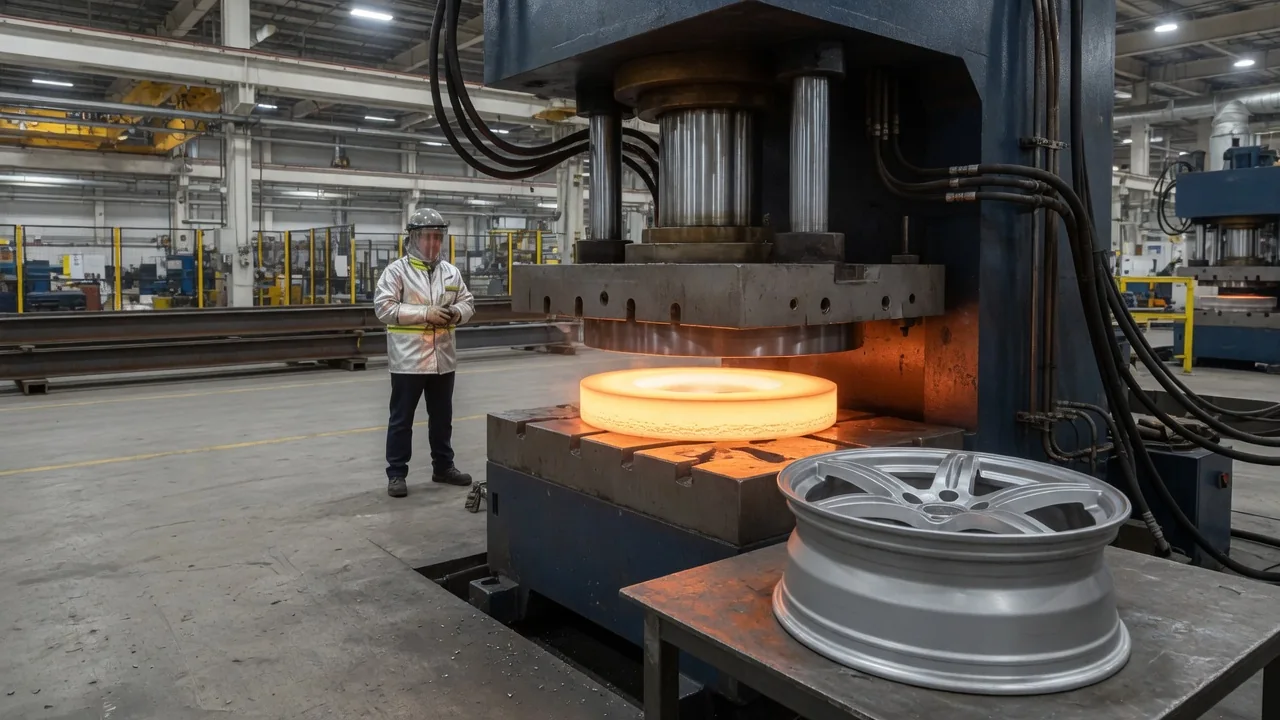
A forged car wheel starts as a solid cylinder of alloy and ends as a precisely machined part that has been pressed, heat treated, cut and inspected. Forged wheel manufacturing differs from casting because the metal is shaped while it is solid instead of being poured as a liquid. That difference affects the internal structure of the wheel, how much machining it needs and how the finished part carries loads. Here is how the process generally works.
Metal forming
Most forged passenger car wheels are made from aluminum alloy, typically a heat-treatable grade, while some specialist wheels use magnesium alloy. The process begins with a billet, a section cut from an extruded or cast bar and sized so its volume covers the finished wheel plus the material that will later be machined away. The billet is heated in a furnace to a controlled forging temperature. The goal is to make the metal plastic enough to flow under pressure while keeping it well below its melting point. Temperature control matters: metal that is too cold resists flow and can develop cracks or folds, while overheating can damage the alloy's structure.
The hot billet is then placed in a closed die inside a large press. Forming usually happens in several stages rather than one stroke. An upsetting step flattens the billet into a thick disc. A preform die then distributes metal toward the hub, the spoke area and the outer edge. A finishing die presses the rough shape of the wheel face and the beginning of the rim. At each stage, solid metal is forced to flow into the die cavities, and excess material squeezed out at the parting line, called flash, is trimmed off afterward.
Manufacturers form the barrel, the cylindrical part that holds the tire, in different ways. Some forge a cup-shaped blank and then spin or flow form the barrel, using rollers that press the wall against a rotating mandrel to stretch and thin it. Others forge only the center section and join it to separately made rim shells in two-piece or three-piece designs. After forming, the blank goes through heat treatment: solution heating, rapid quenching and artificial aging. For heat-treatable aluminum, this sequence develops much of the final strength, and parts may need straightening if quenching causes distortion.
Machining
A forged blank looks thick and blocky compared with the finished wheel, because a large share of its mass is removed by machining. CNC lathes turn the inner and outer barrel profile, the flanges, the bead seats, the drop center, the mounting face and the center bore. The bead seats and flange contours must follow established rim profile dimensions so the tire mounts, seals and seats correctly, and the mounting face must be flat and true so the wheel clamps evenly against the hub.
CNC milling then cuts the spoke openings and shapes the visible face design. The lug holes are drilled to the specified bolt pattern, and their seats are machined to match the intended hardware, such as conical, ball or flat seats. The valve stem hole is drilled as well. Because so much of the design is created by cutting rather than by the die itself, one forged blank can often be machined into several face styles, widths of spoke and offsets. The tradeoff is long machining time and a large volume of chips that must be recycled.
Before finishing, wheels are typically checked for dimensional accuracy and radial and lateral runout, and the barrel may be leak tested to confirm it will hold air. Some producers also use X-ray or ultrasonic inspection to look for internal defects. Finishing can include brushing, polishing, painting, powder coating, clear coating or anodizing, depending on the design and the alloy.
Strength context
The main metallurgical argument for forging is grain structure. When solid metal is pressed into shape, its grains are deformed and tend to follow the contours of the part, a pattern often called grain flow. The pressure also helps close internal voids. A cast wheel, by contrast, solidifies from liquid metal in a mold, which can leave porosity and a coarser structure. As a result, forged aluminum generally offers better ductility and fatigue resistance than a cast part of similar alloy family.
Engineers can use that material margin in different ways. Often they reduce spoke and barrel thickness while keeping the required load capacity, which is why forged wheels are frequently lighter than comparable cast designs and can reduce unsprung and rotating mass. The benefit is not automatic, though. A heavy forged design can weigh more than a lean cast one, and real strength depends on geometry, alloy, heat treatment and machining quality. Sharp internal corners or thin sections in the wrong place create stress concentrations regardless of how the blank was made.
Wheel designs are validated with standardized tests rather than assumed to be strong because they are forged. Common examples include cornering fatigue tests that apply a rotating bending load, radial fatigue tests that roll the wheel under a heavy load, and impact tests that simulate a curb strike or pothole hit. The forging process supplies favorable material properties; testing confirms that a specific design at a specific load rating actually performs.
Practical implications and limits
For buyers, the word forged is not always used consistently. Terms such as flow formed, rotary forged or hybrid forged usually describe a cast wheel whose barrel has been spun under pressure. That process improves the barrel, but the center section remains cast. It also helps to know whether a wheel is a one-piece monoblock or a multi-piece assembly, since the latter adds hardware and sealing that need occasional attention.
The process explains the price. Die tooling, press capacity, heat treatment, long machining cycles and material loss all add cost compared with casting. Any change in steering feel or ride from reduced wheel mass varies with the vehicle, tires and specific design, so it should not be treated as a guaranteed result.
Forged aluminum often bends before it cracks in an impact, but it can still crack. Straightening with heat or welding can disturb the heat treatment, which is why many wheel makers limit or prohibit such repairs. Manufacturing method also does not override fitment: load rating, bolt pattern, offset, center bore and lug seat type still have to match the vehicle, and lug nuts or bolts must be torqued to the vehicle manufacturer's specification. A forged wheel with the wrong specification is not a safer choice than a correctly specified cast one.