How Is a Cast Alloy Wheel Made? From Molten Metal to Final Inspection
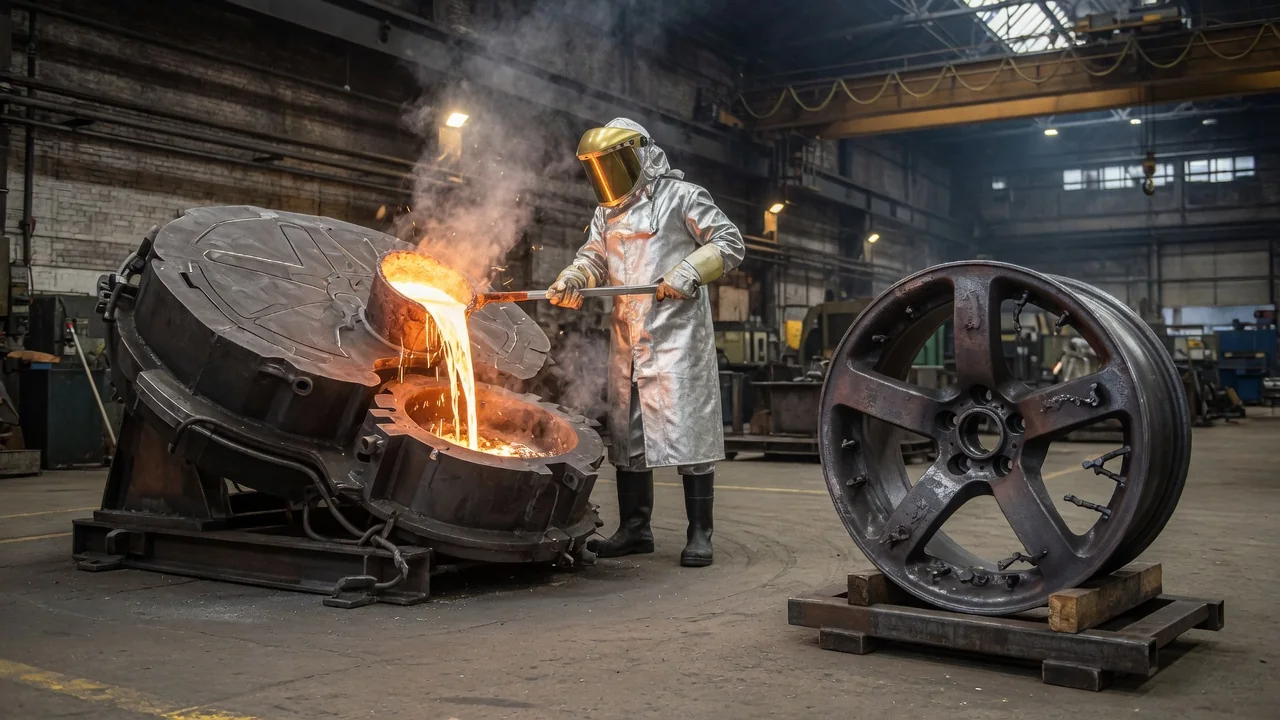
Most alloy wheels on everyday cars start as molten aluminum that is pushed or poured into a steel mold. The cast car wheel process looks simple, but the finished wheel's quality depends on three things: how carefully the metal is prepared, how the mold controls cooling, and how thoroughly each wheel is checked afterward. This guide explains how a cast alloy wheel is made, step by step, and what those steps mean for the wheel on your car.
Molten Metal: Preparing the Alloy
Cast wheels are usually made from an aluminum alloy that contains silicon and a small amount of magnesium. A356 is the grade most often cited. Silicon helps the liquid metal flow into thin, detailed sections of the mold. Magnesium lets the cast part be strengthened later by heat treatment. Producers melt aluminum ingots in gas-fired or electric furnaces, along with controlled amounts of recycled material from their own process, such as trimmed risers and rejected castings.
Melting the aluminum is the easy part. Treating it properly is harder. Liquid aluminum absorbs hydrogen, mainly from moisture in the air and on furnace tools. As the metal solidifies, that hydrogen comes back out of solution and leaves gas pores inside the casting. To prevent this, foundries degas the melt by bubbling an inert gas such as nitrogen or argon through it, often with a rotating impeller that breaks the gas into fine bubbles. The bubbles collect hydrogen and carry oxides up to the surface, where the resulting dross is skimmed off. Small additions of grain refiners and modifiers, commonly titanium-boron and strontium compounds, are mixed in. They give a finer, more uniform internal structure that improves ductility and fatigue resistance. Many plants also pass the metal through ceramic filters to catch remaining oxide films before it reaches the mold.
Before casting, the melt is usually checked. A spectrometer confirms the chemical composition. Small samples solidified under reduced pressure show how much gas remains, because gassy metal expands visibly when it freezes under vacuum.
Mold: Shaping and Solidifying the Wheel
Low-pressure die casting is the most widely used method for passenger car wheels. The steel die sits above a sealed furnace or holding vessel. When air pressure is applied to the surface of the melt, liquid aluminum rises through a riser tube and fills the die from the bottom. This bottom-up filling is relatively calm, which limits turbulence and the oxide films that turbulence can fold into the metal. The die is made of several parts. Top and bottom halves form the face and back of the wheel, and side segments shape the rim. Some manufacturers use gravity casting instead, pouring the metal in from above. It uses simpler equipment but gives less control over how the mold fills.
Aluminum shrinks as it turns from liquid to solid. Any area that freezes while cut off from liquid metal can develop shrinkage voids. Die designers therefore plan directional solidification. The thin rim and outer spoke areas freeze first, and solidification moves toward the hub, which stays connected to the liquid metal in the riser tube until last. The pattern is controlled with cooling channels for air or water in the die and with insulating or conductive coatings sprayed on die surfaces. Pressure is held until the wheel has solidified. Then it is released, the leftover liquid drains back into the furnace, and the die opens to eject the casting.
The raw casting is not yet a usable wheel. It is typically heat treated: heated to dissolve strengthening elements, quenched quickly, then aged at a lower temperature, a sequence commonly called T6. It is then machined on lathes and drilling stations to create the mounting face, center bore, bolt holes, valve hole and bead seats. Some wheels go through flow forming before machining. In this step, the rim section is spun over a mandrel while rollers press and stretch it thinner, which gives the barrel properties closer to forged material. Painting or powder coating completes the finish.
Inspection: Finding What the Eye Cannot See
Defects that matter in a cast wheel are often internal, so X-ray inspection is central to quality control. Automated radiography systems examine the castings, often every one of them, looking for gas porosity, shrinkage cavities and trapped inclusions. They pay particular attention to highly stressed areas such as the spoke roots and the hub. Visual checks catch surface flaws, cold laps where two metal streams did not fuse properly, and machining marks.
Finished wheels then go through dimensional and functional checks. Radial and lateral runout measurements confirm the wheel turns true. Bolt pattern, center bore and offset are verified against the drawing. Because modern wheels hold air directly in tubeless tires, many manufacturers leak test the rim with pressurized air or a tracer gas such as helium to find porosity that passes all the way through the wall. Balance may also be checked.
Some tests destroy the part, so they are done on samples or during design validation rather than on every wheel. These include rotating bending (cornering) fatigue, radial fatigue under load, and an impact test that drops a weight onto the rim edge. Test bars cut from wheels can confirm tensile properties, and polished cross sections reveal whether grain refinement and modification worked. Finally, wheels are marked with information such as size, load rating, manufacturing date and any standard they are certified to.
Practical Implications and Limits
Some porosity and a less directional grain structure are inherent to casting. Designers compensate with thicker sections, so a cast wheel is generally heavier than a forged wheel built for the same load. For daily driving, a properly designed and inspected cast wheel is fully adequate. The trade-off shows up mainly in unsprung weight and cost, not in basic safety.
Cast aluminum is less ductile than forged material, so a hard pothole or curb strike is more likely to crack it than simply bend it. Strength also depends on heat treatment, so local heating during welding or hot straightening can weaken the surrounding metal. For that reason, many in the wheel industry discourage welding structural cracks. Cosmetic refinishing of scuffs is a different matter from structural repair. A slow air leak that does not trace back to the tire or valve can occasionally come from porosity in the rim, and a tire shop can usually locate it with a soapy-water check.
Details vary between manufacturers. Alloy composition, die design, heat-treatment schedules and sampling rates are proprietary, and this article describes general mechanisms rather than any particular brand's process. For a specific vehicle, the right size, offset and load rating come from the vehicle documentation, and a certification mark on a wheel says nothing about damage it may have picked up since it left the factory.