How Does an Open Window Change Car Aerodynamics?
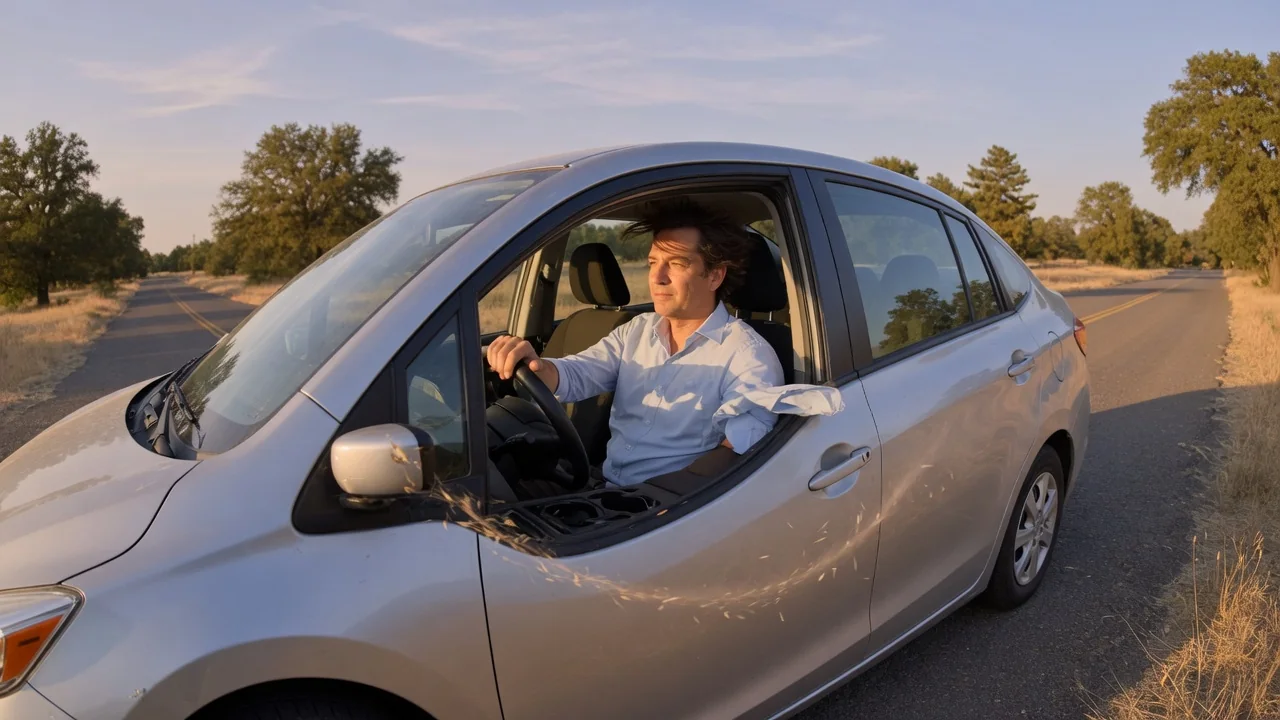
A closed car is shaped to let air slide along its sides with as little disturbance as possible. Lower a window and that smooth surface gains a hole, which raises a common question: how does an open window change car aerodynamics? The answer involves cabin pressure, drag, noise and the energy the vehicle needs to hold its speed.
Cabin pressure
With every window closed, the cabin behaves like a loosely sealed box. Fresh air enters through the ventilation intake near the base of the windshield and leaves through small extractor vents usually hidden at the rear of the body. Opening one window gives the fast-moving air outside a direct connection to that box. Because air rushing along the side glass is typically at lower pressure than the still air inside, the opening tends to pull cabin air outward rather than simply scooping fresh air in.
That exchange is rarely steady. The stream skimming across the opening rolls up into small vortices that strike the rear edge of the window frame, pushing a pulse of air inward, and the cabin responds like a bottle someone is blowing across. The result is buffeting, the low-frequency throbbing that passengers feel in their ears more than they hear. It is often strongest with a single rear window down, and the speed at which it begins depends on cabin volume, opening size and body shape.
Drag
Aerodynamic drag is the force the air exerts against a moving vehicle, and it rises roughly with the square of speed. Designers manage it by keeping the flow attached to the body for as long as possible. An open window interrupts that work. Air that would have followed the glass instead tumbles into the opening, mixes with cabin air and rejoins the outside stream as turbulence. That disturbed air carries away energy the engine or electric motor had to supply, so overall resistance increases.
How much it increases is not a single number. A window cracked a finger's width disturbs far less flow than one fully lowered, and four open windows affect the body differently from one. Shape matters too: a low, sleek sedan has more smooth airflow to lose than a boxy truck or SUV that already produces a large wake. At city speeds the penalty is hard to detect, while at highway speeds the same opening costs noticeably more because the forces involved have grown so much.
Comfort choices
The familiar debate is whether to cool the cabin with open windows or with air conditioning. Each has an energy cost. The air conditioning compressor draws power from the engine or, in an electric vehicle, from the battery, and that load is fairly independent of road speed. The drag from open windows grows quickly as speed climbs. As a general pattern, windows tend to be the thriftier option around town, while closed glass with the climate system running often makes more sense on the highway.
Comfort is more than temperature, though. Wind noise makes conversation and phone calls harder, and buffeting can become tiring on a long drive. Lowering a second window, often one diagonally opposite the first, gives the pulsing air another path and usually calms the throb. Opening the sunroof to its vent position or cracking the glass slightly can also move air without much roar. Some vehicles have a small deflector or notched mirror housing aimed at this problem, so results differ from one model to another.
Everyday Use and Observations
Most of these effects can be noticed without instruments. With a rear window lowered at moderate speed, a passenger can listen for the point where a smooth rush turns into a rhythmic thump; as the car slows, it usually fades. Loose papers drifting toward the opening show that air is being drawn outward, while hair blowing forward from the back seat reveals the recirculating flow inside. On a hot day, opening windows for the first minute of a trip flushes out heat-soaked air faster than the vents alone.
Energy use is harder to see, but trip computers offer hints. On a steady, flat stretch of highway, an instantaneous consumption readout or an electric vehicle's range estimate may shift slightly when windows are lowered, though wind, gradient and traffic easily mask the change. Roof racks, cargo boxes and open pickup beds alter the airflow as well, so two vehicles of the same model can behave differently. Rain and dust are also drawn toward the low-pressure zone, which explains why spray sometimes enters even a slightly open window.
Limits and Next Steps
General principles only go so far. The exact drag increase, the speed at which buffeting starts and the fuel or range penalty all depend on the specific body, window size, seals and even mirror design. Published figures from one test rarely transfer cleanly to another vehicle, and wind tunnel results do not capture crosswinds or the wake of a truck ahead. Treat any single rule about windows versus air conditioning as a starting point rather than a guarantee for a particular car.
A sensible next step is simple observation over several similar trips, comparing consumption with windows up and down under matching conditions. If wind noise or a whistle persists with everything closed, the cause may be a worn door seal, a misaligned window or a damaged mirror cover, and a qualified technician can check it. The owner's manual may also describe ventilation settings that reduce pressure pulsing. Above all, choose the setup that keeps the driver alert, comfortable and able to hear surrounding traffic.