Diagnose or Replace a Honda Accord Engine Control Module
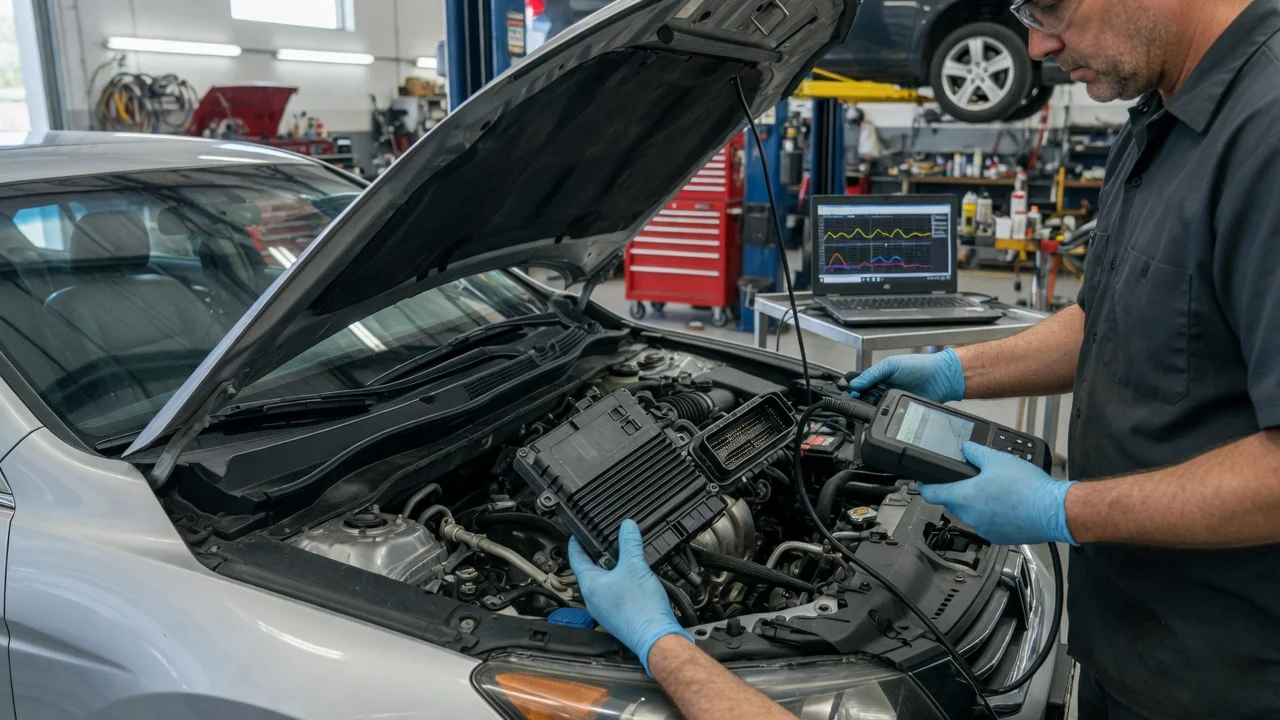
The short answer
The engine control module (ECM) in a Honda Accord is rarely the first part to replace. Most symptoms blamed on the module come from power supply, grounding, wiring, connector, sensor or software problems that make the module appear faulty. Confirm a module fault through systematic checks before buying a replacement. If replacement is justified, the new unit usually has to be programmed to the specific vehicle and matched to its immobilizer system. That step normally requires dealer-level or equivalent professional equipment, so a plug-in swap is generally not enough.
Honda documentation and parts listings may use the term powertrain control module (PCM) or ECM/PCM, particularly on models where one unit manages both engine and transmission functions. The terminology, module location, connector layout and programming procedure all vary by Accord generation, model year, engine and transmission. No model-year-specific specifications, part numbers, locations or costs were available for this guide. Confirm those details for your exact vehicle using its VIN with a Honda dealer or the factory service information.
What the engine control module does
The ECM is the computer that manages the engine. It reads inputs from sensors such as those for airflow, coolant temperature, throttle position and crankshaft and camshaft position. It then controls outputs such as fuel injection and ignition timing. It also stores diagnostic trouble codes and turns on the check engine light, and it communicates with other modules over the vehicle's data network. Because so many systems pass through it, a fault elsewhere can easily look like a module failure.
Symptoms that can point toward the module, and why they are not proof
• Engine cranks but will not start, or does not crank at all; • Check engine light with codes indicating an internal control module fault; • Scan tool cannot communicate with the engine module; • Communication codes stored in other modules, indicating lost contact with the ECM; • Intermittent stalling, rough running or erratic gauge or transmission behavior; • Immobilizer or security indicator behaving abnormally alongside a no-start
Each of these symptoms has common causes outside the module. Treat any fault code as a starting point for investigation, not as confirmation that a part has failed. For example, generic codes in the P0600 range describe control module or internal processor faults. Even so, low system voltage, a poor ground or a damaged connector can trigger them.
What to check next, in order
Check | What to look for | What the result suggests; Battery and charging system | Battery state of charge and condition; charging voltage with the engine running | Low or unstable voltage can cause erratic module behavior and false codes. Correct this before any further diagnosis. Fuses and relays | Blown fuses or faulty relays feeding the ECM, fuel system or ignition | A failed power feed can make the module appear dead. A repeatedly blowing fuse points to a short circuit that needs tracing. Ground connections | Corroded, loose or damaged engine and body grounds | Poor grounds commonly produce intermittent, hard-to-explain faults across several systems. Module connectors and wiring | Corrosion, bent pins, moisture, chafed or rodent-damaged wiring | Damage here can mimic module failure. Moisture or corrosion inside the module case is stronger evidence of a module problem. Full code scan of all modules | Stored and pending codes, including communication codes, plus freeze-frame data | Codes spread across many modules suggest a network or power issue. Codes isolated to the ECM narrow the search. Scan tool communication | Whether a capable scan tool can connect to the ECM | No communication with good power and grounds raises suspicion of the module or its network wiring. Software and service bulletins | Available ECM software updates and technical service bulletins for your VIN | Some drivability faults are fixed by reprogramming the existing module rather than replacing it. Recalls | Open recalls for your VIN | If a recall covers the issue, the dealer may address it at no cost.
If power, grounds, fuses, wiring and connectors all check out, and the module still fails to communicate or stores internal fault codes that return after clearing, a module fault becomes a reasonable conclusion. At that point, professional confirmation is worthwhile before you spend money on a replacement. Some shops can test or verify the module directly.
When to stop driving or get professional diagnosis
• Flashing check engine light, which commonly indicates a severe misfire that can damage the catalytic converter; • Stalling while driving, especially in traffic or at speed; • Overheating, or a temperature warning alongside other faults; • Smell of fuel, or signs of a fuel leak; • Burning smell, smoke or melted wiring near the module or harnesses; • Transmission behaving erratically, such as harsh shifts or failure to engage gears; • No-start combined with an immobilizer or security warning, since key or security faults need proper diagnosis
What replacing the module involves
Replacement options typically include a new unit from Honda, a remanufactured unit, or a used unit from another vehicle. The key issue is programming. A replacement module generally needs the correct software for the vehicle's VIN, engine and transmission, and it must be matched to the immobilizer so the engine will start with the existing keys. A used module taken directly from another car may not start your Accord without this matching. Some remanufacturers offer units pre-programmed to a supplied VIN, but whether additional immobilizer setup is still required depends on the generation and the supplier.
Before buying a module, confirm three things with the seller or installer: the exact part compatibility for your VIN, who will do the programming and immobilizer matching, and whether a warranty covers the unit. Also fix any underlying cause first. If a shorted component or wiring fault damaged the original module, a replacement installed without addressing that fault may fail the same way.
Do-it-yourself or professional?
Several of the early checks are within reach of a careful owner with a multimeter and a scan tool: battery and charging voltage, fuses, visible grounds and connector condition. Module programming, immobilizer matching and network fault tracing usually require equipment and service information that a dealer or a well-equipped independent shop is better placed to provide. A practical approach is to complete the basic checks yourself, record any codes and freeze-frame data, and then take that information to a professional for confirmation before replacing the module.
Gaps in this guide
This guide does not provide module locations, connector pinouts, voltage specifications, part numbers, programming steps, prices or labor times for specific Accord model years. It does not cover specific recalls or service bulletins either. These details vary by generation, engine, transmission and market, and must be confirmed for your exact vehicle using its VIN and Honda service information.