Group 27F Car Battery: What to Check Before You Buy
The short answer
A Group 27F battery is a specific case size and terminal arrangement defined by the Battery Council International (BCI) group numbering system. If your vehicle's owner's manual, the label on your current battery, or a reliable fitment lookup calls for 27F, buy a 27F that meets or exceeds the original cold cranking amps (CCA) rating and matches the original battery technology (flooded, EFB or AGM). The two conditions that most often change this answer: your vehicle may list more than one acceptable group size depending on model year, engine or trim, and a dead or weak battery is sometimes a symptom of a charging system fault rather than the battery itself.
What the 27F designation means
The number 27 describes the battery's case dimensions and general format. The letter F indicates that the terminal positions are reversed compared with a standard Group 27. In practice, a Group 27 and a Group 27F are the same physical size, but the positive and negative posts sit on opposite sides.
This matters because your vehicle's battery cables are cut and routed for one specific layout. A battery with reversed terminals may physically fit the tray, but the cables may not reach the correct posts, or they may stretch, rub against the hood or touch the wrong terminal. Never force cables onto a battery with the wrong orientation; reversed polarity can damage fuses, electronics and the charging system.
The simplest check is to compare the replacement directly with the battery you are removing: with both batteries facing the same way, the positive post should be in the same position on each.
Confirm the correct size for your vehicle
Group size requirements can differ between model years, markets, engine options and equipment packages, even within the same model name. A truck with a larger engine, a towing package or a cold-climate package may have been built with a different battery than a base version. Use more than one of these sources to confirm the fit:
The owner's manual or the vehicle manufacturer's specifications for your exact model year and engine; The label on the battery currently installed, keeping in mind a previous owner may have fitted a different size; A retailer or parts-catalog fitment lookup that asks for year, make, model and engine; A physical check of the tray, hold-down clamp and cable reach
If these sources disagree, for example the manual lists one group size and the installed battery is another, trust the manufacturer's specification for your exact configuration and verify that the hold-down hardware secures the battery properly.
Specifications to compare
Once you know you need a 27F, the batteries on the shelf can still differ meaningfully. These are the ratings and features worth comparing.
Specification | What it means | What to look for; Cold cranking amps (CCA) | How much current the battery can deliver to start the engine in cold conditions | At least the original equipment rating; more is useful in cold climates; Reserve capacity (RC) | How long the battery can power essential loads if the alternator stops charging | Higher is helpful for vehicles with many accessories or frequent short trips; Battery technology | Flooded (conventional), enhanced flooded (EFB) or absorbent glass mat (AGM) | Match the original type; do not downgrade from AGM; Manufacture date | When the battery was built, usually shown as a code on the case | Choose a recently made unit; older stock may have self-discharged; Warranty terms | Free-replacement period and any prorated coverage | Compare the free-replacement period, not only the total length
Cold cranking amps
CCA is the rating most buyers focus on, and it matters most in winter. Meeting the original rating is the baseline. Going higher will not harm the vehicle, since the starter only draws what it needs, but extra CCA usually costs more and is most worthwhile where temperatures regularly drop well below freezing.
Reserve capacity
Reserve capacity is often overlooked but is relevant for vehicles that run lights, winches, aftermarket audio, camping equipment or other accessories, and for owners who make many short trips that never fully recharge the battery.
Flooded, EFB or AGM
Conventional flooded batteries are the most affordable and suit many older vehicles without heavy electrical demands. Enhanced flooded batteries are built to handle more frequent cycling and are often used in vehicles with basic start-stop systems. AGM batteries are sealed, resist vibration well, tolerate deeper discharges and recharge more efficiently, which is why they are common in vehicles with start-stop systems or high electrical loads.
If your vehicle came with an AGM battery, replace it with AGM. A flooded battery in a system designed for AGM may wear out quickly and can cause start-stop or charging behavior to suffer. Upgrading from flooded to AGM is generally acceptable and can be worthwhile for demanding use, though it costs more.
When the battery is not the real problem
Before buying, consider why the old battery failed. A new battery will not fix a charging system problem, and a faulty alternator or a parasitic drain can flatten a brand-new battery within days or weeks. Signs that point beyond the battery include:
A battery or charging warning light that appears while driving; Headlights or dash lights that dim or flicker, especially at idle; A battery that goes flat repeatedly even though it is relatively new; A whining or grinding noise from the alternator area, or a slipping or worn drive belt; Corroded, loose or damaged battery cables and ground connections
Many parts stores and repair shops can test the battery, alternator output and starter draw. As a general guide, a fully charged 12-volt battery at rest typically reads around 12.6 volts, and a healthy charging system with the engine running usually holds voltage in a range noticeably above that, roughly in the mid-13 to mid-14 volt area. Readings well outside those ranges, or a battery that cannot hold a charge overnight, call for a closer look at the charging system or for a parasitic drain test.
Installation considerations
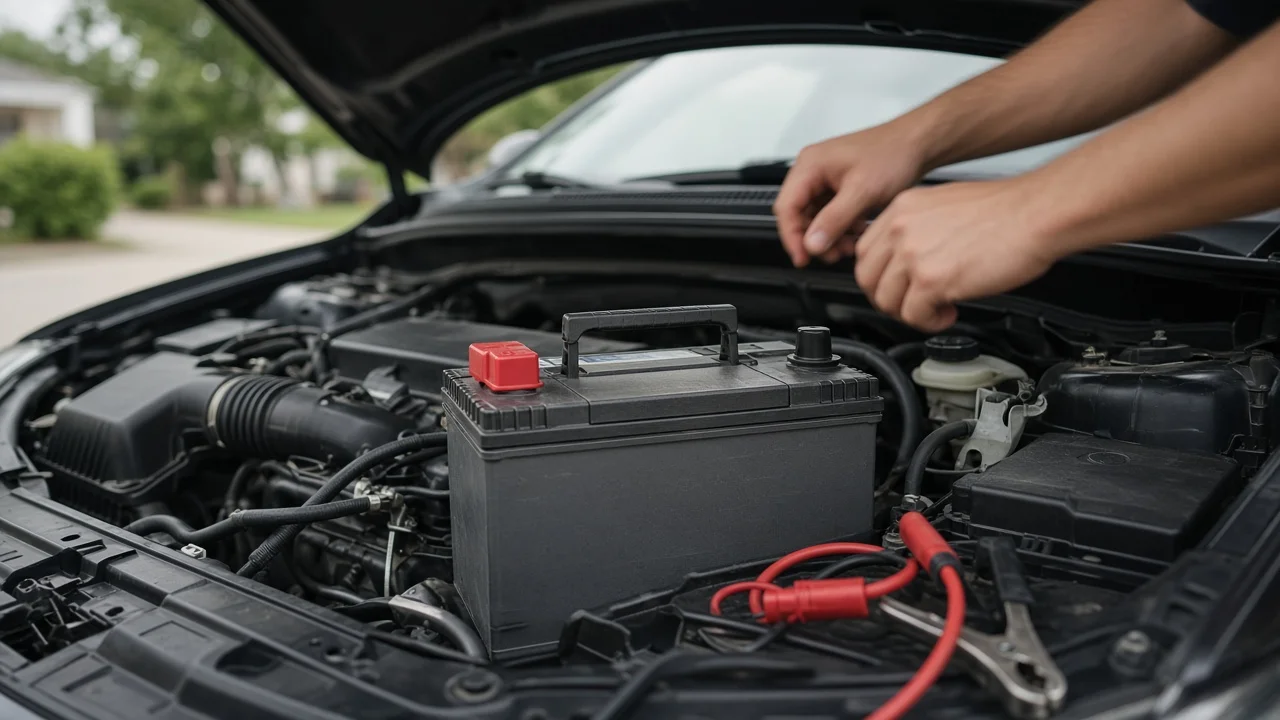
Make sure the hold-down clamp secures the new battery firmly; a loose battery can be damaged by vibration; Clean corrosion from cable ends and terminals before connecting the new battery; Disconnect the negative cable first and reconnect it last to reduce the risk of short circuits; Some newer vehicles use a battery monitoring system that may need to be told a new battery was installed; check the owner's manual or ask a shop if your vehicle requires this step; Expect that radio presets, clock settings or idle learning may reset after the battery is disconnected; Return the old battery for recycling; retailers commonly charge a core fee that is refunded when you bring the old one back
Buying checklist
Confirm Group 27F is correct for your exact year, engine and trim; Check that terminal positions match the old battery; Meet or exceed the original CCA rating; Consider reserve capacity if you run accessories or make short trips; Match the original technology, and do not downgrade from AGM; Check the manufacture date code for a fresh unit; Compare the free-replacement warranty period; Rule out alternator, cable and drain problems if the old battery failed early
If the size, terminal layout, CCA and battery type all line up with your vehicle's requirements, a Group 27F replacement should be a straightforward swap. If the old battery died unexpectedly, have the charging system tested at the same time so the new one gets a fair start.