Glow Plug Control Module Repair: Diagnosis, Options and Verification
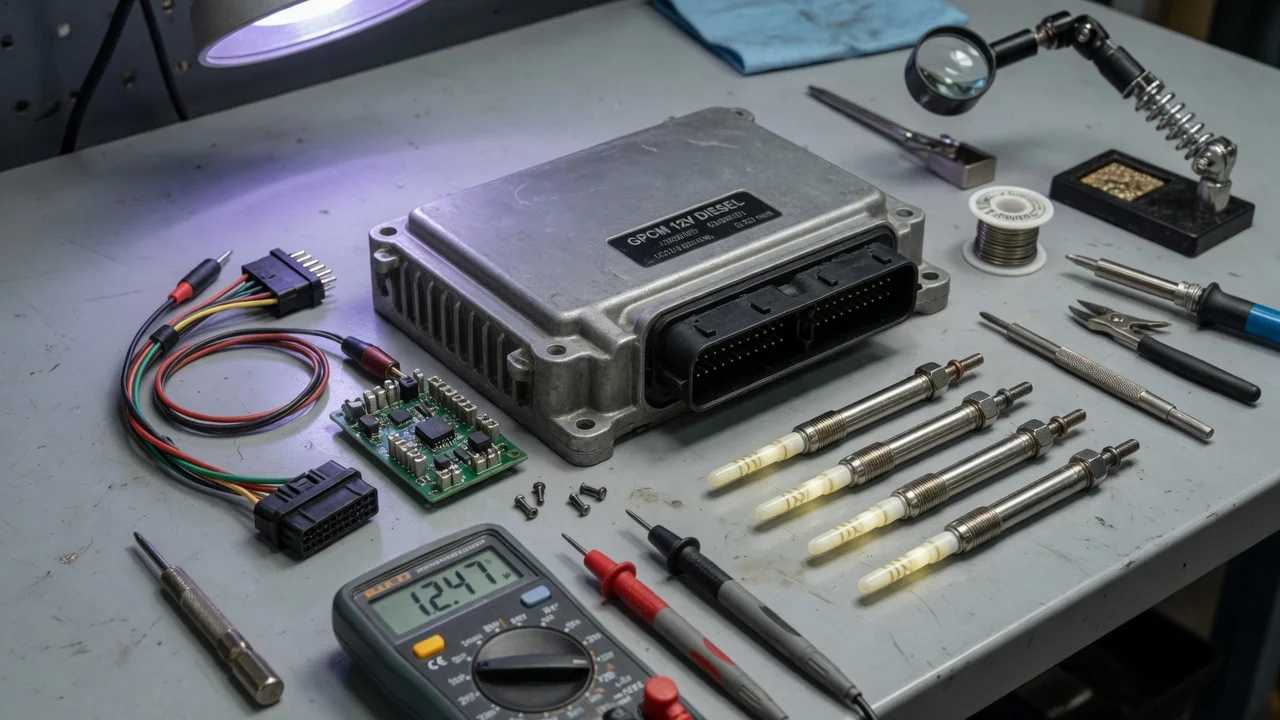
A glow plug control module switches and regulates current to the glow plugs that help a diesel engine start and run cleanly when cold. When it fails, you may see a warning light, stored codes, hard cold starts or white smoke. Fuel delivery, battery and compression problems cause many of the same signs. This guide explains how to confirm a module fault, decide what actually needs repair and check that the fix worked.
Confirm the fault before repair
Start with stored trouble codes and freeze frame data. Glow system codes usually fall into three groups: circuit faults for an individual cylinder's plug, faults in the module control circuit, and faults in communication between the module and the engine control module. Exact code numbers and definitions vary by manufacturer, so read the description in the service information for your vehicle. A code that names a single cylinder usually points to that plug or its wire, not to the module.
Electrical measurements turn a suspicion into a diagnosis. Command a glow cycle with a scan tool if the vehicle supports it, or use the key-on glow period. Then measure voltage at the module outputs and at each plug terminal, and check current draw with an inductive amp clamp. Compare each plug's resistance and current against specification. Next, verify the module's power feed, its ground, and the command or data signal from the engine control module. Condemn the module only when it has correct power, ground and command, yet fails to drive outputs whose plugs and wiring test good, or when it reports an internal fault.
Several conditions mimic a glow system failure. Slow cranking from a weak battery, air in the fuel, a restricted fuel filter, fuel waxing in cold weather, low rail pressure during cranking, a leaking injector and low compression can all cause hard cold starts and white smoke. Use the scan tool to compare desired and actual fuel pressure while cranking, rather than opening any fuel line. On many diesels the injector correction or balance values, which play a role similar to fuel trim on a gasoline engine, can also show whether one cylinder is misbehaving for reasons unrelated to glow plugs.
Define the repair scope
Glow systems are not all alike. Older designs use a relay or simple controller that applies full battery voltage to the plugs for a set time. Newer electronic modules pulse the current to control plug temperature, can run plugs rated below system voltage, provide afterglow after start-up to reduce smoke and emissions, and report per-cylinder diagnostics to the engine computer. Engine configuration also matters. An inline four and a V8 differ in output count, harness routing and module location, and some modules sit close to exhaust or turbocharger heat. Do not assume that a module from a similar engine fits or behaves the same. Match the part number and confirm any required software level.
Next, establish how far the damage goes. A shorted glow plug can overload a module output and burn it, so replacing only the module may lead to a quick repeat failure. Inspect the harness for chafing against brackets or exhaust parts, check connectors for water intrusion, green corrosion and heat-discolored or loose terminals, and test every output, not only the one named in a code. A clear picture of which plugs, wires and connectors are healthy keeps the repair from being either too narrow or needlessly broad.
Compare repair options
There is rarely anything to adjust on a glow control module itself. For certain known faults, however, a manufacturer may specify a software update to the engine control module. A replacement module may also need coding or configuration before it works correctly. When testing shows a circuit problem rather than an internal failure, wiring repair is often the right answer: replace burned or spread terminals with correct parts and repair damaged wire with the proper gauge and sealed splices. This fixes the circuit but does nothing for a module that has failed internally.
Most modules are sealed units, so in practice repair means replacement. Some specialty rebuilders offer board-level repair. Whether that is sensible depends on the part, the availability of a new unit, the warranty offered and whether coding is still required afterward. A new module matched to the correct part number resolves an internal failure. It leaves untouched any worn glow plugs or marginal wiring, and those should be addressed in the same job if testing shows them to be weak.
Replacing glow plugs needs its own judgment. Plugs can seize in the cylinder head after years of heat cycles, and snapping one may mean extraction with special tools or even head removal. That is a reason to involve a diesel specialist when a plug resists. Fuel additives, such as cold flow improvers, can help prevent winter gelling, but they do not repair an electrical glow fault. An easier start after adding one is not proof that the glow system is fixed.
Requirements and limits
You need several tools before starting: a scan tool that can read glow system data and run output tests, a digital multimeter, an inductive amp clamp, and wiring diagrams and connector views specific to the vehicle. You also need the correct torque values for plugs and module fasteners. The glow circuit carries high current, so follow the service procedure for disconnecting the battery before unplugging the module or plug leads. Plugs reach very high temperatures and should be allowed to cool before handling. Do not bench-test plugs by connecting them straight to a battery unless the specification allows it, because some modern plugs are rated below system voltage and can be destroyed this way.
Respect the fuel system while you work. Common-rail diesels can operate above 20,000 psi, and fuel escaping at injection pressure can penetrate skin and cause serious injury. Never loosen a high-pressure line to relieve pressure, bleed air or look for a leak, and never feel along lines by hand. Any leak check on the high-pressure side should follow the manufacturer's procedure with the engine off and the system at rest. If a module or plug can only be reached by removing fuel lines, follow the service information. Some manufacturers require replacing high-pressure lines once removed. Work on the injection pump, rail or injectors falls outside a glow system repair and belongs with a qualified diesel technician.
Verify the outcome
After the repair, clear the codes, run a glow cycle and record the current and voltage for each output. Confirm that scan data shows no module or circuit faults. The most meaningful test is a cold start after an overnight soak at temperatures similar to the original complaint, noting cranking time, smoke and idle quality during warm-up. Record part numbers, measured values, any coding or software updates, and the location of harness repairs, so a future fault can be compared against a known baseline.
If a glow code returns, recheck that specific circuit. For intermittent faults, flex the harness while watching live data to catch a break that only appears with movement or heat. If the glow system now tests good but cold starting is still poor, the cause lies elsewhere. Check fuel pressure during cranking, the condition of the fuel filter and water separator, the performance of the lift or supply fuel pump, injector balance or return data, cranking speed and compression. Diagnosis that requires opening the high-pressure side or testing injector leak-back should go to a diesel fuel system specialist.