Find a Coolant Leak at the Front of the Engine
The Short Answer
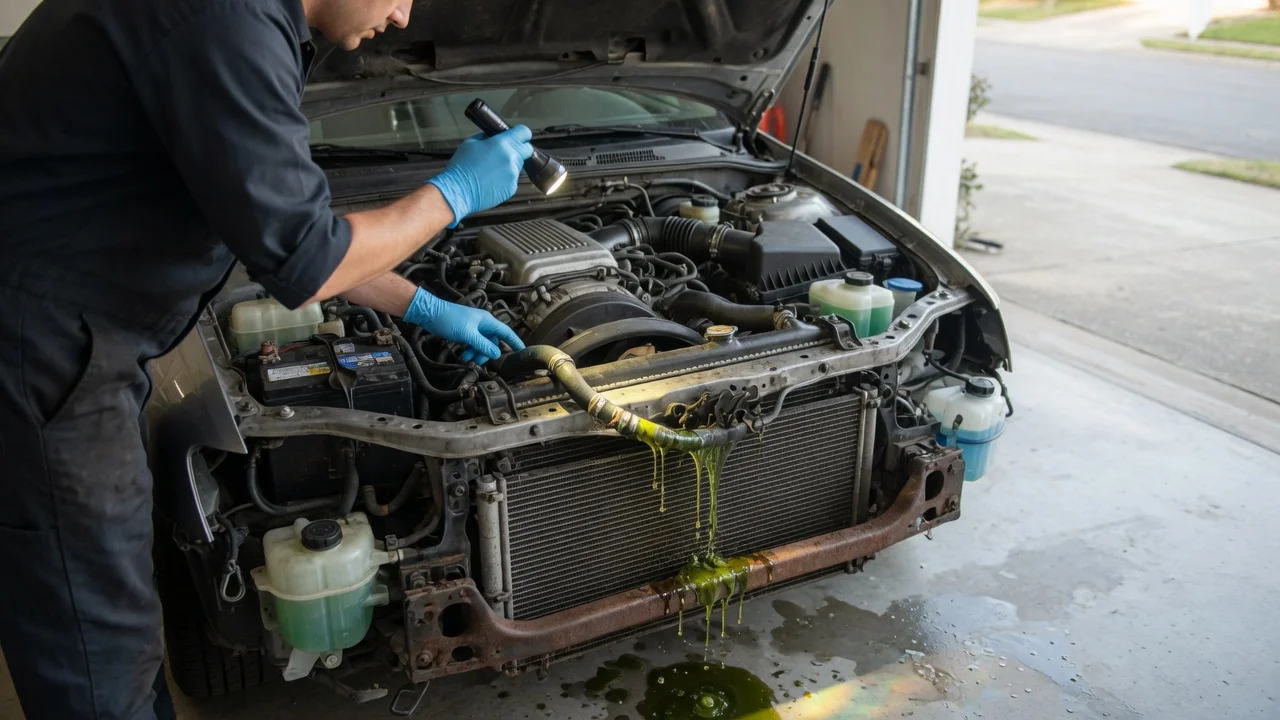
Coolant that appears at the front of the engine usually comes from a part of the cooling system mounted there. The common suspects are the water pump, the upper or lower radiator hose and their clamps, the thermostat housing, the radiator itself, and the coolant reservoir or expansion tank. The visible puddle or drip is often not where the leak starts. Coolant runs downhill and is blown rearward by airflow while driving, so the drip point can be some distance from the real source. To find it, trace the wetness or dried residue upward and forward until you reach the highest point where it appears.
Which parts sit at the "front" depends on how the engine is mounted. On a longitudinal engine, which runs front to back as in many rear-wheel-drive vehicles, the front of the engine faces the radiator and usually carries the water pump and the belt drive. On a transverse engine, which runs side to side as in many front-wheel-drive vehicles, the belt and timing end of the engine faces one side of the engine bay. The side facing the radiator may carry different parts, such as the exhaust or intake manifold. Before you start, decide whether you mean the area behind the grille and radiator, or the belt and timing end of the engine, because the list of suspects changes.
Safety Before You Look
Work only on a cooled-down engine. A hot cooling system is under pressure, and opening the radiator cap or reservoir cap while hot can spray scalding coolant. Keep hands, hair and clothing away from the fan and belts. On many vehicles the electric cooling fan can start even when the engine is off. Coolant is toxic to people and animals and often tastes sweet. Wipe up puddles and keep pets away from them. If the temperature gauge rises or a warning light comes on, stop driving. Running an engine low on coolant can overheat it and cause serious damage.
Confirm the Fluid Is Coolant
Several fluids can collect at the front of a vehicle, so confirm what you are dealing with first. Coolant, also called antifreeze, is a mix of water and glycol-based concentrate. It feels thin and slightly slippery and usually has a sweet smell. Coolant comes in several colors, including green, orange, pink, red, blue and yellow. The color depends on the coolant type and the manufacturer, so color alone does not identify a fluid. Dried coolant often leaves a crusty or chalky residue in a color similar to the fluid.
Fluid | How it usually looks and feels | Common reason it appears near the front; Coolant | Thin, slightly slippery, sweet smell, colored; dries to crusty residue | Cooling system leak; Air conditioning condensation | Clear, odorless, behaves like plain water | Normal drip after A/C use; often lands near the firewall area rather than the very front, depending on the vehicle; Engine oil | Amber to black, slick, does not evaporate quickly | Leaks from the timing cover, front crankshaft seal, valve cover or oil filter area; Power steering fluid | Oily, often red or amber, depending on type | Hydraulic power steering pump or hoses on vehicles that use them; Windshield washer fluid | Very thin, often blue, smells like glass cleaner | Washer reservoir or lines; Automatic transmission fluid | Oily, often red when new | Transmission cooler lines that run to the radiator on some vehicles
Check the coolant level in the reservoir or expansion tank with the engine cold and compare it with the minimum and maximum marks. A level that keeps dropping between checks supports a cooling system leak, even if you cannot see the drip yet.
How to Recognize the Likely Sources
The descriptions below are general. The exact location, routing and appearance of each part varies by make, model, model year, engine and market. Check the service information for your specific vehicle before you identify or replace anything.
Water Pump
The water pump circulates coolant through the engine and radiator. On many engines it is bolted to the front or belt end of the engine and driven by the accessory belt. On those engines, it often sits behind a pulley near the center or lower part of the belt run. On other engines it is driven by the timing belt or timing chain and sits partly or fully behind the timing cover. In that case, a leak may only show as coolant seeping from the lower edge of the timing cover.
Many water pumps have a small weep hole, a drain passage below the shaft that lets coolant escape when the internal seal starts to fail. Residue or drips just below the pump pulley, or streaks on the engine block beneath the pump, point to the pump. A pump pulley that wobbles or grinds when the engine is off and the belt is checked by hand can indicate a worn bearing, which often goes with seal failure. Its lookalikes are the front crankshaft seal and timing cover gaskets. Those leak oil rather than coolant, which is why confirming the fluid matters.
Radiator Hoses and Clamps
The upper radiator hose usually runs from the thermostat housing or engine outlet to the top of the radiator. The lower hose connects the bottom of the radiator back toward the water pump inlet. Look for wetness or residue at each end where the hose meets its fitting, cracks or splits in the rubber, a swollen or soft section, or a loose or corroded clamp. Squeeze the hoses when the engine is cold. A hose that feels spongy, brittle or crunchy may be failing. Small bypass hoses and heater hoses can also run near the front on some engines and deserve the same check.
Thermostat Housing
The thermostat controls coolant flow to the radiator and sits inside a housing, sometimes called the water outlet or water neck. The upper radiator hose usually attaches to this housing. Depending on the engine, the housing may sit at the front, top or side of the engine. Residue around the joint where the housing bolts to the engine suggests a failed gasket or seal. A cracked plastic housing, used on some engines, can leak from the body of the housing itself.
Radiator
The radiator sits directly behind the grille, usually with the air conditioning condenser in front of it. Many modern radiators have an aluminum core with plastic end tanks along the sides or top and bottom. Common leak points are the seam where a plastic tank joins the core, cracks in the tanks, the hose necks, the drain plug at the bottom, and damaged fins or tubes in the core. Wet spots or residue on the core, or drips from the bottom edge, point here. If transmission cooler lines connect to the radiator, a leak at those fittings will usually be transmission fluid, not coolant.
Reservoir, Expansion Tank and Cap
The coolant reservoir or expansion tank is usually a translucent plastic bottle near the front or side of the engine bay. On some vehicles it is pressurized and has its own cap, while on others it is an overflow bottle and the pressure cap is on the radiator. Look for cracks in the tank, seepage at its hose connections, and residue around the cap. A worn cap seal can let coolant escape as vapor or drips and may not leave much visible evidence.
Less Common Front-Area Sources
Depending on the engine design, coolant can also leak from an engine oil cooler that uses coolant, from coolant passages in an intake manifold gasket, from a coolant temperature sensor or its seal, or from core plugs, which are pressed-in metal plugs in the engine block. A head gasket failure can sometimes leak coolant externally at the front corner of the engine. Head gasket problems often show other signs, such as overheating or white exhaust smoke, and a technician should confirm them with dedicated tests.
How to Trace the Leak Step by Step
Park on a level surface, let the engine cool fully, and place cardboard under the front of the vehicle overnight to mark where drips land. Open the hood and inspect from the top with a good light. Then look from below if you can do so safely, using proper supports and never relying on a jack alone. Start at the drip location and follow the wet trail or residue upward and toward the front. The highest wet or crusty point is usually closest to the source. Check each suspect in turn: the hose ends and clamps, the thermostat housing joint, the water pump body and weep hole area, the radiator tanks, seams and core, and the reservoir and cap. If everything is coated in old residue, clean the area, refill coolant to the correct level with the engine cold, and recheck after a short drive and cool-down. A fresh leak is easier to pin down on clean surfaces. If the leak only appears when the engine is warm or under pressure, a cooling system pressure tester can help. It pressurizes the system with the engine off so you can watch for seepage. Use the pressure rating specified for your vehicle and cap. For slow or hidden leaks, a UV leak-detection dye added to the coolant and an ultraviolet lamp can make the source glow. Confirm that the dye is compatible with your coolant type.
When the Evidence Points Inside the Engine
If the coolant level keeps dropping but you find no external trace, the coolant may be leaving somewhere you cannot see from outside. Possibilities include an internal leak into the combustion chambers or engine oil, or a heater core leak inside the cabin. Warning signs include milky or tan-colored engine oil, a sweet smell inside the vehicle, a fogged windshield, damp carpet, or persistent white exhaust smoke. These usually need professional diagnosis.
Gaps to Fill for Your Vehicle
This guide does not cover exact component locations, hose routing, the correct coolant type, cap pressure ratings, fastener torque values, or whether your engine's water pump is belt-driven or sits behind the timing cover. All of these vary by vehicle, engine, model year and market. Look up the service manual or manufacturer information for your specific vehicle before replacing parts or pressure-testing the system. If the leak source is still unclear after these checks, have a qualified technician perform a pressure test.