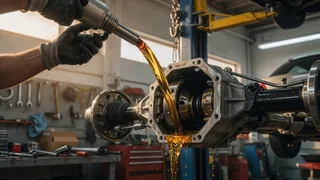
Choosing Febi 21829 Gearbox Oil: What to Check Before You Buy
Febi 21829 is a gearbox oil sold under the Febi Bilstein brand, a German aftermarket parts supplier. Whether it is right for your car depends on one thing: whether its stated lubricant specification matches what your transmission's manufacturer requires. A gearbox oil can be well made and still be wrong for your gearbox. Treat the part number as a starting point, and confirm the match against your vehicle's requirements before you order.
The Short Answer
Buy Febi 21829 only if the specification and approvals printed on the container, or in the seller's listing, match the fluid your transmission calls for. Your owner's manual, a dealer parts lookup by VIN, or the transmission's own identification code will tell you that requirement. If the product only claims to be suitable for a specification rather than holding a formal manufacturer approval, decide whether that is acceptable for your situation. This matters most for a vehicle under warranty or a transmission known to be sensitive to fluid choice.
Two conditions change the answer. First, if your vehicle has an automatic, CVT or dual-clutch transmission, a fluid meant for a manual gearbox is not interchangeable with what those units need. The reverse is also true. Second, many vehicles were built with more than one transmission across model years, markets and trims. A part number that fits one version may not fit another.
Identify Your Transmission First
Equipment identification means confirming exactly which transmission is in your vehicle, not just the make and model. The same model name can cover several gearboxes. Engine size, drive layout, model year and the market the car was built for can all change the gearbox.
Check the owner's manual or maintenance booklet for the recommended transmission fluid and any listed specification codes. Look for a transmission code on the vehicle's build sticker or service data label. On many European vehicles this sits in the spare wheel well, the trunk floor or the service booklet. Ask a dealer parts counter to look up the factory fluid by VIN. This removes most of the doubt about which gearbox you have. If the car has been imported, rebuilt or had its transmission swapped, do not assume the original listing still applies.
Match the Lubricant Specification
Gearbox oils are described by several kinds of rating. Read each one on the Febi 21829 container or product data and compare it with your vehicle's requirement.
Rating type | What it tells you | Why it matters; Viscosity grade (for example, a 75W-xx style rating) | How thick the oil is when cold and at operating temperature | Wrong viscosity can affect shift feel, cold-weather shifting and protection under load; API GL performance level (such as GL-4 or GL-5) | How much extreme-pressure additive the oil contains | Some manual gearboxes need a specific level; using the wrong one can affect synchronizer behavior; Manufacturer specification or approval code | Whether the oil meets a carmaker's own standard | Many European transmissions are specified by an OEM code rather than by viscosity alone; Base oil type (mineral, part-synthetic, synthetic) | General formulation | Usually less decisive than the specification match, but relevant to change intervals
Pay particular attention to GL-4 versus GL-5. They are not simply better and worse versions of the same thing. Many manual gearboxes with brass or bronze synchronizers specify GL-4, and the manufacturer's stated requirement should decide the choice. Some oils are labeled as meeting both levels. Accept that only if your vehicle's requirement allows it.
Manufacturer Approval Versus Suitability Claims
A manufacturer approval means the carmaker has formally listed the oil as meeting its standard. A suitability or meets-the-requirements claim means the oil supplier states the product is appropriate, without necessarily holding that formal listing. Aftermarket oils commonly carry either type of claim, sometimes both for different specifications.
For an older vehicle out of warranty, a well-matched suitability claim is often an acceptable trade-off. For a newer vehicle, or a transmission with a reputation for being sensitive to fluid, a listed approval or the dealer fluid may be the safer choice. If the listing does not say which applies, treat that as an open question before you buy, not a detail to sort out after installation.
Fill Quantity and How Much to Buy
Fill quantity is the amount of oil your gearbox holds. Container size is the amount in the bottle. The two rarely line up neatly. Check your vehicle's specified capacity, then compare it with the container size shown in the listing. You may need more than one container.
Use the capacity for your exact transmission. Capacities can differ between versions of the same model. A drain-and-refill often takes slightly less than the total dry capacity, because some oil stays inside the gearbox. Buying a little extra lets you top up correctly at the fill plug without running short partway through the job. If the gearbox shares oil with a differential, or has a separate differential, confirm which compartment each fluid is for.
Level Check and Fill Method
Many manual gearboxes have no dipstick. The level check is done at a fill plug on the side of the casing, and the usual approach is to fill until oil just begins to run out of the fill hole with the vehicle level. Some transmissions use a different procedure, a specific fill temperature or a dedicated filling tool. Follow the method for your gearbox rather than a generic rule.
Make sure the vehicle is level when you check or fill. A tilted car gives a false reading. Loosen the fill plug before the drain plug. That way you are not left with an empty gearbox you cannot refill. Check whether the drain and fill plugs need new sealing washers. Budget for them if so. Use a fluid pump or a suitable bottle nozzle. The fill hole is often in an awkward position.
Service Interval
Some manufacturers describe manual gearbox oil as filled for life, while others list a change interval by mileage or time. Severe use, such as towing, frequent short trips, heavy stop-and-go driving or track use, can justify changing it sooner than the standard schedule. Check your maintenance schedule. Also consider a change if the vehicle's history is unknown, or if shifting has become notchy and the oil has never been replaced. Changing to a correctly specified oil is the variable you control. A different brand of the same specification should not, by itself, change the interval.
What to Check Before You Commit
Specification match: viscosity, GL level and any OEM code all line up with your vehicle's requirement. Approval status: you know whether the product holds a formal approval or a suitability claim, and that is acceptable for your vehicle. Transmission type: the oil is intended for your type of gearbox, whether manual, automatic, CVT, dual-clutch or differential. Quantity: you are buying enough containers to cover your gearbox's fill quantity. Seller reliability: buy from a seller who shows the actual product label or specifications, because packaging and formulations can change over time. Total job cost: include sealing washers, any tools you need, and shop labor if you are not doing the work yourself. Returns: confirm the return policy in case the specification turns out not to match once you check your vehicle.
On price, compare like with like. Work out the cost per liter or per quart instead of per bottle, and check whether shipping is included. A listed price is not always the final cost. For a gearbox oil change, the fluid is often only part of the total, especially when a shop does the work.
Febi 21829 Versus Other Options
If you are weighing Febi 21829 against alternatives, compare them on the same criteria. Do not rank on brand reputation alone. The useful comparison is whether each option meets your vehicle's requirement, and on what basis.
Option | Typical strength | Typical trade-off | Best fit; Dealer or OEM-branded fluid | Matches the factory requirement by definition | Often costs more and may only be sold through dealers | Vehicles under warranty or fluid-sensitive transmissions; Febi 21829 or similar aftermarket gearbox oil | Often easier to buy alongside other parts, may cost less | You must confirm the specification and approval status yourself | Out-of-warranty vehicles where the specification is confirmed to match; Major lubricant brand with a listed OEM approval | Formal approval on a widely available product | Choosing the correct variant within a product range takes care | Owners who want an approved product without going through a dealer
If Febi 21829's stated specification matches your requirement and you are out of warranty, it is a reasonable choice, especially if you are already ordering other Febi or European parts. If your car is under warranty, or the listing does not make the specification clear, the dealer fluid or an oil with a listed approval for your gearbox removes the uncertainty.
Next Step
Find your transmission's required fluid specification and fill quantity from the owner's manual or a VIN lookup. Then compare those details with the specification and container size shown for Febi 21829. If everything matches, buy enough to complete the fill. If anything is missing or contradictory, settle that question before you order, not after the old oil is drained.