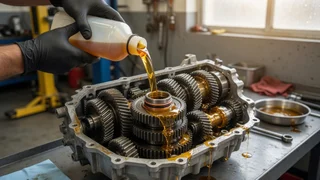
Thick gearbox oil
Thick gearbox oil usually refers to a high-viscosity transmission lubricant rather than a contaminated or aged fluid. Drivers often ask about it when shifting feels stiff, a gearbox is noisy, or an older unit consumes oil. Viscosity is the fluid’s resistance to flow, and choosing a thicker grade changes film strength, cold-temperature behavior, and the effort required to move synchronizers and gears. Understanding why a transmission may call for a heavier oil helps separate a useful specification change from a temporary fix for mechanical wear or the wrong fill quantity.
Essential answer
Thick gearbox oil is a transmission lubricant with higher viscosity than a typical factory fill. In a manual gearbox or transaxle, viscosity affects how well the oil clings to gear teeth under load, how quickly it reaches bearings after a cold start, and how easily synchronizers match shaft speeds. A heavier oil can quiet gear rattle and cushion worn clearances, but it may also increase drag, raise shift effort, and delay lubrication in cold weather. The essential answer is that the correct choice depends on the lubricant specification, not simply on choosing the thickest available product.
Equipment identification is the first step before evaluating a thicker fluid. Gear oil viscosity grades and engine oil viscosity grades use different scales, so a 75W-90 gear oil is not directly comparable to a 10W-40 engine oil. Manufacturer approval and the stated service interval reflect the loads, bearing clearances, synchronizer materials, and operating temperatures the transmission was designed to handle. A fill quantity or level check procedure also matters, because an overfilled or underfilled gearbox can imitate the symptoms that lead someone to consider a thicker oil, such as whining, hard shifting, or leakage.