Manual gearbox and clutch operation
A manual gearbox and clutch operation depends on a direct mechanical link between the driver, the engine and the wheels. In a vehicle equipped with this transmission type, the driver selects each gear and controls torque transfer with the clutch pedal. Understanding that connection helps explain shift behavior, wear patterns and maintenance needs. The arrangement remains valued for engagement and control, but it also requires coordinated inputs. The sections below describe the essential function, operating principles, practical assessment, shifting procedure and symptom interpretation for a manual transmission clutch operation.
Essential answer
Manual gearbox operation is the driver-controlled process of selecting fixed gear ratios to regulate speed and torque at the wheels. The clutch sits between the engine and gearbox and interrupts power long enough for a ratio change. When the pedal is pressed, the clutch disc separates from the flywheel. When the pedal is released smoothly, friction reconnects the rotating parts and transmits engine output through the selected gear pair.
Because the system is mechanical, the results depend on the driver's inputs, the condition of the clutch friction surfaces and the gearbox lubricant. Shift behavior can reveal whether the release mechanism, synchronizers or fluid specification are appropriate. Service history and fitment also matter when a transmission has been replaced or repaired. No single observation confirms a part failure, but several symptoms together can point toward a specific area.
How it works
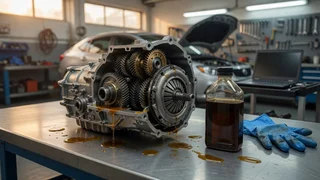
Inside the gearbox, shafts carry gears of different diameters. Selecting a gear engages a pair that creates a mechanical ratio between engine speed and wheel speed. Lower ratios multiply torque for acceleration or climbing, while higher ratios reduce engine rpm at road speed. The shift lever moves internal forks and collars, and synchronizers match gear speeds before engagement to reduce clash.
The clutch uses a pressure plate to squeeze the clutch disc against the flywheel. During a shift, the release bearing moves the pressure plate away, removing clamp load from the disc. This interrupts torque flow, allowing the collar to engage the next gear without fighting the engine's rotation. Releasing the pedal restores clamp load progressively, and the friction surfaces smoothly tie the parts together. The working fluid lubricates bearings and gears while also supporting smooth synchronizer action.
Strengths, limitations and suitability
A manual gearbox gives the driver immediate control over gear selection and engine speed, which can improve response in certain road conditions. It has fewer complex hydraulic and electronic shift components than some automatic designs. For drivers who prefer a direct connection, the feedback through the lever and clutch pedal is part of the appeal. It also remains common in smaller cars and some performance models.
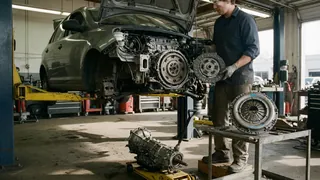
The trade-off is greater physical effort and the need to coordinate the clutch and shifter. Frequent stop-and-go travel can make the repeated clutch operation tiring. Launching, hill starts and low-speed maneuvers require more attention. A worn or misadjusted clutch can produce noise, slipping or hard shifting. Repair options may include replacing the disc, pressure plate or release mechanism, and the correct fluid specification supports consistent operation over time.
Procedure
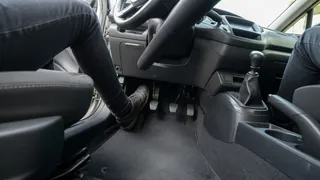
Start by seating yourself so the clutch pedal can be fully depressed without stretching. Press the pedal to the floor, move the shifter into first gear, and feed in power while releasing the pedal past the friction point. If the vehicle tries to move too abruptly, pause the pedal briefly and reduce throttle. In normal driving, release the pedal smoothly without holding it partially engaged for long periods.
Before shifting, lift off the accelerator and simultaneously press the clutch pedal fully. Move the lever cleanly into the next gear, then release the pedal while adding throttle to match engine speed. Downshifts require a small throttle increase before engaging the lower gear in some vehicles. For maintenance or inspection, follow the owner's manual for checking clutch adjustment and fluid condition. Avoid using the transmission as a hand rest or coasting with the clutch depressed.
Diagnosing a problem
Difficulty engaging first or reverse may indicate clutch drag, where the disc does not release fully. Check whether the pedal has free movement according to manufacturer guidance and whether fluid level is adequate when the system uses a hydraulic release. Grinding during shifts can point to synchronizer wear, while a slipping clutch often appears as rising engine speed without matching road speed under load.
Noise that changes with clutch pedal position can help separate gearbox bearing wear from clutch release bearing wear. A fault code is useful evidence but does not prove that a specific component has failed, especially when manufacturer-dependent codes require vehicle-specific confirmation. Observe whether the symptom changes when the engine is warm or cold, in neutral or in gear. If part failure is suspected, stop driving and arrange diagnosis before a minor issue damages other portions of the driveline.