Why Are Car A-Pillars Sometimes Thick?
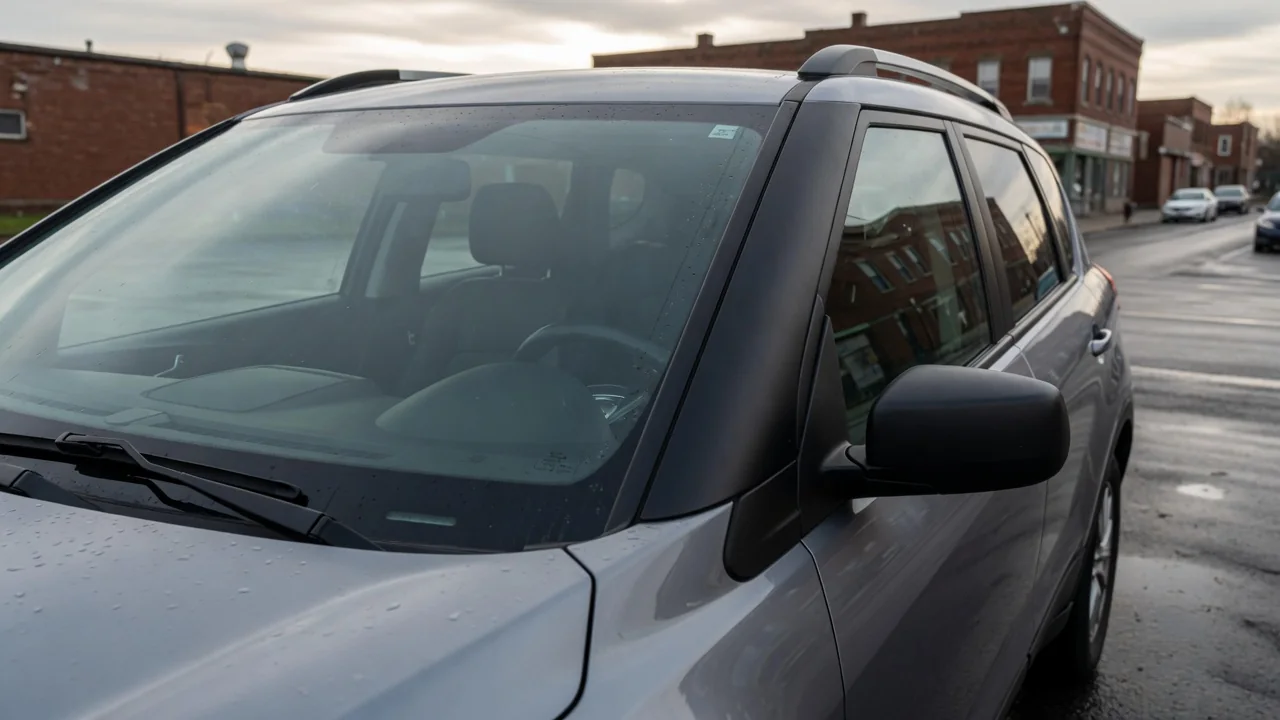
If you have ever leaned around the corner post of a windshield to spot a pedestrian, you have run into the A-pillar's tradeoff. These pillars frame the windshield and tie the roof to the body, and on many modern cars they look bulkier than on older designs. Car A-pillars are rarely thick because of styling alone. The size usually reflects a balance of crash structure, interior packaging, aerodynamics and mirror mounting. Understanding these car A-pillar design tradeoffs helps explain why forward visibility sometimes suffers.
Structure: What the Pillar Has to Carry
The A-pillar is part of the passenger compartment's safety cage. In a rollover, it helps keep the roof from collapsing toward the occupants. In a frontal crash, especially one in which only a corner of the car strikes an object, it is one of the paths that carries loads from the front structure up and over the cabin. A pillar that bends or folds lets the windshield frame intrude into the space around the driver's head and upper body. Stricter roof-strength requirements and more demanding crash-test protocols introduced over the past few decades have pushed engineers to make this region stiffer, and a stiffer section often means a larger cross-section.
Material choice helps, but only up to a point. Many current bodies use high-strength or press-hardened steels in the pillars and roof rails, which deliver a given strength with a thinner wall. Even so, a structural member's resistance to bending depends heavily on the overall depth and width of its section, not only on the metal itself. The bonded windshield also contributes to body stiffness, so the pillar has to provide a solid, continuous flange for the glass to attach to.
Packaging adds bulk on top of the steel. The interior trim may cover side curtain airbag components that run along the roof rail, wiring for mirrors, speakers or sensors, door seals, and sometimes a grab handle or tweeter. A steeply raked windshield, common for aerodynamic and styling reasons, makes the pillar longer and lays it more horizontally across the driver's line of sight. As a result, even a similar cross-section can appear wider from the driver's seat.
Visibility: How a Pillar Creates a Blind Zone
From the driver's seat, an A-pillar blocks a wedge-shaped zone that grows wider with distance. The closer the pillar is to the driver's eyes and the wider it is, the larger the angle it hides. Farther down the road, that angle can be large enough to conceal a pedestrian, a cyclist, or even another vehicle. Because each eye views the scene from a slightly different position, a narrow pillar can sometimes be partly seen around with binocular vision, while a wider one may block the view from both eyes at once and leave a genuine gap.
The problem tends to appear in specific situations: turning at intersections, entering roundabouts, and driving on winding roads where the next stretch lies at an angle to the car. A pedestrian or cyclist moving in a way that keeps them at a constant angle relative to the turning car can stay hidden behind the pillar for a surprisingly long time. The driver-side pillar is usually the more critical one because it sits closer to the driver's eyes, though the passenger-side pillar can also hide traffic during turns toward that side.
Seating position changes the picture as well. A taller or shorter driver, or one who sits closer to the steering wheel, sees the pillar from a different angle, so two people in the same car can experience noticeably different visibility.
Mirror Placement: Where the Pillar Meets the Door
The side mirrors sit right beside the base of the A-pillar, and their placement can either enlarge or soften the blocked zone. On many vehicles the mirror is mounted on a triangular panel at the front corner of the door window, often called the sail panel. That puts the mirror housing directly next to the pillar, so from the driver's seat the two can merge into one larger obstruction toward the front corner of the view.
Other designs mount the mirror on the door skin itself, slightly lower and farther back, leaving a strip of glass between the pillar and the mirror. That gap can open a view toward the front corner that would otherwise be hidden. Small fixed quarter windows ahead of the front door work in a similar spirit, although the frame divider beside them can add its own narrow obstruction. Mirror position is also constrained by wind noise, aerodynamics, the required rearward field of view and door construction, so designers cannot place it freely. Inside the cabin, the rear-view mirror and any windshield-mounted camera or sensor housing occupy space near the top center of the glass, adding to forward clutter even though they are not part of the pillar.
Practical Implications and Limits
For drivers, the most useful response is behavioral. Before and during a turn, moving your head forward or sideways a few inches lets you look around the pillar rather than relying on a single fixed viewpoint. Slowing down at intersections and crosswalks gives a hidden road user more time to come into view. Adjusting seat height and fore-aft position so you can see past the pillar comfortably, while still reaching the controls safely, can also reduce how much it hides. When shopping for a vehicle, checking the view at a real intersection during a test drive tells you more than any general rule, because pillar shape, seat geometry and mirror mounting vary widely.
There are limits to what an owner can or should do. The pillar structure, and any airbag hardware behind its trim, should never be cut, thinned or otherwise modified, and removing the trim panel can be hazardous where an airbag is packaged; the vehicle's service information is the right guide for any work in that area. Driver-assistance features such as cameras or pedestrian detection may help in some situations, but they have their own coverage gaps and do not replace looking. Finally, a thick pillar does not by itself prove a car is safer, and a slim one does not prove it is weaker. Crash performance depends on the entire body structure, so judging a particular vehicle requires its own crash-test results rather than pillar width alone.