F-150 EcoBoost Oil Leak: Likely Sources and How to Narrow Them Down
The short answer
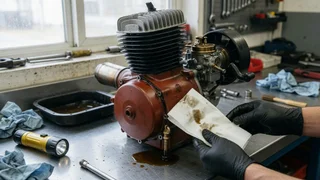
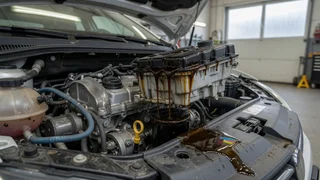
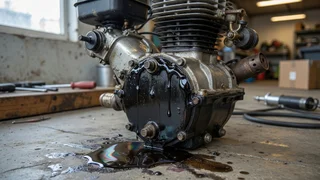
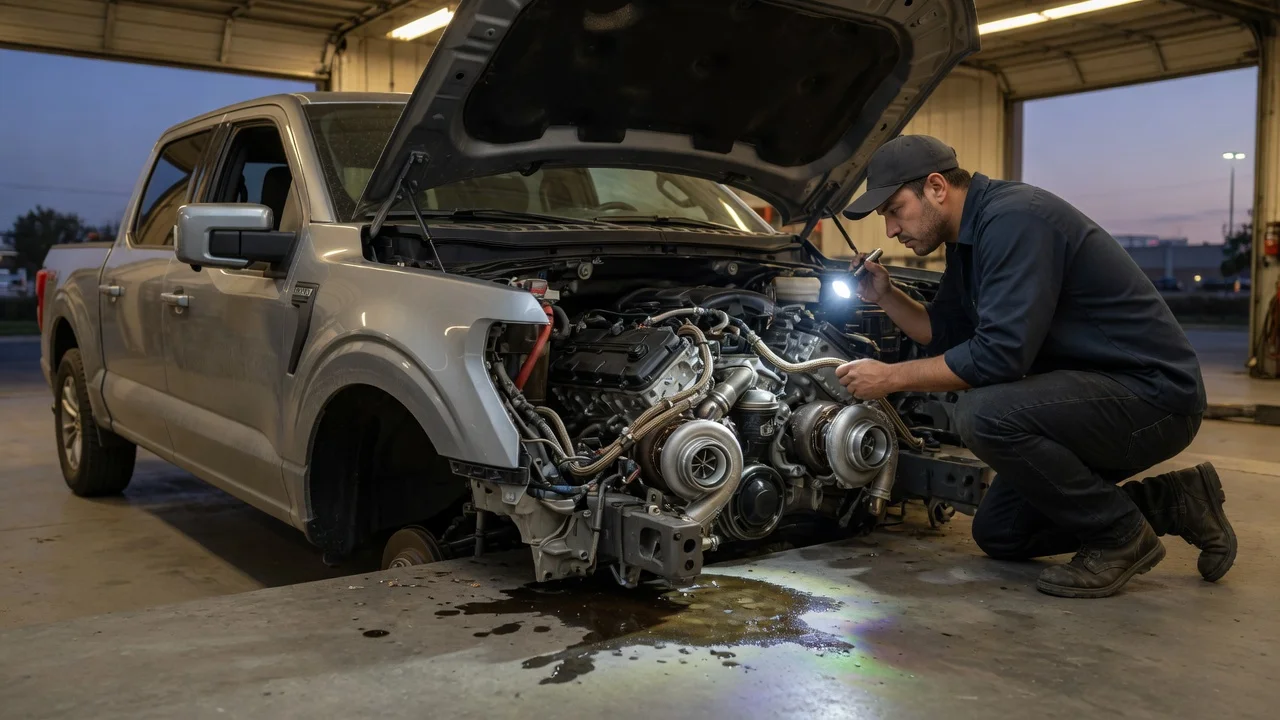
An oil leak on an F-150 with an EcoBoost engine usually comes from a gasket or seal around the engine, not from the turbochargers themselves. Owners and repair shops most often report leaks at the oil pan, the front timing cover, the valve cover gaskets, the rear main seal, the oil filter housing area and the oil lines that feed and drain the turbochargers. Which of these is most likely depends on which EcoBoost engine is in the truck and its model year, so the location of the wet area and the drip matters more than any general list.
No technical evidence, service bulletins or measured failure rates were supplied for this guide. The leak points described here reflect commonly reported patterns rather than verified data for a specific truck. Confirm the source by inspection, and check with a Ford dealer for any service bulletin or recall that applies to your vehicle identification number (VIN).
Why the engine and model year matter
EcoBoost is Ford's name for a family of turbocharged, direct-injection gasoline engines, not a single engine. In the F-150 it has included the 3.5-liter V6, offered since the 2011 model year, and the 2.7-liter V6, introduced for 2015. The 3.5-liter hybrid version, sold as PowerBoost, appeared from the 2021 model year. These engines also changed between generations, so a leak point that is common on one version may be rare or redesigned on another.
One frequently cited example is the oil pan on earlier 2.7-liter engines. That oil pan uses composite (plastic) construction in part, and leaks at its sealing surface are widely reported. Whether this applies to your truck, and whether Ford has issued a revised part or procedure for it, should be confirmed for your specific model year. Those details were not supplied here.
Matching the leak location to the likely source
Where the oil collects is the most useful clue. Oil runs downward and is blown rearward by airflow while driving, so the lowest wet spot is often not the source. Look for the highest point where fresh, wet oil appears.
Where oil appears | Commonly suspected sources | Notes; Bottom of the engine, around the pan edge or drain plug | Oil pan gasket or sealant, drain plug or its washer | A drain plug that drips after a recent oil change points to the plug or washer first. Front of the engine, behind the accessory belt area | Front timing cover seal or sealant, front crankshaft seal | Usually more labor-intensive to repair because of what must be removed for access. Top edges of the cylinder heads | Valve cover gaskets | Oil may run down the sides of the block and look like a lower leak. Where the engine meets the transmission | Rear main seal, oil pan rear section | Hard to confirm without inspection, because oil from higher leaks can collect here. Near the oil filter | Oil filter housing or adapter seals, a loose or double-gasketed filter | Check the filter first, since it is the simplest cause to rule out. Around the turbochargers or their lines | Turbocharger oil feed or return line seals or fittings | Oil near hot exhaust parts can cause a burning smell or light smoke.
Leak, consumption or normal residue?
Not every case of low oil or oily parts is an external leak. Separating these three situations changes what you should do next.
External leak: drips under the truck, or wet oil on the outside of the engine, usually with dirt collecting on the wet surfaces. Oil consumption: the oil level drops but the engine stays dry outside. Oil may be burning inside the engine or being drawn into the intake, which is a different diagnosis from a leak. Oily residue in the intake tract: turbocharged engines route crankcase vapors back into the intake through the positive crankcase ventilation (PCV) system. A light oily film inside intake hoses or the charge air cooler (CAC, the intercooler that cools air after the turbochargers) can come from these vapors. It is not necessarily a leaking seal, although heavy pooling deserves inspection.
What to do next
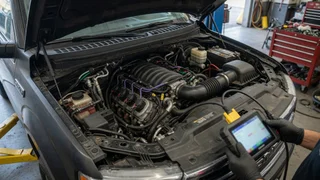
Check the oil level on the dipstick and top up with the oil type and viscosity listed in your owner's manual before driving further. Note where drips land under the truck when it is parked. Cardboard placed under the engine overnight helps you see where the drips fall and what color they are, which also separates engine oil from other fluids. Inspect the oil filter and drain plug first, especially if the leak began after an oil change. If the source is unclear, have the engine cleaned and inspected. Shops often add an ultraviolet dye to the oil and trace it with a lamp to find the exact source. Ask a Ford dealer to check your VIN for open recalls, service bulletins or warranty coverage before paying for repairs, because coverage depends on the truck's age, mileage and history. Treat oil dripping onto exhaust or turbocharger parts, a burning smell, smoke or a low-oil-pressure warning as urgent, and avoid driving until the cause is found.
What this guide cannot confirm
Without supplied documentation, this guide cannot give torque specifications, part numbers, repair costs, labor times or confirmed service bulletin and recall details. It also cannot state which model years of each engine are most affected. Treat the leak points above as starting points for inspection, and rely on a physical inspection and Ford's VIN-specific records for a definitive answer.