Exhaust Muffler Replacement: Fitment and Service Options
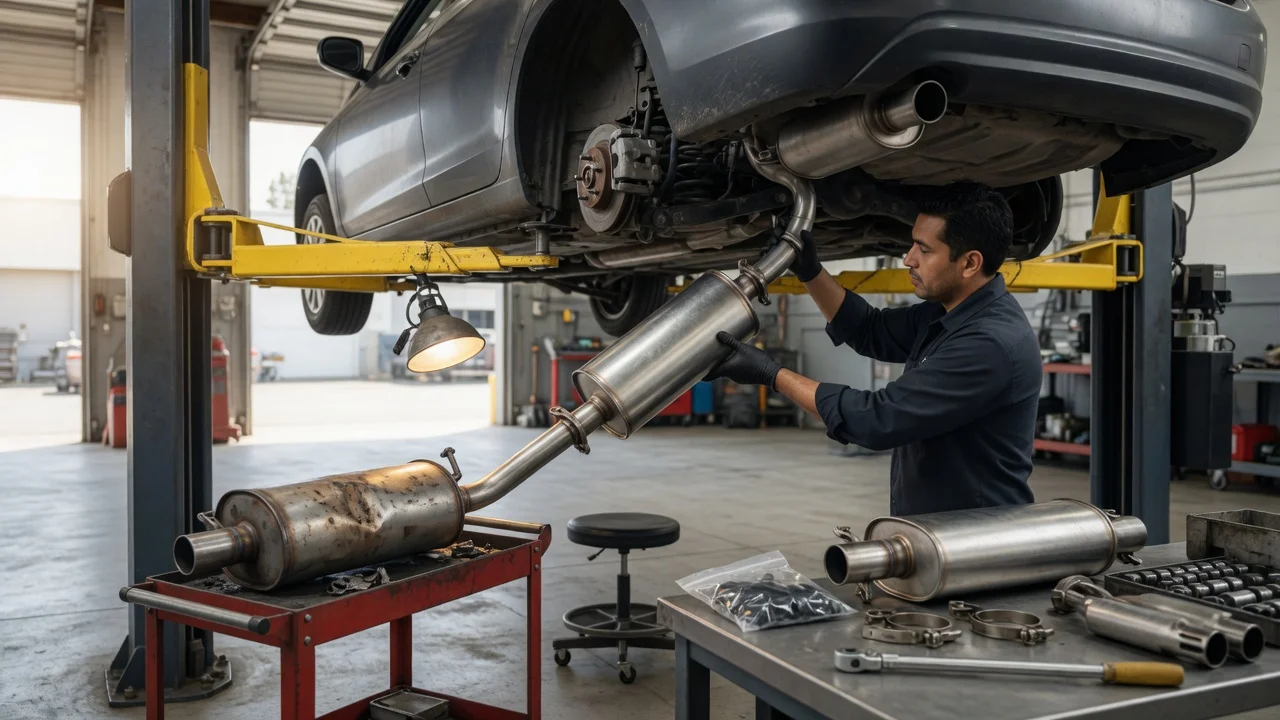
What an exhaust muffler replacement actually involves
An exhaust muffler replacement removes a worn or damaged muffler and installs a compatible replacement in the exhaust system. The muffler is the large canister located toward the rear of many vehicles, but replacement scope varies by model. Some vehicles use a single rear muffler, others have a central resonator plus a rear muffler, and performance-oriented or aftermarket systems may combine several sections. Because model years, powertrains, and trim levels can change pipe diameter, hanger placement, inlet and outlet configuration, and overall length, replacement fitment must be confirmed against the specific vehicle configuration rather than assumed from the body style alone.
The direct answer is that replacement is possible for most vehicles, but the correct part category depends on the existing system. In some cases, the original equipment muffler is available only as part of a larger intermediate pipe or rear silencer assembly. On other vehicles, the rear muffler can be replaced independently. A rusted flange, damaged isolator, or degraded connecting pipe may also require replacement at the same time, which changes the parts list from a simple muffler swap to a broader exhaust repair.
Signs that the muffler may need replacement
The muffler fails through internal baffle degradation or external corrosion, and the symptoms are different. Internal failure often produces a louder or more metallic exhaust note, especially under acceleration, while the outer shell may still look intact. External corrosion typically appears first at the seams, inlet and outlet necks, hanger brackets, or the lower section where moisture collects. A visible hole, separated seam, missing hanger, or sooty leak point indicates that the muffler can no longer be repaired by patching and should be replaced.
Not every exhaust sound means the muffler has failed. A leak before the muffler, such as at a flex joint, flange gasket, or catalytic converter connection, can produce similar noise. Confirming the leak location before ordering a replacement avoids replacing a functional rear muffler while leaving the actual leak in place.
Choosing between direct-fit and universal mufflers
Two broad replacement categories exist: direct-fit mufflers and universal mufflers. A direct-fit or vehicle-specific replacement is built to match the original routing, pipe diameter, inlet and outlet style, hanger positions, and overall length. It is the most predictable option for a normal repair because installation should not require cutting, expanding, or repositioning the exhaust. The tradeoff is that direct-fit coverage is stronger for high-volume vehicles; less common configurations may only be served by a complete muffler assembly or an aftermarket system.
A universal muffler is chosen when the goal is sound tuning, a lower purchase price, or fitment where no direct replacement is listed. It has generic inlet and outlet sizing but no vehicle-specific hanger or pipe profile. Installation may require cutting the old pipe, adapting diameter, welding or clamping joints, and fabricating or relocating hangers. Universal fitment is preferable when the installer can modify the system correctly and the owner accepts the change in noise character and clearance risk. Direct fit is preferable for a straightforward repair, predictable clearance, and preserved sound level.
Fitment details to check before buying
Replacement fitment is not complete with the year, make, and model alone when multiple powertrains or trims share a platform. The important checks are inlet diameter, outlet diameter or tip configuration, body length and width, overall length, hanger rod count and location, and connector type. A rear muffler may use a slip fit, a flanged connection, or a clamped joint. The replacement must match the existing connection or include the needed gasket and hardware.
Vehicle configuration affects more than body shape. A V-6 and a four-cylinder version of the same model may use different exhaust routing, and all-wheel drive, a long wheelbase, or a tow package can change the space available around the rear axle. Using a catalog filter that includes submodel, engine, and drive type reduces the chance of receiving a muffler that is dimensionally similar but does not clear the suspension or align with the original hangers.
Comparing service options
Replacement is completed through a general repair shop, a dedicated muffler or exhaust shop, a dealer service department, or as a do-it-yourself job. A general shop is a practical choice when the muffler is a direct-fit replacement and no custom work is required. A dedicated exhaust shop offers a clear advantage for universal fitment, rusted hardware, or a system that needs cutting, welding, and hanger adjustment, because the staff and tooling are oriented around that work. A dealer is most useful when warranty coverage, an exact original-equipment replacement, or model-specific repair guidance is the priority.
Do-it-yourself replacement is generally realistic when the muffler is a bolt-on or clamp-on direct-fit part, the fasteners are not heavily corroded, and safe lifting support is available. If the joint requires welding, the pipe must be cut to adapt a universal part, or the original hardware is likely to break, a shop with the correct equipment is the better fit because a partial disassembly can leave the vehicle undrivable. The best option depends on whether the priority is lowest parts-only cost, shortest downtime, preservation of the original sound and routing, or the ability to repair additional corrosion discovered during the job.
What to expect during replacement
The process begins by supporting the exhaust and unfastening the connection ahead of the muffler. The rear section is then separated from its rubber isolators and removed. The replacement is hung in the original position, the connection is aligned, and the clamp, gasket, or weld is completed. After installation, the system should be checked for contact with the floor, suspension, bumper, or heat shields and tested for leaks at idle and under load.
Replacement hardware is part of the value of the job. Rubber hangers lose flexibility and can crack, and reusing a worn isolator can place the new muffler under tension or transmit more vibration. Exhaust clamps and flange gaskets are also single-use or corrosion-sensitive items. Replacing them during the same service reduces the chance of a follow-up rattle or leak at the connection.
Material and sound considerations
The replacement shell and internal construction affect service life and sound. Aluminized steel is common for original-equipment and replacement mufflers, while stainless steel is more corrosion resistant and is often used in higher-grade or performance systems. Stainless construction does not by itself guarantee that the complete muffler is louder or quieter; the internal baffle or packing design determines sound level and tone. A replacement described as sport or performance is likely to be louder than a standard replacement despite having the same pipe connections.
Because sound is subjective and depends on engine, pipe diameter, and adjoining resonators, a posted product description is only a rough guide. The most predictable way to preserve original sound is a direct original-equipment or equivalent replacement. A universal performance muffler should be chosen only when a deliberate sound or appearance change is acceptable.
Cost and service-life factors
The installed cost is driven by the replacement part, connection and hanging hardware, and the labor required to remove corroded fasteners and fit the part. A direct bolt-on replacement has the lowest expected labor. A universal muffler can have a lower component price but may cost more to install because of cutting, fitting, and welding. If the work also includes an intermediate pipe, rear silencer assembly, clamps, gaskets, and hangers, the final total should be compared as a complete service rather than by muffler price alone.
Service life varies too much for a universal mileage claim. Cold starts, short trips, road salt, and high humidity promote condensation inside the exhaust and external corrosion, while heat cycling and vibration stress the seams and hangers. A replacement in a mild climate with longer drives will generally last longer than the same part exposed to frequent wet short trips in a salt-belt region.
Deciding when replacement should not wait
A failed muffler is not only a noise issue. A separated rear section can drop onto the road, and a leak near the cabin or fuel tank area can expose occupants to exhaust gas. A muffler that is hanging, dragging, or visibly separated should be addressed before continued driving. A small perforation may be a cosmetic noise problem initially, but corrosion that has opened the shell is usually widespread enough that replacement is the durable repair rather than repeated patching.
There is no documented universal interval for muffler replacement. The appropriate trigger is inspection evidence of structural failure or a confirmed internal baffle failure, combined with a replacement that matches the vehicle configuration. Owners who confirm the leak location, select the correct fitment category, and match the service option to the required installation work can avoid both an unnecessary system replacement and a short-lived repair.