Exhaust Muffler Replacement: Fitment and Service Options
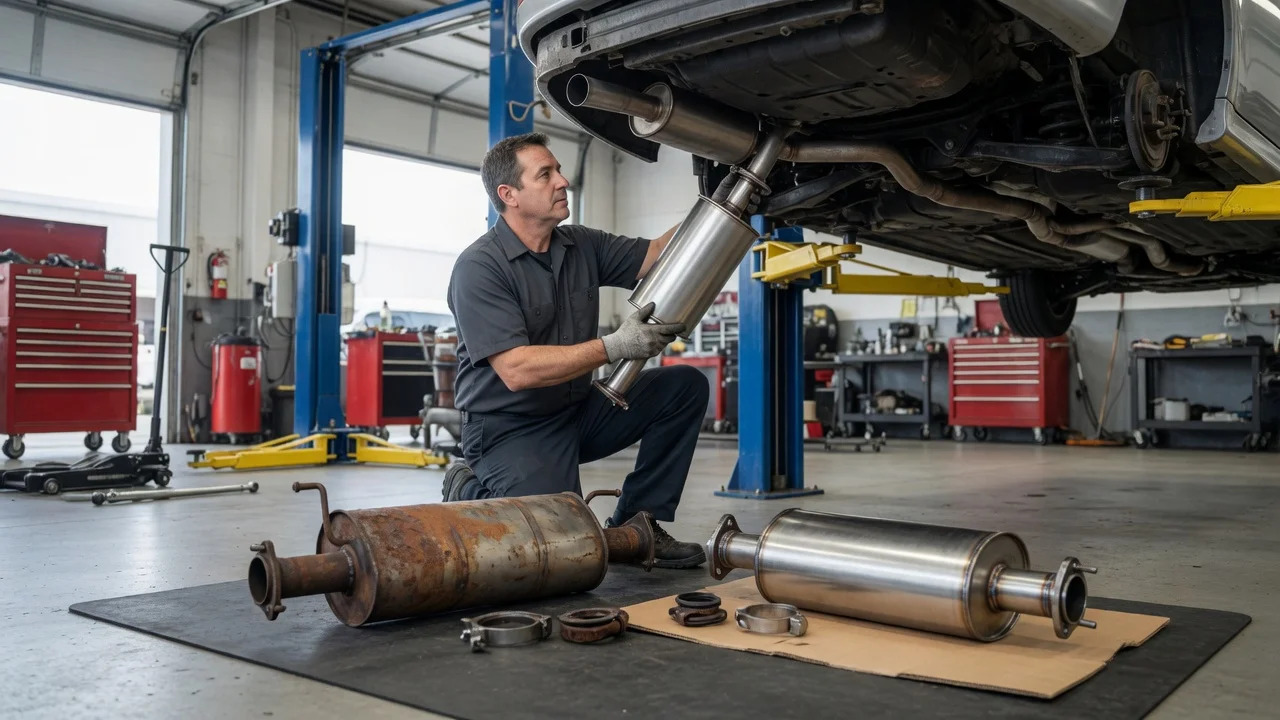
What an exhaust muffler replacement involves
An exhaust muffler replacement removes the worn or damaged underbody silencer and installs a replacement that matches the vehicle's exhaust diameter, hanger locations, inlet and outlet positions, and overall case length. The muffler controls exhaust noise, but it is also part of a system that routes hot gases, supports exhaust weight, and manages clearance to the body, fuel tank, suspension, and heat shields.
A replacement is not universal. Fitment depends on the model year, generation, engine, drivetrain, body style, and sometimes trim or towing package. A part listed for the same model may still differ in pipe diameter, flange type, number of inlets and outlets, hanger rod position, or tip style. The essential first step is confirming that the candidate part matches the specific vehicle configuration rather than assuming all examples of a model use one muffler.
Replacement options
Direct-fit mufflers are formed to replicate the original pipe routing and bracket locations for a stated vehicle range. They generally require the least modification and are preferable when the owner wants predictable fitment and a standard sound level.
Universal mufflers are built around case size, inlet and outlet diameter, and offset configuration rather than a specific application. A shop can adapt them by cutting, expanding, welding, or clamping the surrounding pipe and adding or relocating hangers. This option can suit custom systems, older vehicles with limited catalog coverage, or owners who want a different sound character, but it depends heavily on fabrication quality and accurate measurement.
Complete rear sections or cat-back systems replace the muffler together with adjacent pipe, resonator, or tip components. They are useful when corrosion has affected more than the muffler shell or when the original system has already been modified. Choosing a complete assembly can reduce the number of reusable rusted joints, but it usually costs more than replacing only the muffler.
Key fitment checks
Inlet and outlet count and diameter, measured on the pipe that will connect to the muffler; Offset and center configurations, because the same case size may not align with the existing pipe path; Case length and body width, which affect clearance around the rear axle, bumper, and spare tire area; Hanger rod orientation and count, since missing or repositioned hangers can cause vibration and early joint failure; Flange style and gasket condition at any bolted connection; Material and coating, such as aluminized steel or stainless steel, which affect corrosion resistance rather than fitment
Service choices: shop replacement versus home installation
A shop replacement is preferable when the original joints are heavily corroded, when cutting or welding is required, or when the vehicle needs the work completed with a warranty on labor as well as parts. Exhaust work can expose a technician to hot components, sharp edges, and undercarriage clearance problems, and a lift makes access materially safer and faster.
Doing the work at home can be practical for a direct-fit bolt-in muffler on a vehicle with enough ground clearance and sound jack-stand placement. The main needs are accurate identification of the replacement part, a safe cutting method only when required, new hangers or gaskets as applicable, and a test for leaks after assembly. A driveway replacement is not a controlled comparison of sound or fitment; it is a judgment based on access, tooling, rust condition, and local disposal rules for the old assembly.
What affects cost and lifespan
Price differences come from the vehicle application, whether the part is direct-fit or universal, the use of aluminized or stainless construction, and whether surrounding pipes, clamps, gaskets, or hangers are replaced at the same time. Labor can vary with the number of rusted joints, the need for cutting or welding, and whether the work is done on a lift or on the ground.
A good replacement should restore a secure, leak-free exhaust path and an appropriate noise level. The repair is likely to last longer when the mating surfaces are clean, hangers are not overstretched, the new joint is sealed correctly, and the chosen material suits the local climate and driving conditions. A muffler that fits mechanically but hangs under tension or touches a heat shield can fail through vibration even when the shell itself is new.
Known gaps in this guide
This article does not supply model-specific part numbers, current regional prices, labor times, or sound-level measurements. Exact compression, decibel, or durability comparisons are not provided because comparable test data was not part of the source material. Fitment should always be confirmed against the vehicle identifier and the exhaust configuration on the car itself before ordering or cutting any component.