Ethanol-free vs ethanol gasoline: which should you use?
The short answer
For most modern cars and light trucks in the US, ordinary ethanol-blended gasoline is the right choice, as long as it meets the octane rating in your owner's manual. These vehicles are designed and certified to run on the standard E10 blend, which contains up to 10 percent ethanol. Ethanol-free gasoline is mainly worth paying for in small engines, boats, some classic or vintage vehicles, and any equipment whose fuel will sit unused for long periods. The qualification is simple: whichever fuel you choose, match the octane your engine requires. Choosing ethanol-free fuel does not by itself give you higher octane or better protection.
What the terms mean
Ethanol is an alcohol, usually made from corn in the US, that is blended into gasoline. The label E10 means the fuel contains up to 10 percent ethanol, and it is the most common blend at US pumps. E15 contains up to 15 percent ethanol, and E85 is a high-ethanol fuel intended only for flex-fuel vehicles. Ethanol-free gasoline, sometimes called E0, pure gas or recreational fuel, contains no added ethanol.
Octane rating measures a fuel's resistance to knock, which is uncontrolled ignition of the fuel-air mixture that can damage an engine. US pumps display the anti-knock index, the number shown on the yellow pump label. A higher number means more knock resistance, not more energy or more power on its own.
How ethanol affects octane
Ethanol has a high octane value, so blending it into gasoline raises the octane of the finished fuel. This is one reason refiners use it. An ethanol-free fuel has to reach its octane rating without that help. As a result, ethanol-free gasoline at a given station may be sold at a different octane grade than the ethanol blends next to it.
Do not assume ethanol-free fuel is a premium fuel, and do not assume it is a lower grade. Read the octane number on the pump. If your vehicle requires premium and the only ethanol-free option is a lower grade, the ethanol-blended premium is the safer choice for that engine. If your vehicle specifies regular, buying a higher octane than required does not usually add benefit.
Ethanol-free vs ethanol gas compared
Factor | Ethanol-blended (E10) | Ethanol-free (E0); Compatibility with modern cars | Designed for it | Also compatible; Octane source | Ethanol helps raise octane | Achieved without ethanol; check the pump grade; Energy per gallon | Somewhat lower, because ethanol carries less energy than gasoline | Somewhat higher; Storage stability | Can absorb moisture and separate over long storage | Better suited to long storage; Rubber, plastic and older fuel parts | Can harm some older or non-rated materials | Gentler on older components; Availability | Sold at most stations | Limited to select stations and marinas; Price | Usually the cheaper option | Usually costs more
When ethanol-free gas makes sense
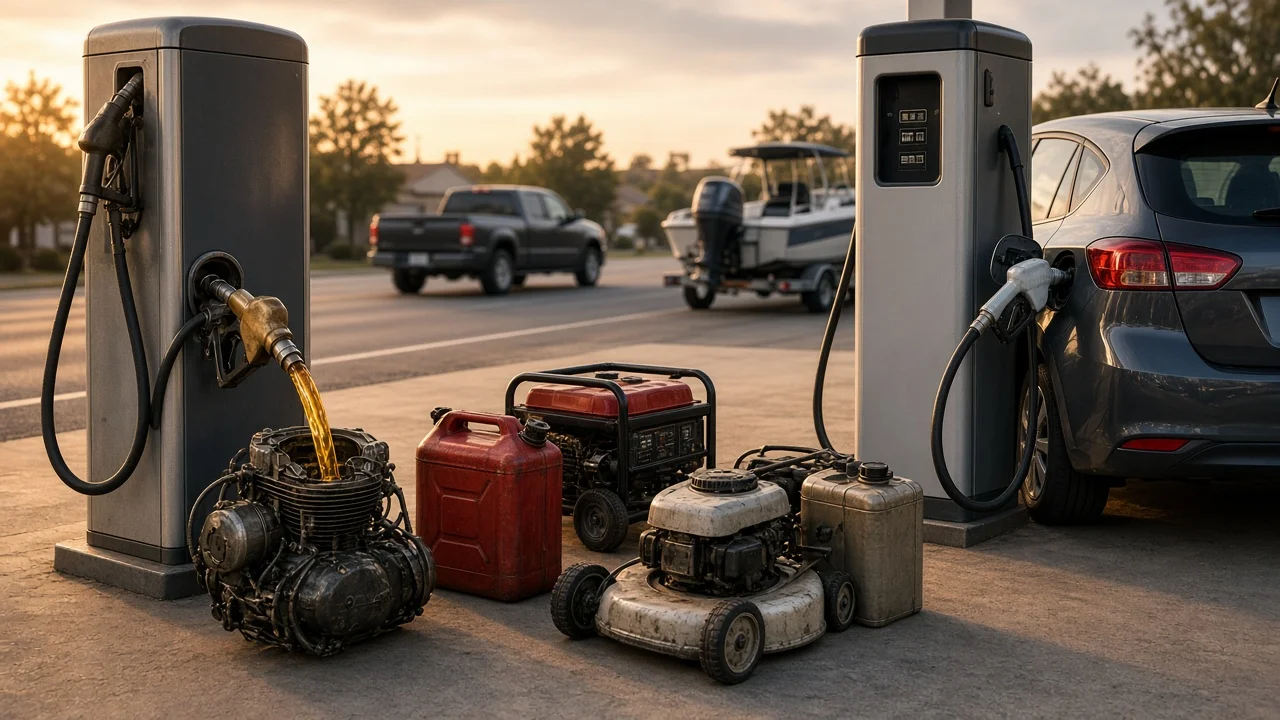
Small engines such as lawn mowers, string trimmers, chainsaws, generators and snow blowers, especially if they sit unused between seasons. Marine engines and boats, where moisture exposure is high and some older fiberglass fuel tanks and fuel lines may not tolerate ethanol. Classic and vintage vehicles built before ethanol blends were common, whose original fuel system materials may degrade with ethanol. Motorcycles, ATVs and other equipment stored for months at a time. Any engine whose manufacturer specifically recommends or requires ethanol-free fuel.
The common thread is storage and materials. Ethanol attracts water. Over long storage, enough absorbed moisture can cause phase separation, where a layer of water and ethanol settles at the bottom of the tank. An engine that draws this layer can run poorly or fail to run. Fuel that is used within a few weeks, as in a daily-driven car, rarely sits long enough for this to matter.
When ethanol-blended gas is the better choice
If you drive a modern car regularly, E10 at the correct octane is the practical default. It is widely available, usually less expensive, and is the fuel the vehicle was engineered and certified around. Flex-fuel vehicles can use higher blends such as E85, but only if the vehicle is specifically rated for them; check the owner's manual, the fuel door or the gas cap.
E15 has been approved by the EPA for cars and light-duty trucks from model year 2001 and newer. It is not approved for motorcycles, boats, small engines or older vehicles. If you are unsure whether your vehicle can use E15, stick with E10 or check your owner's manual.
Is ethanol in gas good or bad?
It depends on the engine and how the fuel is used. In modern vehicles, ethanol is not harmful at approved blend levels, and it contributes octane. Its drawbacks are slightly lower energy content, which can mean modestly lower fuel economy, and its tendency to absorb moisture, which matters mostly for stored fuel and older or marine fuel systems. Calling ethanol simply good or bad is misleading; it is a trade-off that matters far more for a boat or a seasonal mower than for a commuter car.
What the available information cannot tell you
This guide does not give specific price differences, exact fuel economy changes or station availability, because those vary by region, station and time, and no confirmed figures were available. The mileage difference you see in your own vehicle will depend on the engine, driving conditions and the exact blend. For precise local prices and whether ethanol-free fuel is sold near you, check the pump labels at stations in your area.
How to decide
Check the owner's manual for the required octane and any ethanol limits or recommendations. For a modern, regularly driven car, use ethanol-blended gasoline at the specified octane. For small engines, boats, classic vehicles or anything stored for months, choose ethanol-free fuel if it is available at the octane the engine needs. If ethanol-free fuel is not available for stored equipment, consider a fuel stabilizer and avoid leaving fuel in the tank longer than necessary, following the equipment maker's storage guidance. Always read the octane number on the pump rather than assuming a grade based on whether the fuel contains ethanol.