Differential Oil vs Transmission Oil: What Is the Difference and Can You Swap Them?
The short answer
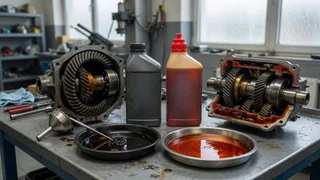
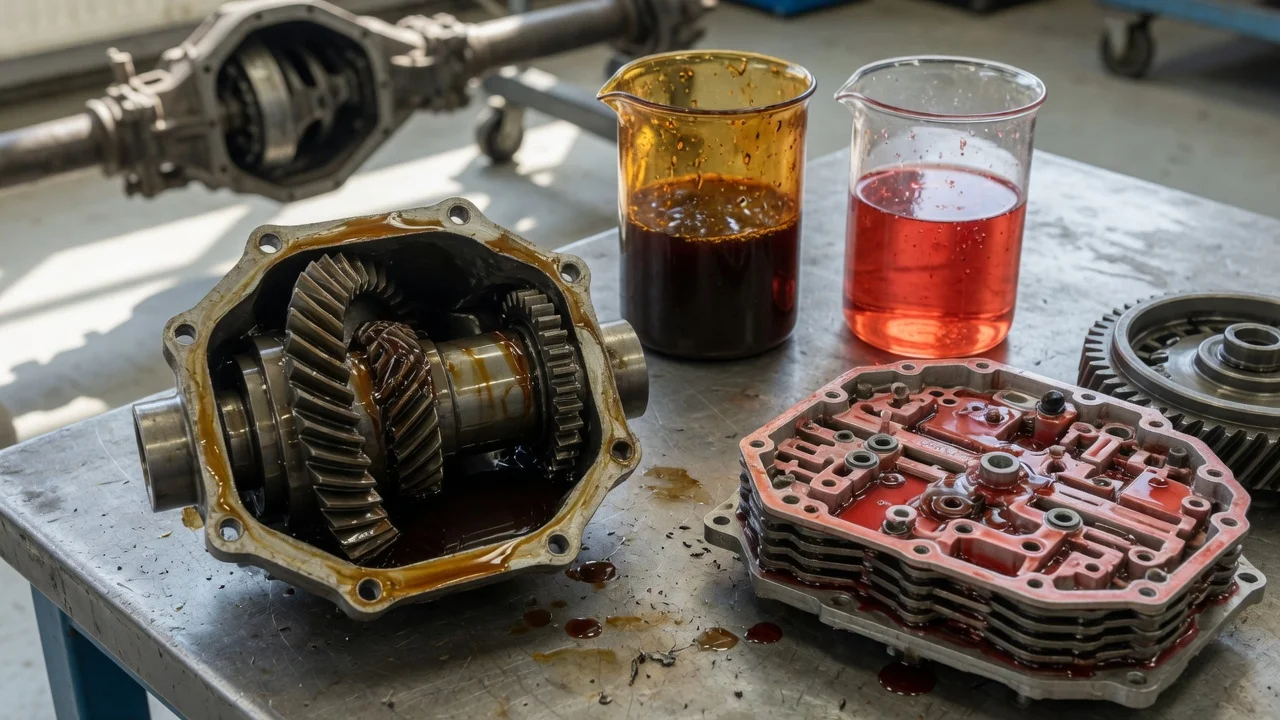
Differential oil and transmission oil are not interchangeable as a general rule. Differential oil is a gear oil formulated to protect heavily loaded gears, especially the hypoid gears found in most rear and four-wheel-drive axles, using a high level of extreme-pressure additives. Transmission oil is a broad label that covers several different fluids: manual gearbox oils, automatic transmission fluid (ATF), CVT fluid and dual-clutch fluid. Each is tuned for the friction, shifting and hydraulic needs of a specific type of transmission.
The important qualification is that some vehicles do use the same fluid in both places. Many front-wheel-drive cars have a transaxle, where the gearbox and differential share one housing and one oil supply. Some manual gearboxes are also specified to use a gear oil similar to what an axle uses. Whether the two fluids can be the same in your vehicle depends entirely on the manufacturer's specification for that model, powertrain and market, so the owner's manual or service information is the deciding source.
What each fluid is designed to do
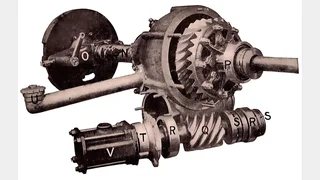
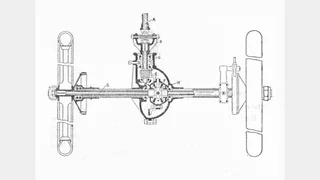
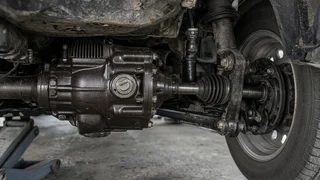
A differential splits engine torque between the left and right wheels and lets them turn at different speeds in corners. In most rear-drive axles it uses hypoid gears, where the pinion meets the ring gear offset from its centre. That geometry creates a lot of sliding contact under high pressure, which can break down an ordinary oil film. Differential oil counters this with extreme-pressure (EP) additives, typically sulfur and phosphorus compounds, that form a protective layer on the gear teeth when contact gets severe.
A manual transmission also contains gears, but it relies on synchronizers, small friction rings that match gear speeds before engagement so shifts are smooth. Its oil needs enough gear protection while still allowing those synchronizers to grip correctly. In some gearboxes the synchronizers are made of brass or other copper-based alloys, often called yellow metals, which certain high-EP formulations may affect.
An automatic transmission is a different machine altogether. ATF acts as a hydraulic fluid that operates clutches and bands, transmits power through the torque converter, cools the unit and controls friction during shifts. CVT and dual-clutch transmissions have their own dedicated fluids with friction properties specific to their belts, chains or clutches. These fluids are generally much thinner than axle gear oil and have completely different additive packages.
Differences that matter when choosing
Criterion | Differential oil | Manual transmission oil | Automatic transmission fluid (ATF, CVT, DCT); Main job | Protect highly loaded hypoid gears from wear and scuffing | Protect gears while allowing synchronizers to engage smoothly | Operate hydraulics, control clutch friction, cool and lubricate; Typical service classification | Commonly API GL-5 | Commonly API GL-4, or a manufacturer-specific manual transmission fluid | Manufacturer-specific specifications rather than an API gear oil rating; Extreme-pressure additive level | High | Moderate in GL-4 oils | Not formulated as an EP gear oil; Friction requirements | Limited-slip units with clutch packs may need a friction modifier | Must suit synchronizer materials and shift feel | Precise friction behaviour is critical to shift quality and durability; Relative thickness | Usually a heavier gear oil grade | Varies widely by design; some specify gear oil, some ATF, some other fluids | Usually thin; Shared with the other component? | Shared in many transaxles; separate in most rear-drive axles | Shared with the differential in many manual transaxles | Shared in some automatic transaxles; others have a separate differential compartment
Additive chemistry and service ratings
The API GL ratings describe how much load-carrying protection a gear oil is meant to provide. GL-5 is the common rating for hypoid differentials because of their severe sliding loads. GL-4 carries a lower level of EP additives and is often specified for manual gearboxes. Putting a GL-5 oil into a gearbox that calls for GL-4 is a known concern in transmissions with yellow-metal synchronizers, while putting a GL-4 oil into a hypoid differential that calls for GL-5 risks inadequate gear protection. Some oils are marketed as meeting both ratings; use one only if the vehicle manufacturer's specification allows it.
Friction behaviour
Friction is where the fluids diverge most. A limited-slip differential that uses clutch packs may need a friction modifier, either already blended into the oil or added separately, to prevent chatter in turns. Automatic transmissions depend on ATF with a specific friction profile so clutches engage at the right rate. Using the wrong fluid in either case can cause noise, harsh or slipping engagement and accelerated wear.
Viscosity grades are not directly comparable
Gear oils are graded on a different SAE scale from engine oils, so the numbers on a gear oil label cannot be compared directly with engine oil numbers. A gear oil marked 75W-90 is not necessarily far thicker than an engine oil with a lower-looking number, because the two scales measure against different ranges. ATF usually has no SAE grade at all and is identified by the manufacturer specification it meets. When comparing fluids, compare them against the specification your vehicle requires rather than against each other's label numbers.
Which fluid should you use?
Rear-drive axle or four-wheel-drive axle with a separate housing: use the gear oil and service rating the manufacturer specifies, commonly a GL-5 gear oil, and add or select a friction modifier if it is a clutch-type limited-slip unit that requires one. Manual transmission: use the exact fluid listed for that gearbox. Depending on the vehicle this may be a GL-4 gear oil, a dedicated manual transmission fluid, ATF or another specified fluid. Automatic, CVT or dual-clutch transmission: use only fluid that meets the manufacturer's named specification. Do not substitute differential gear oil. Front-wheel-drive transaxle: check whether the differential shares fluid with the transmission. If it does, use the single specified transmission fluid. If it has a separate differential compartment, that compartment may need its own fluid. All-wheel-drive vehicles: transfer cases, power take-off units and rear differentials may each specify different fluids, so check each component individually.
If the specification is unclear, or the vehicle has been modified or imported from another market, confirm the correct fluid with a dealer parts department or a qualified technician using the vehicle identification number. Fluid requirements can change between model years, generations and powertrain options within the same model name.
What this article cannot tell you
No vehicle-specific specifications, laboratory test results or change-interval data were available for this comparison, so it does not list exact capacities, service intervals or approved product names for any model. It also cannot quantify how much wear or performance difference results from using the wrong fluid, because that depends on the specific gearbox or axle design, the fluids involved and how the vehicle is driven. For those details, the manufacturer's service information for your exact vehicle is the authoritative source.