Diagnose Honda check engine light
A glowing check engine light on a Honda can mean anything from a loose fuel cap to an emissions or engine-control fault that deserves prompt attention. The light is the powertrain control module asking for diagnosis, not a single failure verdict. Reading the stored trouble code, noting the symptom conditions, and checking freeze-frame data usually narrows the cause quickly. A steady light typically allows careful driving to a safe diagnostic stop, while a flashing light signals a misfire condition that may damage the catalytic converter and calls for reduced load and early professional evaluation.
Essential answer
The essential answer is that a Honda check engine light on means the onboard diagnostic system has detected a condition outside expected operating parameters and stored a diagnostic trouble code. The light does not identify one failed part by itself. It is an invitation to retrieve the code and interpret it alongside live data and the driving situation. Common causes range from a loose or missing fuel cap, which may set an evaporative emissions code, to oxygen sensor, ignition coil, catalytic converter, or mass airflow sensor issues. The same warning can appear with no noticeable driveability change or alongside rough running, reduced power, or poor fuel economy.
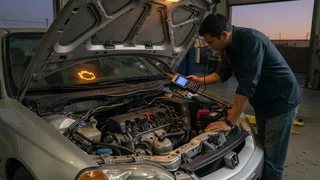
The correct first step is not guessing or replacing parts. A code reader or scan tool can retrieve the stored code, and many auto parts locations offer this service. The code points to a circuit, sensor, or system that the control module observed operating out of range, but a fault code is evidence to interpret rather than proof that the named component has failed. Wiring, connectors, vacuum leaks, contamination, and fuel quality can produce similar readings. Matching the code with freeze-frame data, such as engine temperature, rpm, and fuel trim at the moment the fault recorded, provides a more useful diagnosis than the code alone.
Diagnosing a problem
Diagnosing the problem begins with observing when the light appears and whether the symptom conditions repeat. Note whether the warning comes on at cold start, during acceleration, after refueling, or at steady highway speed. A light that appears shortly after filling the tank often points to an evaporative system leak, commonly a fuel cap that was not tightened until it clicked. A light accompanied by hesitation, rough idle, or a fuel smell suggests a different path, such as an ignition misfire, an intake leak, or a fuel delivery concern. Recording the conditions helps separate intermittent faults from consistent failures.
Use a scan tool to read the trouble code and freeze-frame data, then compare live data with expected behavior. For example, if an oxygen sensor code appears, watch whether the sensor signal is stuck, slow to switch, or biased. If a misfire code is present, inspect the affected cylinder’s ignition and fueling inputs rather than assuming the coil or injector is bad. A flashing check engine light indicates active misfire severe enough to raise exhaust temperatures and potentially damage the catalytic converter, so avoid heavy throttle and prolonged driving until the cause is identified. If the light returns with the same code after a repair, treat the previous fix as incomplete evidence and continue with wiring, vacuum, and confirmation testing before condemning another part.