How to Diagnose a Diesel Check Engine Light
The short answer
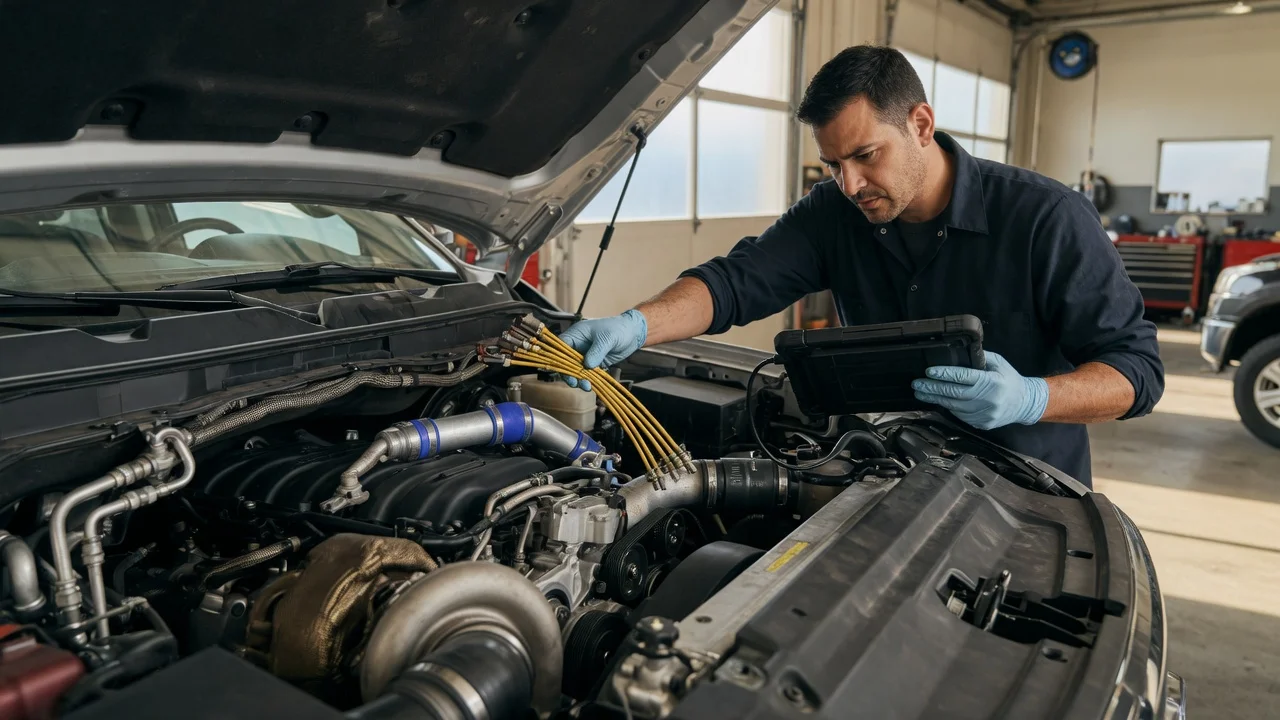
A check engine light on a diesel means the engine control module has detected a fault in an emissions-related or engine-management system and stored a diagnostic trouble code. The light does not identify the problem by itself. To diagnose it, read the stored code with a scan tool, note how the vehicle is behaving, and then use those facts to narrow down the cause.
On modern diesels, many warnings trace back to emissions hardware. This includes the diesel particulate filter (DPF), which traps soot; exhaust gas recirculation (EGR), which routes some exhaust back into the intake; and selective catalytic reduction (SCR), which uses diesel exhaust fluid, also called DEF or AdBlue, to reduce nitrogen oxides. Fuel, air, boost and glow plug faults are also common triggers.
Which systems your vehicle has, and how its warnings behave, depends on the model year, engine, market and whether it is a light-duty or heavy-duty vehicle. Older diesels may have no DPF or SCR at all. No model-specific data was supplied for this guide, so treat it as general guidance and confirm details against your owner's manual or service information.
First, judge how urgent it is
Before you investigate, decide whether the vehicle is safe to keep driving. Stop as soon as it is safe and arrange professional help if the check engine light appears with any of the following:
A red warning light, especially oil pressure, coolant temperature or charging system; A rising temperature gauge or signs of overheating; Knocking, grinding or other new mechanical noises; Heavy smoke of any color, or a strong smell of fuel or burning; Sudden loss of power, or reduced-power (limp) mode that does not clear; A DEF or emissions warning showing a countdown, a speed limit or a restart limit; A flashing check engine light, unless your owner's manual says otherwise
Manufacturers treat a flashing light differently, so the manual is the authority for your vehicle. A steady light with normal driving, no noise and normal gauges is usually less urgent. It still deserves prompt diagnosis, because some diesel faults get more expensive the longer they are ignored. A blocked particulate filter is a common example.
Read the code, but don't treat it as a verdict
Most modern light-duty vehicles support standard OBD-II diagnostics. A generic scan tool plugged into the diagnostic port under the dashboard can read the main powertrain codes.
Generic tools have limits. Manufacturer-specific codes, live sensor data and service functions such as forced DPF regeneration may need an enhanced or dealer-level tool. Heavy-duty trucks often use a different diagnostic protocol and connector, so a standard car scanner may not communicate with them.
Record every stored and pending code, along with any freeze-frame data. Freeze-frame data is a snapshot of engine conditions at the moment the fault was logged. Do not clear codes before you write them down, because clearing them erases information a technician may need.
A trouble code tells you which circuit or system failed a self-test. It does not prove that a particular part has failed. For example, a low EGR flow code can come from a carbon-clogged valve, a blocked cooler, a vacuum or wiring fault, or a faulty sensor reporting incorrect values. Replacing the part named in the code description without testing often wastes money.
Common diesel causes and what to check
The table below lists common fault areas, example generic codes, and the first checks that help confirm or rule each one out. The code numbers are standard generic definitions. Manufacturers may also log their own codes for the same problem, and the exact code set varies by vehicle.
Fault area | Example generic codes | Typical signs | First checks; Diesel particulate filter (DPF) | P2002, P2463 | Reduced power, frequent or failed regenerations, DPF warning light | Driving pattern (many short trips prevent regeneration), soot load and differential pressure readings, pressure sensor hoses for splits or blockages; Exhaust gas recirculation (EGR) | P0400 series, e.g. P0401 | Rough idle, hesitation, black smoke, possible DPF problems later | Valve operation and carbon build-up, cooler condition, wiring and connectors, related sensor readings; SCR and DEF/AdBlue system | P20EE, plus DEF quality and NOx sensor codes | DEF warning, countdown to restricted operation | DEF level and quality, signs of contamination or crystallization, NOx sensor readings, heater and pump function; Turbocharger and boost | P0299 | Low power, whistling or hissing under load | Intercooler pipes and clamps for leaks or oil, boost pressure readings, actuator movement; Glow plugs and glow system | P0380 series, P0670 series | Hard cold starts, white smoke at start-up | Glow plug resistance, control module and wiring, whether the fault is on one cylinder or the whole circuit; Fuel system | Rail pressure and injector codes | Hard starting, misfire-like running, smoke, loss of power | Water-in-fuel indicator and separator, fuel filter service history, rail pressure readings, recent fueling with poor-quality or wrong fuel; Air intake and metering | MAF and intake pressure codes | Poor performance, lean or rich running | Air filter, intake ducts for leaks or tears, sensor plug and condition
Checks you can do before visiting a workshop
Write down the codes, the freeze-frame data, and when and how the light came on (cold start, under load, at a steady cruise, after refueling); Check the DEF level, and consider whether recent DEF came from a sealed, reputable source; Drain the water separator if your vehicle has one and the manual explains how; a water-in-fuel warning should be dealt with promptly; Check engine oil level and condition; on some diesels a rising oil level can point to fuel dilution linked to regeneration problems; Look over intake and intercooler hoses for loose clamps, splits or oil residue; Check the air filter and confirm fuel filter service is up to date; Think about recent driving: long periods of short, low-speed trips are a common contributor to DPF faults
If a check points to something simple, such as a loose intake hose or contaminated DEF, fix it and see whether the fault comes back. Some codes clear on their own after several successful self-tests. Others must be cleared with a scan tool after the repair.
When professional diagnosis is the right call
Some diesel faults need specialist tools and procedures. Get professional diagnosis for:
Faults involving high-pressure fuel components such as injectors and the fuel rail; DPF and SCR problems that need forced regeneration, adaptation resets or component replacement; NOx sensor and DEF dosing faults; Codes that return after you have cleared them
High-pressure diesel fuel systems can be hazardous to work on. Forced regeneration produces very high exhaust temperatures and should follow the manufacturer's procedure. Emissions components may also be covered by an extended warranty in some markets, so check your vehicle's warranty terms before paying for repairs.
If an emissions-related warning has started a countdown to reduced power or a restart limit, do not wait for the restriction to take effect. Book diagnosis promptly and give the technician your recorded codes and observations to speed up the process.
Gaps to keep in mind
This guide does not cover any specific make, engine or model year. Some details vary by vehicle and should be confirmed in model-specific service information:
Exact code definitions; Regeneration strategies; DEF countdown thresholds; The meaning of a flashing light; Which systems are fitted