Chrysler Town and Country TCC Solenoid Identification and Location
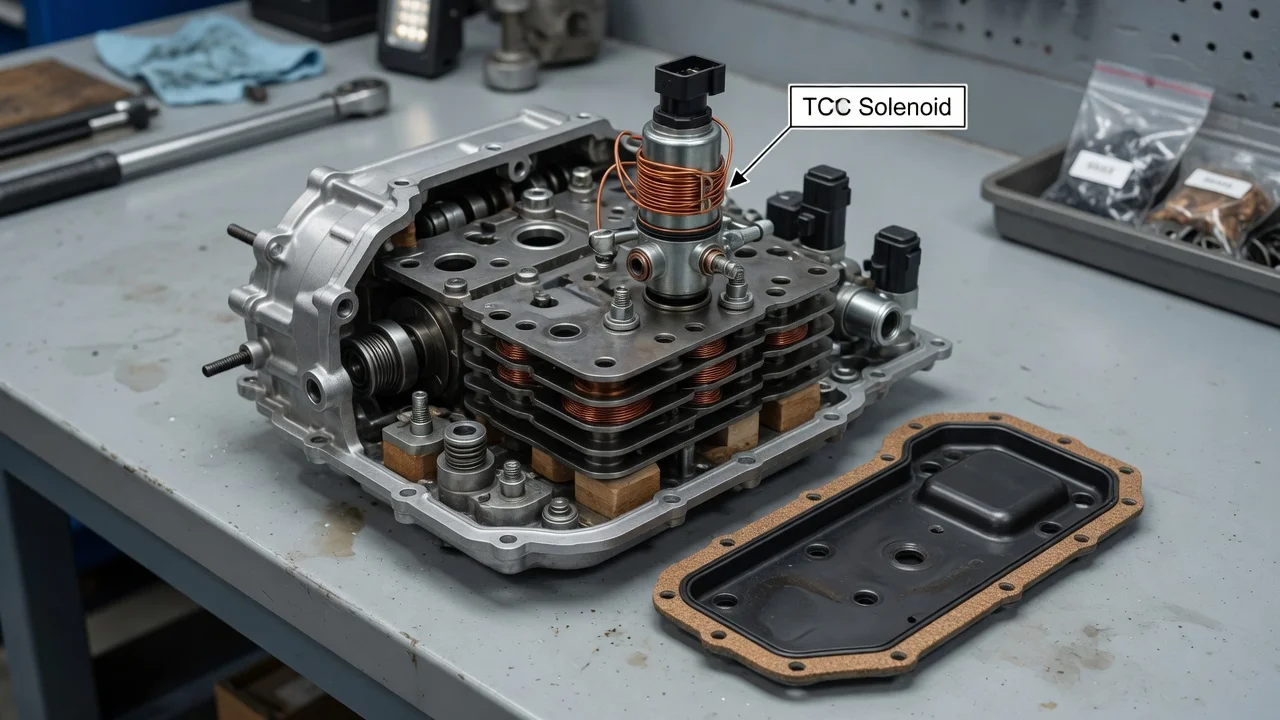
On a Chrysler Town and Country, the torque converter clutch (TCC) has no separate solenoid that you can find and unbolt by itself. A solenoid inside the transmission solenoid assembly, often called the solenoid pack, controls it. That assembly bolts to the outside of the transaxle case. Once you know which transmission your van has, you know which part to look for and how to reach it.
Where the TCC solenoid is on a Town and Country
Most Town and Country model years use one of Chrysler's electronically controlled front-wheel-drive transaxles. The four-speed began as the A604 and was later called the 41TE, with the closely related 40TE used in some years. Many later vans, depending on engine, have the six-speed 62TE. In all of these units, converter clutch control is part of the external solenoid assembly. On the four-speed family, the low/reverse and converter clutch solenoid, usually written LR/CC, does two jobs. It applies the low/reverse clutch in first gear and reverse, and once the van is in a higher gear, a valve in the valve body sends that solenoid's pressure to the converter clutch instead.
The solenoid assembly mounts on the outside of the transaxle case. Its single electrical connector also carries the pressure switch signals on many versions. On these minivans the transaxle sits on the driver's side of the engine bay, so the assembly is below and behind the battery and air intake area. Reaching it often means removing the air cleaner housing and intake duct, and on some years the battery and battery tray as well. Because the TCC function is built into this assembly, the usual repair is to replace the whole solenoid pack rather than one solenoid.
How converter clutch control works
The torque converter connects the engine to the transmission through fluid. Some slip between the two is normal, and it produces heat and wastes fuel. At steady cruising speeds, the transmission control module commands the converter clutch to apply, which locks the converter's turbine to its housing. Slip drops, engine speed drops, and fluid temperature stays lower. The module decides when to apply the clutch using vehicle speed, throttle position, fluid temperature and current gear. Many versions apply the clutch partially at first and then lock it fully, which smooths the transition.
The module watches two kinds of problems. One is an electrical fault in the solenoid circuit, such as an open or shorted winding or wire. The other is a performance fault: the module commanded lockup, but the speed difference across the converter did not drop as expected. Generic codes in the P0740 range cover these cases, and Chrysler-specific solenoid or pressure switch codes may set alongside them. Common symptoms include: • shudder at light throttle between roughly 35 and 50 mph; • higher than normal engine speed at highway cruise; • worse fuel economy; • hot transmission fluid; • stalling when coming to a stop, if the clutch stays applied
What changes the answer
Four things change the answer: model year, engine and transmission type. The four-speed and six-speed units have different solenoid assemblies, part numbers and connector layouts. The fourth is the type of fault. A circuit code points toward the solenoid pack, its connector, the wiring or the control module. A performance code without a circuit fault can also come from the converter itself, worn or wrong fluid, or a sticking valve in the valve body. The solenoid is one possible cause, not the automatic answer.
Operating conditions also matter. When fluid temperature is high or throttle demand is heavy, the module may delay or cancel lockup on purpose. Delayed lockup under those conditions is not a fault. Towing a trailer or carrying a full load of passengers and cargo adds heat and strain to the converter clutch. The owner's manual lists the gross vehicle weight rating, combined weight rating and tongue weight limits for your exact configuration, and staying within them matters. A shudder that appears only near those limits needs a different diagnosis than one that appears with an empty van.
What the owner can do
First, confirm which transmission the van has. You can check the identification label on the transaxle case, ask a dealer to look up build data from the VIN, or use model-year service information for your engine. Next, read the stored codes with a scan tool that can communicate with the transmission control module. Basic engine code readers may miss transmission-specific codes. Write down the exact code numbers and descriptions, and note whether the codes are current or stored.
Check the fluid level and condition using the procedure for your transmission. These transaxles call for ATF+4, and the wrong fluid is a known cause of converter shudder. Inspect the solenoid pack connector for: • oil intrusion; • corrosion; • bent or pushed-back pins; Follow the harness and look for chafing. Note when the symptom occurs, including road speed, engine temperature and load, because that pattern helps separate a solenoid fault from a converter or fluid problem.
If you replace the solenoid pack: 1) Disconnect the battery. 2) Clean around the mounting area so dirt cannot enter the case. 3) Install the new seal or gasket supplied with the part. 4) Tighten the bolts to the torque values in the service information for your model year. 5) Run the adaptive learning procedure with a compatible scan tool. On the 41TE family this is called the quick learn. Without the relearn, shift and lockup quality can stay poor even with a good new part.
Limitations and next step
This article covers the general layout and control logic only. It does not give torque specifications, connector pinouts or resistance values, and access steps vary by year and engine. Use service information that matches your VIN before ordering parts or removing components. Solenoid pack part numbers differ between transmission versions, and an assembly that looks similar may not fit or work correctly.
See a transmission specialist in any of these cases: • codes return after the solenoid pack is replaced; • shudder continues with correct, fresh fluid; • the fluid contains metal debris or smells burnt; • the transmission slips in gear; • you do not have a scan tool that can run the relearn; Converter and internal valve body faults need shop diagnosis. Until the cause is found, avoid towing and heavy loads, since added heat can turn a minor lockup problem into internal damage.