How to Look Up Chrysler 300 Check Engine Codes
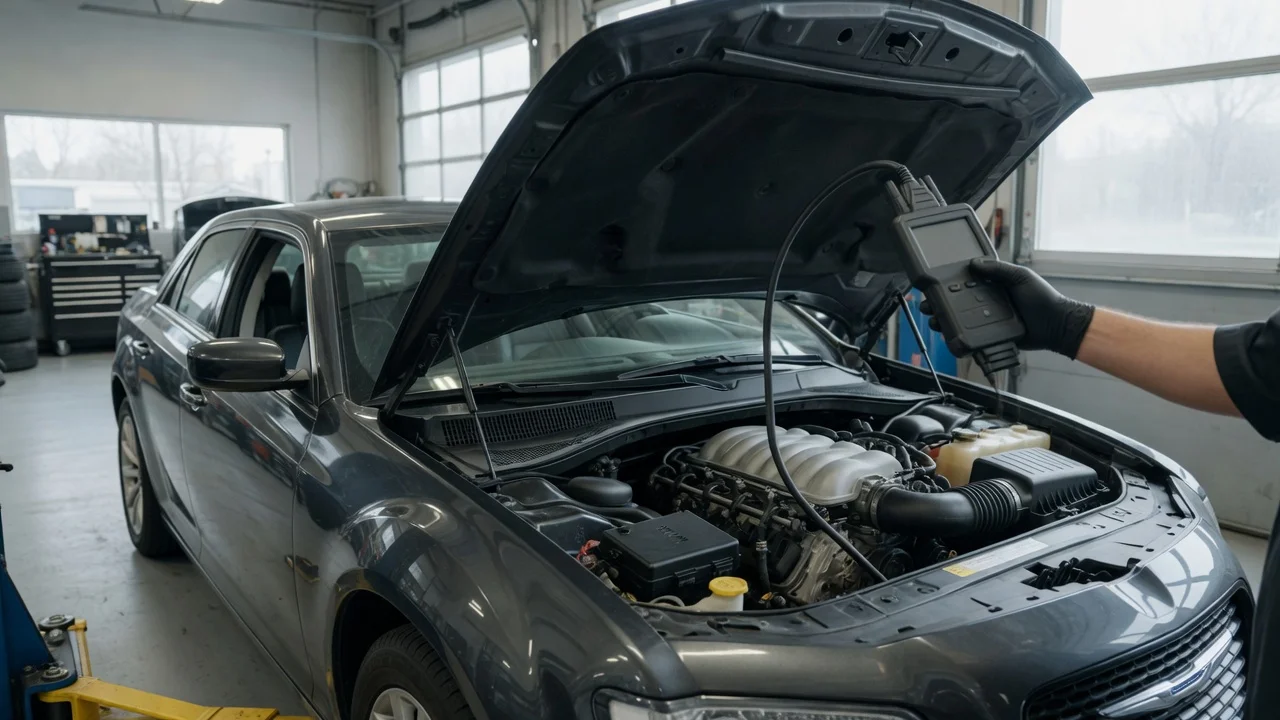
The short answer
To find out why the check engine light is on in a Chrysler 300, connect an OBD-II scan tool to the car's diagnostic port and read the stored diagnostic trouble codes (DTCs). OBD-II, short for On-Board Diagnostics, second generation, has been required on light-duty vehicles sold in the United States since the 1996 model year, so every Chrysler 300 sedan from the 2005 through 2023 model years supports it. The code tells you which system or circuit the engine computer flagged. It does not, by itself, tell you which part to replace.
Scope note: this guide covers the Chrysler 300 sedan sold from the 2005 model year onward. The earlier 300M (1999 to 2004 model years) also uses OBD-II, but its procedures and code coverage may differ. Market matters too. The OBD-II requirement described here applies to US-market vehicles, and other regions use related but separately regulated standards.
Where to plug in the scanner
The diagnostic link connector is a 16-pin, trapezoid-shaped socket. On OBD-II vehicles it is normally under the dashboard on the driver's side, near the steering column. The exact position on a given Chrysler 300 can vary by model year, so check the owner's manual if you cannot see it.
Reading the codes step by step
1) With the engine off, plug the scan tool or Bluetooth OBD-II adapter into the diagnostic connector. 2) Turn the ignition to the on position, or start the engine if the tool's instructions call for it. 3) Select the option to read codes. Many tools label it read DTCs or read faults. 4) Write down every code before you do anything else, including any listed as pending or permanent, and any freeze-frame data the tool shows. 5) Look up each code's definition, then diagnose the cause before replacing parts or clearing the light.
Many auto parts retailers in the United States will read codes for free. A basic generic scanner shows standard powertrain codes. Reading manufacturer-specific codes in other modules, such as the body, airbag or transmission controllers, usually requires a more capable tool.
Checking codes without a scanner
Many Chrysler-group vehicles have a built-in method: cycle the ignition on and off several times in quick succession without starting the engine, and stored codes appear in the instrument cluster display. Whether this works on a particular Chrysler 300, and exactly how, depends on the model year and instrument cluster. Some versions, especially those with push-button start, may not support it or may use a different sequence. The supplied material does not confirm which model years support it, so treat it as something to try rather than a guaranteed method. A scan tool remains the dependable option.
How to read a code
An OBD-II code has five characters, such as P0300. The first character identifies the system, and the following digits narrow down the fault.
Position | Meaning; First letter P | Powertrain (engine, transmission, emissions); First letter B | Body systems; First letter C | Chassis systems; First letter U | Network and module communication; Second character 0 | Generic code defined by the OBD-II standard, with the same meaning across manufacturers; Second character 1 | Manufacturer-specific code, whose definition comes from Chrysler service information; Remaining characters | The specific subsystem and fault
For generic P0 codes, any reputable code database gives the standard definition. For manufacturer-specific codes, the meaning can depend on model year and engine, for example the V6 versus the V8 versions offered in the 300. Confirm those definitions against service information for your exact vehicle.
Steady versus flashing light
Under OBD-II convention, a steady check engine light means the computer has stored a fault. You should have it checked soon, but it is not usually an immediate emergency. A flashing light typically signals an active engine misfire severe enough to damage the catalytic converter. If the light flashes, reduce load and get the car diagnosed promptly rather than continuing to drive normally.
Before you clear the codes
Clearing codes with a scanner turns the light off, but it does not fix the underlying fault, and the light will return if the problem persists. Clearing also resets the car's readiness monitors, which are the self-tests the computer runs on emissions systems. Until they complete again over normal driving, the car may fail an emissions inspection. Record the codes and freeze-frame data first so the information is available for diagnosis.
What this guide does not cover
No model-year-specific list of common Chrysler 300 trouble codes, factory code definitions or technical service bulletins was available for this article, so none are listed here. For a specific code on your car, use service information that matches your model year and engine, or ask a qualified technician who can run follow-up tests.