Choosing a Glow Plug Relay Timer for Your Diesel
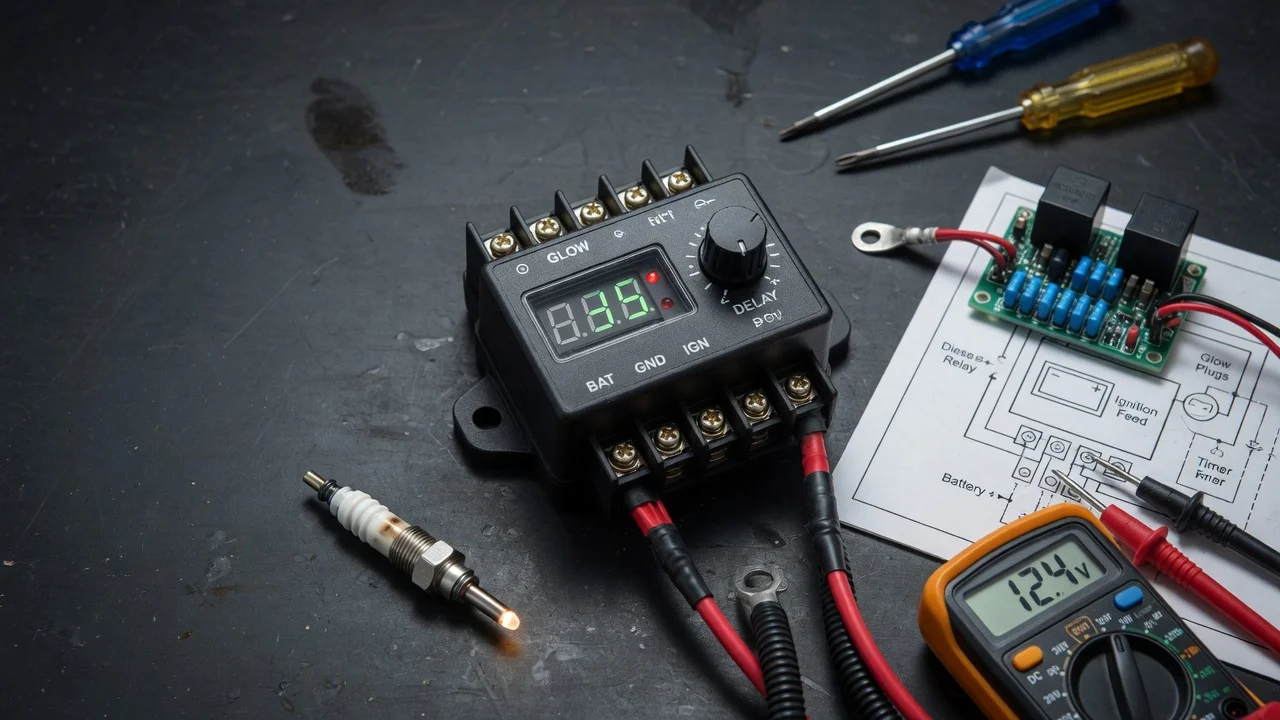
A glow plug relay timer decides when the glow plugs in a diesel engine get battery power and for how long. The wrong one can cause hard cold starts, white smoke, a drained battery or burned-out plugs. This guide covers how to confirm the timer is really the problem, which specifications have to match your engine, which features matter, and what a new unit cannot fix.
Define the job the timer must do
Start with what the engine actually needs. Glow plugs are used only on compression-ignition diesel engines. A gasoline engine relies on spark plugs and has no use for this part. On a diesel, the relay switches the heavy current the plugs draw. The timer or controller decides how long they stay on before cranking and, on many engines, after the engine starts. Some vehicles combine both functions in one unit, while others use a separate relay and controller. Newer engines often give the job to an electronic glow plug control module that the engine computer commands.
Your use case shapes the choice. A daily driver in a cold climate needs reliable preheat and afterglow every morning. A work truck that idles through winter, a tractor, a generator or an engine swap may need a universal timer wired into a harness that never had one. Note the temperatures you start in and whether you need a wait-to-start lamp. Also decide whether you want the original behavior restored or a configurable unit.
Confirm the timer is the actual fault
Before buying, make sure the timer is to blame. Typical failures include plugs that never energize, plugs that stay powered with the key on, an erratic wait lamp, or a relay that clicks without passing current. Check battery condition and cables, the main fuse or fusible link, and the voltage at the glow plug feed while the system is commanded on. Test each plug's resistance or current draw. One shorted plug can overload a relay, and a few open plugs can look like a timer fault. On engines with a control module, read stored codes with a scan tool that supports glow plug diagnostics.
Hard starting is not always electrical. Air in the fuel lines, a restricted fuel filter, a weak lift or transfer fuel pump, low fuel pressure or worn injectors can produce similar symptoms. On electronically controlled diesels, many scan tools show injector correction values. These serve a role similar to fuel trim on gasoline engines and can point to an injector problem. An injector return-flow leak check is another common test. Common-rail systems hold very high pressure, so do not crack injector lines or rail fittings to bleed air or check flow. Follow the manufacturer's procedure, including any specified wait for pressure to drop. Additives such as anti-gel treatments can help prevent winter fuel problems, but they are not a proven repair for a failed injector, pump or timer.
Check compatibility with your engine
Match system voltage first. Most passenger vehicles and light trucks run 12 volts, while many heavy trucks and some equipment use 24 volts. Then match the glow plug type. Older indirect-injection engines and many early direct-injection engines use plugs designed for full battery voltage, which a simple timed relay can feed. Many modern engines use low-voltage plugs, often ceramic or fast-heating designs, driven by a pulse-width-modulated module. Feeding those plugs steady battery voltage through a basic relay can destroy them quickly. If your engine uses a dedicated control module, replace it with a part designed for that module, not a generic relay timer.
Check current capacity next. Total draw depends on engine configuration, plug design and temperature. A V8 diesel with eight plugs can pull far more current in the first moments of preheat than a four-cylinder. The relay's contact rating should comfortably exceed the combined peak draw of all plugs, and the wiring, terminals and fuse must suit that load. Finally, compare the physical interface: connector shape and pin count, terminal studs, mounting bracket and ground path. Also confirm the inputs the timer expects, such as a coolant temperature signal, an ignition feed, a starter signal or an alternator signal for afterglow.
Features that affect the choice
Control strategy is the biggest difference between units. Fixed-time units energize the plugs for a set period regardless of conditions. That is simple, but it can overwork plugs in mild weather and underheat them in deep cold. Temperature-compensated units read coolant temperature or an internal sensor and shorten preheat as the engine warms. Afterglow, also called post-glow, keeps the plugs on briefly after start to reduce white smoke, rough running and combustion noise. Engines designed with afterglow may idle differently when cold if the replacement leaves it out.
Other useful features include a wait-to-start lamp output that matches your dashboard and a safety cutoff that limits on-time if the key is left in the run position. Some units also give diagnostic feedback that flags a failed plug. Solid-state units avoid mechanical contacts but still need adequate heat sinking and a sound mounting location. Treat labels such as heavy duty, OEM quality or extreme cold with caution. Trust them only when the listing supports them with a contact rating, voltage, duty cycle and fitment data you can check against your engine.
Limitations and ownership costs
A new timer only controls power delivery. It cannot fix worn or swollen glow plugs, damaged wiring, slow cranking, low compression, gelled fuel or injector faults. Inspect the plug harness and connectors while you are working in the area, because heat-hardened insulation and corroded terminals are common on older engines. If one plug has failed, many owners replace the full set so heating is even across cylinders. That is a cost decision rather than a requirement.
Labor varies widely. On some engines the relay bolts to the fender or intake. On others the module sits under the intake manifold and takes much longer to reach. Budget for a fuse or fusible link, terminal hardware and dielectric grease where the manufacturer allows it. A stuck relay can keep power on, burning out plugs, draining the battery or overheating wiring. After installation, confirm that the plugs switch off at the expected time. Universal timers in custom installs also need correct wire gauge and fusing, which adds parts and time.
Build a practical shortlist
Narrow the candidates with a short checklist. Confirm fitment by model, year and engine code, or by the original part number. Verify system voltage, glow plug type and whether the engine needs a PWM control module rather than a relay. Compare the current rating with the total draw of your plug set. Check connector and terminal layout, mounting, and required inputs such as coolant temperature and starter or alternator signals.
Then compare behavior and support. If your engine was designed with temperature-compensated preheat and afterglow, choose a unit that provides both. Look for a wait lamp output that works with your cluster and an on-time safety limit. Read the warranty and return terms, and keep the old unit until the new one handles a real cold start. If two candidates meet every specification, choose the one whose listing gives clear, checkable data over the one with the boldest claims.