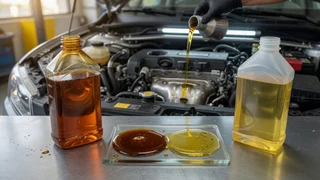
Choose high-mileage oil versus full synthetic
Choosing between high-mileage oil and full synthetic starts with the condition of your engine rather than the bottle label. A high-mileage formula is often a full synthetic, synthetic blend, or conventional base with added seal conditioners and extra viscosity, while a full synthetic lubricant protects through uniform molecular engineering and oxidation resistance. The right answer depends on whether your priority is slowing seepage from aging gaskets or maintaining the strongest possible lubrication under heat and cold. Reading the lubricant specification, manufacturer approval, and current leak pattern helps you match the fill quantity and service interval to what the engine actually needs.
Direct answer
For most drivers, use a high-mileage oil when the engine has crossed roughly 75,000 miles, shows minor oil seepage, consumes oil between level checks, or has begun to sound slightly dry on cold starts. The added conditioners are designed to soften aging seals and reduce weeping around valve covers and main seals. Full synthetic remains the stronger choice when the engine is tight, runs with forced induction, tows regularly, or experiences extreme temperature swings and long drain intervals where oxidation resistance matters more than seal swelling.
There is no universal rule that full synthetic is automatically better once a vehicle has accumulated miles. An older engine with hardened seals may respond more favorably to a high-mileage formulation than to a thin full synthetic that exposes leaks. However, if your engine is not leaking and the owner’s manual permits it, a full synthetic that carries the correct lubricant specification still provides excellent protection. Check the level often and choose the option that keeps consumption and visible seepage stable.
Differences and suitability
High-mileage oils and full synthetics differ most clearly in additive chemistry and base-oil construction. Full synthetic uses a uniform base that resists thermal breakdown, flows predictably in cold weather, and maintains film strength under high heat. High-mileage products focus on conditioning older elastomers and may use a higher viscosity or a synthetic blend to help fill worn clearances. A synthetic blend sits between conventional and full synthetic, offering some oxidation improvement while retaining the seal-softening and oil-consumption benefits that many high-mileage engines need.
Suitability comes down to the failure mode you are managing. If the concern is seepage, oil consumption between oil changes, or a slightly noisy valvetrain after startup, the high-mileage formulation is the practical choice. If the concern is heat, sustained load, turbocharger coking, or long intervals without a level check, the full synthetic’s stability is a better match. Always confirm the fill quantity, the equipment identification on the cap or dipstick, and the manufacturer approval listed in the owner’s documentation before switching from one family of lubricants to the other.