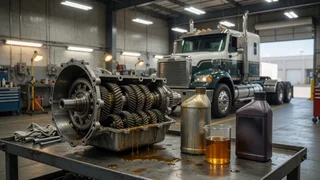
Choose Freightliner gear oil

Choosing the right Freightliner gear oil starts with the axle, transmission or transfer case in front of you rather than the truck name alone. The correct lubricant depends on the component’s design, its expected load, and the manufacturer’s written approval for that unit. Because Freightliner installs many supplier-built driveline parts, a single viscosity or additive package does not fit every model. Working through the identification plate, the lubricant specification, and the fill-and-check procedure prevents mismatched oil from shortening bearing life or causing hard shifting in severe service.
Essential answer
The essential answer is that Freightliner gear oil must be selected by the driveline component specification, not by the truck badge. A heavy-duty manual transmission, a hypoid drive axle, and a power divider can each require different chemistry. The equipment identification tag or build information points to a lubricant specification, and that specification names the required API category, viscosity grade, or manufacturer approval. Using an engine oil or a generic gear oil merely because it is available can create a lubrication mismatch even when the container label sounds suitable.
The practical starting point is the fill and level-check location for the specific unit. Once the component is identified, the owner can confirm the fill quantity and the method for checking level, because overfilling can cause churning and overheating while underfilling starves the upper bearings. The lubricant must also match the expected ambient operating range so the oil flows during cold starts and maintains film strength when the axle runs hot under load. For many Freightliner applications, the correct product is a heavy-duty gear lubricant carrying the approval stated for that component and the proper viscosity for the regional climate.
Relevant alternatives
The main comparison is between a single-grade gear oil and a multigrade heavy-duty lubricant approved for the same service. In consistent operating temperatures, a straight-grade oil can provide stable film thickness and simple selection. In regions with wide seasonal swings, a multigrade product flows better at cold startup while still protecting gears at full operating temperature. The choice is not about one being universally superior, but about matching the viscosity behavior to starting conditions, sustained loads, and the manufacturer approval for the installed component.
Another relevant distinction is between conventional mineral gear oil and a synthetic or synthetic-blend product. Synthetic formulations typically resist thermal breakdown and oxidation better during long hauls or mountainous duty, while mineral products can be a practical choice where drains follow a shorter service interval. Either option must still meet the named lubricant specification for the unit. Rather than paying for an unrelated premium feature, the owner should compare products on the shared criteria of the required approval, the expected temperature range, and the component’s fill quantity and service interval.