Chevy Silverado Transfer Case Shift Motor Identification
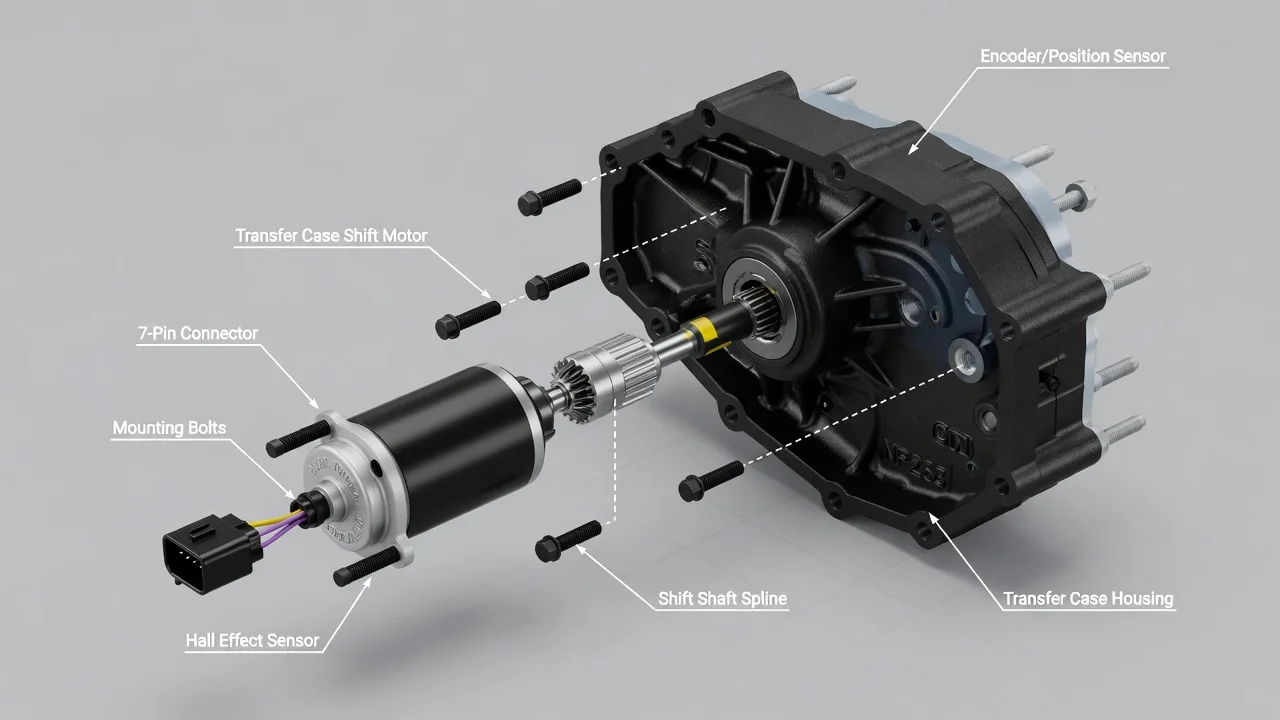
If the 4WD lights on a 2004 Chevy Silverado blink, or the truck refuses to change ranges, the transfer case shift motor is one of the first parts a technician checks. Finding the right replacement is not as simple as matching the model year, because Silverados of this era left the factory with different transfer cases and selector setups. This guide explains how to confirm which shift motor your truck uses and what to verify before buying one.
The short answer for a 2004 Silverado
On a 2004 Silverado with push-button four-wheel drive, the shift motor, often called the encoder motor, bolts to the transfer case and turns its internal shift shaft when the transfer case control module commands a range change. The correct motor depends on which transfer case is installed, not just on the year. On light-duty trucks of this generation, models with an Auto 4WD button commonly use the NP246, a case with an automatic clutch mode, while trucks with only 2HI, 4HI and 4LO buttons commonly use the part-time NP263. Heavy-duty versions can use different cases again, and some trucks were built with a floor-mounted shift lever, which means there is no shift motor at all. The dependable way to identify the part is to read the transfer case identification tag and the factory option codes, then match the motor to those.
The 2005 Silverado and 2005 Silverado 1500 belong to the same body generation, so motors frequently interchange between 2004 and 2005 trucks with the same transfer case. Frequent overlap is not a guarantee, though, and the configuration of the individual truck still decides the fit.
How the shift motor and encoder work
When you press a selector button, the switch sends a request to the transfer case control module. The module checks conditions such as vehicle speed and transmission position, then powers the motor. The motor rotates the shift shaft inside the case, moving the internal parts that select two-wheel drive, four-wheel high, four-wheel low or, on cases that have it, the automatic mode. An encoder mounted with the motor reports shaft position back to the module so it knows where the case is and when the shift is complete. Front wheel engagement is handled separately by a front axle actuator.
Because the module depends on that position signal, a fault does not always mean the motor itself has failed. Worn internal contacts, a damaged encoder, a corroded connector or a chafed wire can all produce the same symptoms: flashing indicator lights, a 'Service 4WD' message, a shift that starts and stops, or no shift at all.
What changes the correct part
Four details matter most: the transfer case model, the selector type, the weight class of the truck and the model year within the generation. A 1500 and a 2500HD from the same year may not share a motor. A 2000 Silverado belongs to the earlier years of this body style, and its selector and electrical components can differ from those on 2003 and later trucks, so do not assume a 2000 part fits a 2004. A 2008 Silverado is a newer body generation, introduced during the 2007 model year alongside the carryover Classic, and its transfer case parts should not be treated as interchangeable with a 2004 without confirmation.
Service history can change the answer too. If the transfer case was ever replaced with a used or remanufactured unit, the correct motor must match the case that is actually installed, which may not be what the original labels describe. The same applies to trucks converted from one setup to another.
How to identify the motor on your truck
Start with the Service Parts Identification label, usually found in the glove box. It lists the factory option codes, including the code for the transfer case. A dealer parts department or a parts catalog that accepts a VIN can decode those codes into the correct part. Next, inspect the transfer case itself. It carries an identification tag with its model number, often on the rear housing; clean off road grime carefully so the tag stays readable. Finally, look at the existing motor for a part number on its housing and compare its connector shape and mounting pattern with any replacement you are considering.
Before removing the old motor, note which mode the transfer case is in. Some replacement instructions call for the case and the new motor to be in a matching position before installation, so follow the directions supplied with the part rather than forcing the shaft to line up.
Checks before replacing the motor
A motor is not always the cheapest fix, so a short inspection is worthwhile. Read trouble codes with a scan tool that can access the transfer case module, since generic engine code readers may not show them. Check the related fuses, inspect the motor connector for corrosion and look over the wiring near the exhaust for heat or rub damage. With the engine running and conditions met for a shift, press a selector button and listen near the transfer case: no sound at all points toward power, wiring or module issues, while a motor that runs but never completes the shift points toward the motor, the encoder or the case. A weak battery or poor ground can also cause erratic behavior, and a failing selector switch can mimic a bad motor.
If the transfer case changes modes but the front wheels do not drive, the problem may be front axle engagement rather than the shift motor. Separating these two systems before ordering parts prevents an unnecessary purchase.
Limitations and when to get help
This guide cannot confirm compatibility for a specific truck; only the VIN, the option codes and the transfer case tag can do that, and manufacturer specifications take priority over general advice. Diagnostic steps also vary with the exact configuration. If codes point to the control module, or if the case makes grinding noises, leaks fluid or jumps out of gear, a new motor will not solve the underlying problem. A replacement control module may also require setup with dealer-level equipment. In those cases, a professional inspection with the truck's service history in hand is the sensible next step.