Transfer Case Shift Motor Replacement Cost: What Shapes the Price
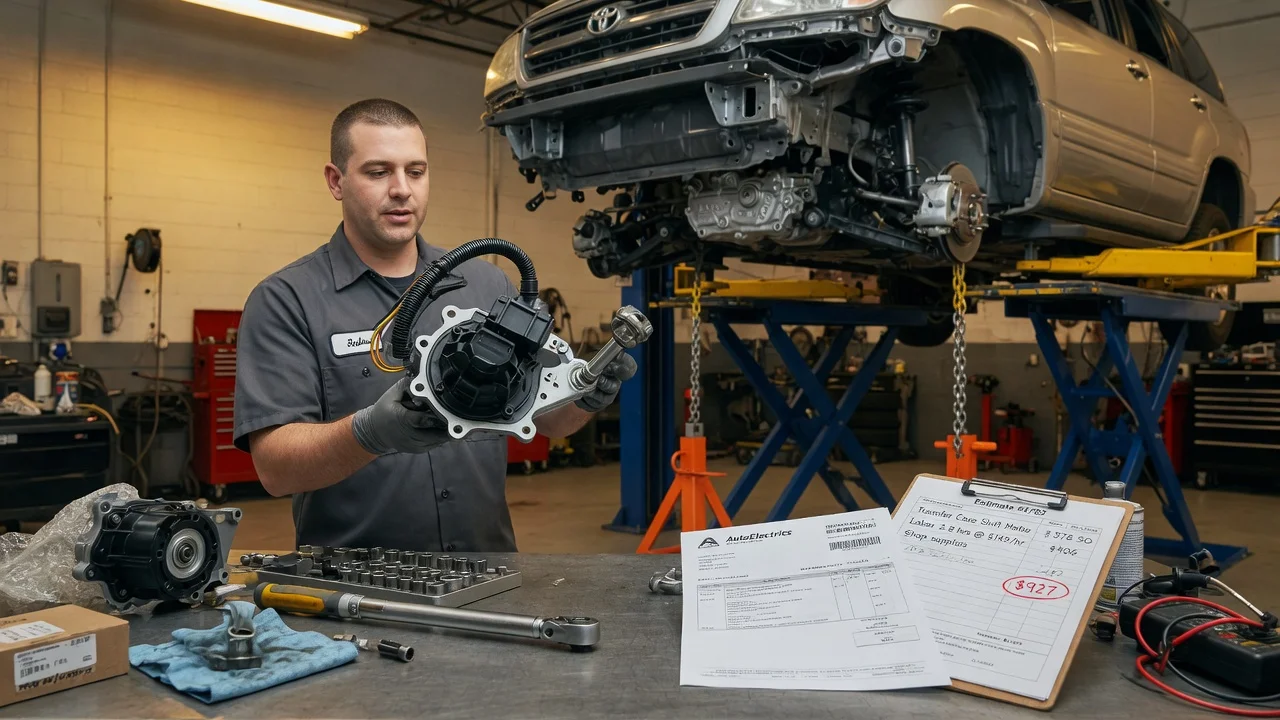
When four-wheel drive will not engage, shifts slowly or triggers a service 4WD warning, a shop may recommend replacing the transfer case shift motor. What you pay depends less on the motor itself than on your exact vehicle configuration, how the fault was diagnosed and what work the quote actually covers. This guide explains what a sound estimate includes, which factors move the price and how to compare offers without paying for parts or labor you do not need.
What the estimate includes
The shift motor, also called a transfer case actuator or encoder motor depending on the manufacturer, is the electric unit that turns the shift shaft on an electronically controlled transfer case. It moves the case between modes such as 2WD, 4 High and 4 Low when you press a button or turn a selector. A complete replacement estimate normally covers diagnosis, the replacement part, labor to remove the old unit and install the new one, any calibration or relearn procedure the manufacturer requires, and a road test confirming that every mode engages and the dash indicators report correctly.
Many figures you see are partial. A parts price from a catalog leaves out labor, and a labor-only number leaves out the part. On some designs the position encoder or sensor is a separate component, so a motor price may not include it. Seals, mounting hardware, scan tool programming, shop supplies and tax can also be missing. Before comparing anything, ask whether a number is the out-the-door total for the full repair or only one piece of it.
What changes the cost
Vehicle configuration comes first. Make, model, year, drivetrain and the specific transfer case all determine which motor fits. The same nameplate can use different transfer cases across trims or model years, for example a part-time unit on one version and a case with an automatic 4WD mode on another, and the motors are not always interchangeable. A shop should look up the part by VIN rather than by model name alone, following manufacturer specifications.
Parts choice matters as well. Original equipment, new aftermarket and remanufactured motors differ in price, fit and warranty. Labor depends on access: some motors are reachable from underneath once a skid plate is removed, while others require moving a crossmember, exhaust components or other parts. Rusted or seized fasteners add time on vehicles driven in salt or wet operating conditions. Shops typically bill from a labor time guide multiplied by their hourly rate, and rates vary by region and by whether you use a dealer or an independent shop.
The biggest swing is scope. Similar symptoms can come from a blown fuse, a corroded connector, damaged wiring, a faulty selector switch, the transfer case control module, a front axle engagement actuator or internal transfer case damage. If inspection finds one of these instead of, or in addition to, a failed motor, the repair and its cost change accordingly.
Compare like-for-like options
Quotes are only comparable when they address the same diagnosis. One shop may quote a new original equipment motor, another a remanufactured unit, and a third may propose a wiring repair because it traced the fault to a connector. These are different jobs, not cheaper or pricier versions of the same one. If shops disagree about the cause, resolve the diagnosis before comparing prices. If internal transfer case damage is involved, an overhaul or replacement of the case is a much larger scope that should be quoted separately.
Compare warranty on equal terms: whether it covers parts only or parts and labor, how long it lasts and where it can be honored. Customer-supplied parts often carry no labor warranty from the installing shop. Also confirm necessary associated work is included in each quote, such as calibration, clearing stored codes and verifying operation in every mode. Checking transfer case fluid level and condition while the vehicle is on a lift is sensible, but a fluid service should appear as its own line item and match your maintenance schedule rather than being added by default.
Be wary of shortcuts. A used motor from a salvage vehicle has an unknown history and may not match your part number. On many designs the motor position must be aligned with the transfer case shaft before installation, and skipping that step or a required relearn can leave the system misreading its mode even with a good part installed.
Read an itemized quote
A useful quote lists the part number, brand and condition, whether new, remanufactured or used, and states that the part was matched to your VIN. Labor should show hours and the hourly rate. Look for the diagnostic fee and whether it is credited toward the repair, any programming or calibration charge, shop supplies, environmental fees and tax. Warranty terms should be written on the estimate, not just stated verbally.
Then check what is excluded. Common exclusions include broken or seized fasteners, wiring or connector repair, control module replacement and anything described as additional work if found. Ask how long the quote is valid and whether the shop will contact you before exceeding it. Ask what evidence supports the diagnosis, such as stored trouble codes, circuit tests or a commanded actuator test with a scan tool. Share your service history too, since a previous repair to the same system can change both the diagnosis and the warranty picture.
Decide the next step
Start by collecting your VIN, a description of the symptoms, when they occur, which warning lights appear and any records of earlier 4WD repairs. Ask a dealer to check by VIN whether open recalls, technical service bulletins or remaining powertrain or extended coverage apply. Have the fault diagnosed with documented tests before buying parts. Request written, itemized quotes that specify the same part type, warranty and associated work, and confirm that calibration and a road test in every mode are included.
Avoid replacing parts based on a trouble code alone, since a code points to a circuit, not necessarily a failed motor. If the transfer case is stuck in four-wheel drive on a part-time system, extended driving on dry pavement can bind the driveline, so ask the shop how to use the vehicle until it is repaired. Choosing the right diagnosis and a correctly matched part usually protects your budget more than chasing the lowest headline number.