Transfer Case Shift Motor Problems: Symptoms and Testing
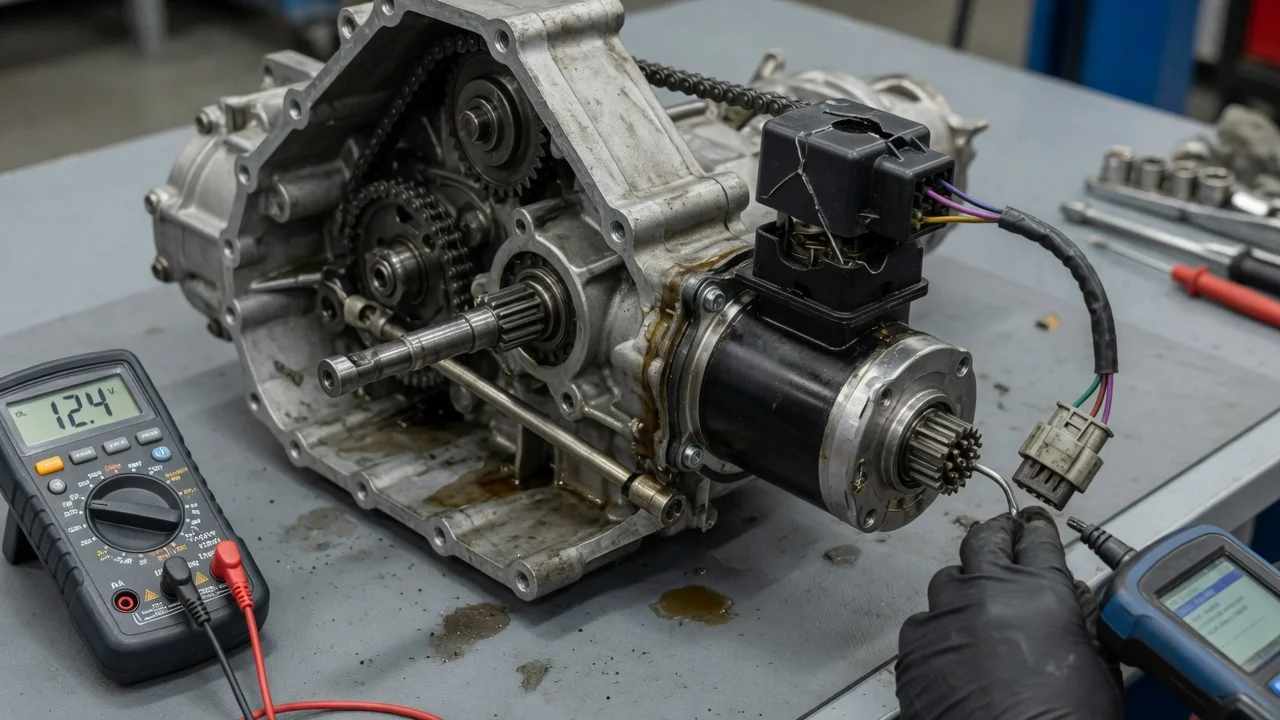
Many part-time and selectable four-wheel-drive vehicles use a small electric shift motor on the transfer case. It moves the internal shift mechanism when you press a button or turn a dial. When it fails, the vehicle may refuse to change ranges, stay stuck in one mode or flash a warning. This guide covers how to recognize the problems, separate them from faults that look the same, and test the system in a sensible order before buying parts.
Establish the symptoms
The most common signs of a bad transfer case shift motor are a 4WD indicator that keeps flashing and a selector that does nothing when you use it. Other signs include a system that reaches 4High but not 4Low, or the reverse, and a vehicle stuck in four-wheel drive or two-wheel drive. You may also see a service or check 4WD message. Sounds help too. Some motors make a faint whir or click during a shift, so silence where you normally hear that sound is worth noting. So is a repeated clicking or buzzing near the transfer case. Shifts that succeed only after several tries, or only when the vehicle is warm or cold, point toward an intermittent fault rather than a complete failure.
Write down the context each time the problem appears. Record the road speed, the transmission selector position, whether the brake was pressed, and the outside temperature. Note recent events such as deep water, off-road use, a pressure wash underneath, a battery replacement, a jump start or other repair work, including a transfer case fluid service. List any other dashboard warnings, such as ABS or traction control lights. Also check the owner's manual for the conditions required for a range shift. Many vehicles need the transmission in neutral or the vehicle barely rolling to shift into or out of low range. A shift attempted outside those conditions may simply be refused, which is not a fault. Finally, note the exact vehicle configuration, including year, model, engine and transfer case type, because the shift procedure and hardware differ between designs.
Distinguish plausible causes
The motor itself can fail through worn brushes, damaged internal gears or a faulty position encoder, which is the sensor that tells the control module where the motor is. Several observations support a motor fault: no sound or movement even though power and ground are confirmed at the connector during a shift command, stored codes for motor position or motor circuit performance, and corrosion or water inside the motor housing. A motor that runs normally on command while the drivetrain fails to change mode weakens the case against it. The exception is stripped internal gears, which can let the motor spin without moving the shift shaft.
Electrical supply and control faults often look exactly like a dead motor. These include a blown fuse, a failed relay, a chafed harness, a corroded connector, a faulty selector switch, a transfer case control module problem or low system voltage. The case for these causes is stronger if several related codes are stored, if the fault began after water exposure or electrical work, if the selector backlight is also out, or if the trouble started after a weak battery or jump start.
Mechanical causes sit downstream of the motor. These include a binding shift rail or fork, internal transfer case wear, and low or incorrect fluid. They also include front axle engagement components such as an axle actuator, a vacuum system or locking hubs, depending on the design. A mechanical cause is more likely if the motor is heard running but nothing changes, if the indicator shows 4WD while the front wheels are not driving, or if you hear grinding during the shift. If a shift completes once the vehicle rolls slightly, gear teeth may simply have been aligning, which points away from the motor.
Checks in a useful order
Start with observations that need no tools. On level ground, follow the shift procedure in the owner's manual exactly, and note what the indicator does. With the vehicle parked securely, the parking brake set and nobody underneath, have a helper operate the selector while you listen near the transfer case. Then check the related fuses and relays using the fuse box legend, and look at the battery condition and terminals, since low voltage can disrupt electronic shifting. If the vehicle is properly supported, inspect the motor connector and the harness you can see for damage, corrosion or a loose plug.
The next stage needs tools and service information. A scan tool that can communicate with the transfer case or four-wheel-drive module is important, because a basic engine code reader may not see these codes. Live data can show whether the module recognizes the selector input and what motor position it reports. Some tools can also command the motor directly. With a multimeter and the correct wiring diagram, you can check power, ground and encoder circuits at the connector during a command. Compare the readings with the manufacturer specifications for that vehicle rather than generic values, and back-probe carefully so the connector seals are not damaged.
Some work is better left to a qualified technician. This includes removing the motor, checking whether the transfer case shift shaft turns freely, bench testing the motor, inspecting the case internally and diagnosing the front axle engagement system. These jobs require the vehicle to be supported safely on stands. On vehicles whose transfer case has a neutral position, a case left in neutral can let the vehicle roll even with the transmission in Park. Some replacement motors also have to be aligned to a specific position or calibrated after installation, according to the manufacturer procedure.
Interpret the findings
Each result narrows the search in a specific way. If the module sends a command and power and ground are present at the connector, but the motor makes no sound or movement, the motor becomes the prime suspect. Even then, check the connector pins and encoder wiring first. If no command reaches the motor, the fault lies upstream in a fuse, relay, switch, wiring or the module, and a new motor will not cure it. If the motor runs but the range does not change, look at stripped motor gears, internal transfer case parts or front axle engagement. If the motor works correctly off the vehicle but the shift shaft is stiff, the problem is inside the transfer case.
Several points still need confirmation before replacing parts. A trouble code shows what the module detected, not necessarily which component failed. For example, a position sensor code can come from damaged wiring rather than the motor. Record codes and freeze frame data before clearing anything, then try to reproduce the fault under the same conditions you noted earlier. Intermittent problems often only show up hot, cold or after rain. Ask a dealer whether software updates or technical service bulletins apply to the vehicle. Review the service history for earlier motor replacements, and check whether fluid service has followed the maintenance schedule for your operating conditions.
Urgency and next action
Some signs mean you should stop driving and arrange inspection or towing. On a part-time system, being stuck in four-wheel drive on dry pavement can cause driveline binding, tire scrubbing, hopping in turns and component damage. Grinding, banging or a burning smell from the transfer case, a visible fluid leak, a neutral indicator you did not select, or a vehicle that rolls while in Park also call for stopping. A flashing indicator alone, while the vehicle drives normally in two-wheel drive, is usually less urgent. Still, have it inspected soon, and do not count on four-wheel drive for snow, towing or off-road use until it is repaired. No reliable figure exists for how far a vehicle can safely be driven with this fault.
Give the repair shop as much of the following as you can: the VIN or exact vehicle configuration, all stored codes with freeze frame data, and the conditions under which the problem occurs. Add what was heard during shift attempts, any test results with the values and measurement points, recent repairs or water exposure, and the vehicle's service history. Mention whether the current motor is original or a replacement. Ask the shop to confirm the diagnosis before ordering parts, and to state whether the replacement motor needs alignment or calibration.