No Power to the Transfer Case Shift Motor: Diagnostic Checks
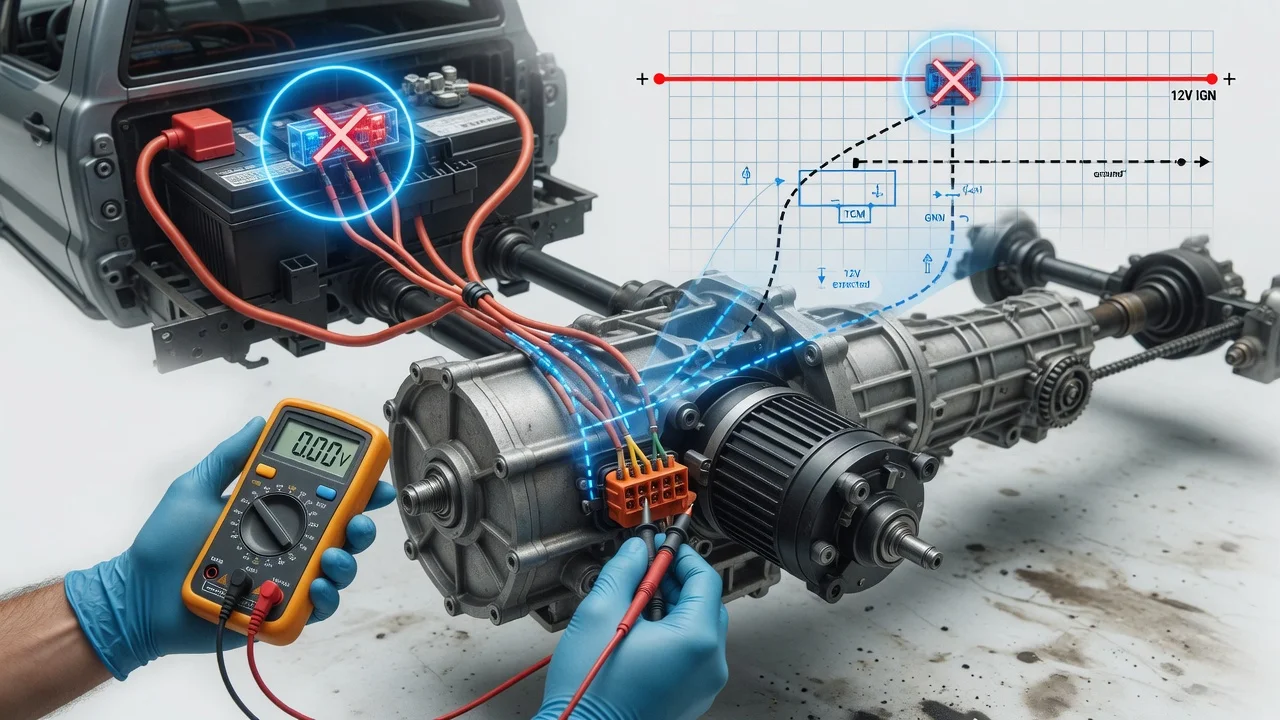
When you press the 4WD selector and the transfer case motor never seems to receive voltage, the fault can be anywhere between the battery and the motor windings. On many electronic-shift systems, a control module powers the motor only briefly and only when its shift conditions are met. A missing voltage reading therefore does not prove a part has failed. This guide covers the symptoms to record, the likely causes, a sensible test order and how to read the results before you buy parts.
Establish the symptoms
Note exactly what happens when you request a shift. Check whether the 4WD indicator flashes, stays in its old state or shows a message. Listen for a relay click or a brief hum from under the vehicle. Note whether the problem affects every mode or only shifts into or out of low range. Record the symptom conditions too: engine running or key on, transmission in park or neutral, brake pressed or not, vehicle stopped or rolling, cold start or after a long drive, and dry weather or after water, mud, salt or a car wash. These details matter because many systems refuse to shift unless specific conditions are met.
Write down any recent changes, such as a battery replacement, jump start, aftermarket lighting or trailer wiring, lift kit, transfer case or driveshaft work, or underbody damage. If a scan tool is available, save every trouble code with its status and freeze-frame data before clearing anything. A stored code tells you which circuit or condition the module flagged and when. It does not prove that the motor, the module or the wiring has failed. Clearing codes first throws away the snapshot that often points to the real fault.
Distinguish plausible causes
The first possibility is that the power supply is fine and the module is simply not commanding a shift. Low-range shifts commonly require the transmission in neutral, the brake applied and the vehicle stopped or nearly stopped. Other faults can also stop the module from issuing the command: a faulty selector switch, a missing vehicle speed signal, a brake switch problem or a network communication fault. Two observations support this branch. Live data may show that the module never sees a shift request, or the codes may point to inputs rather than the motor circuit.
The second group of causes is on the supply side. These include a blown fuse, a failed relay on systems that use one, a poor module power feed and a bad ground. On some vehicles, low battery voltage can also make the module reject or abort a shift. A fuse that blows again immediately suggests a short to ground in the motor circuit or a seized motor drawing excessive current. That is a different problem from a fuse that has simply aged out.
The third group sits between the module and the motor. The connector at the transfer case is low and exposed, so common findings include corrosion, water intrusion, pushed-out terminals and harness chafing against the frame or exhaust. A harness fault often appears and disappears with weather or suspension movement. Finally, the module's motor driver can fail, and so can the motor or its position sensor. A failed motor normally still receives voltage, though. A genuine absence of voltage at the motor connector during a commanded shift points to a fault upstream of the motor.
Checks in a useful order
Start with owner-level checks, which need no special tools. Confirm the battery is charged and its terminals are clean and tight. Repeat the shift exactly as the owner's manual describes, including neutral and brake if required. Check the fuses listed for the 4WD system, either with a test light or by swapping in a fuse of identical rating. With the engine off and the vehicle safely supported, inspect the harness along the frame to the transfer case for damage, melted insulation or a disconnected plug.
Next, use a scan tool. A capable tool can read codes from the transfer case or 4WD module and show live data for the selector switch, the motor position or encoder reading, and the brake and speed inputs. Some tools can also run an output test that commands the motor. If the module never registers the switch request, the problem is upstream and the motor circuit does not need testing yet. If the module registers the request but reports a motor circuit or position fault, follow that path.
Circuit tests require service information for the specific vehicle: the wiring diagram, connector pinouts, expected voltage and resistance values, and the test sequence. Voltage on the motor wires is usually present only during a commanded shift, so you must measure it while the command is active. This is typically done by back-probing the connector during an output test or an assisted shift attempt. A loaded test is more meaningful than an open-circuit meter reading. Use a suitable test light or a voltage drop check under load, because a corroded wire can show full voltage when no current is flowing. Test the module's power and ground pins the same way. Applying power directly to the motor can drive it past its stops or damage the mechanism. Unless the service procedure covers it, leave bench testing and any module work to a qualified technician.
Interpret the findings
Each result narrows the field without settling the diagnosis on its own. A blown fuse confirms an overcurrent event, not its cause, so find the short or the binding motor before installing a new fuse. If the motor connector has good voltage under load during a command but the motor does not move, suspect the motor or a seized shift mechanism inside the transfer case. If voltage is present at the module output but missing at the motor connector, the harness or connector between them is at fault. If the module produces no output even though it sees a valid shift request and its power and ground circuits test good under load, the module or its configuration becomes the leading suspect.
Before replacing a part, confirm three things: the reading was taken while the shift was actually commanded, the shift conditions were met, and any intermittent fault was reproduced rather than assumed. Some modules need a learn or calibration procedure after a motor or module replacement, so check service information before ordering. After the repair, run a confirmation test. Clear the codes, select every mode under the documented conditions, check that the indicator matches the actual mode, and recheck codes and live data. If a code returns, a fault remains unresolved, though not necessarily in the part you just changed.
Urgency and next action
A transfer case that will not shift but stays in two-wheel drive is usually an inconvenience rather than an emergency. Treat it more seriously if the vehicle will not move in gear, moves unpredictably or may be stuck in transfer case neutral. A transfer case in neutral can let the vehicle roll even with the transmission in park, so set the parking brake and do not leave the vehicle unattended until the problem is fixed. Stop driving and arrange an inspection if you hear grinding or clunking, feel binding or tire scrubbing in turns on dry pavement, smell hot wiring, see smoke, or a fuse blows repeatedly. No distance can be promised as safe in these conditions.
For an efficient repair, give the technician the year, model, engine and transfer case type, along with the exact symptom and the conditions when it occurs. Mention any recent work and provide saved codes with their freeze-frame data. Include any measurements already taken and explain how they were taken, such as whether voltage was checked during a commanded shift or with the motor idle. That record lets the shop start on the right diagnostic path instead of repeating checks or replacing the motor on a guess.