How to Find Your Car's Catalytic Converter
Before you start
The catalytic converter is part of the exhaust system and is installed inline between the engine and the muffler. On most passenger vehicles it sits underneath the car, so you need a safe way to see the underside and enough lighting to tell exhaust parts apart. This is an informational inspection task you perform on the vehicle itself; no app, camera service, or upload is required.
A converter can be close to the exhaust manifold at the front, under the middle of the vehicle, or behind that area depending on the engine and exhaust layout. Vehicles with more than one converter may have both a front and rear unit. If you only need a general idea rather than access to the part, a well-lit photo taken from the side at ground level can help you see the exhaust routing without lifting the car.
Step-by-step instructions
Park the vehicle on a firm, level surface and set the parking brake. If you plan to raise the car, use jack stands on the manufacturer-approved support points and chock a wheel that remains on the ground. Never work beneath a car supported only by a jack.
Let the exhaust system cool before looking closely. Catalytic converters become extremely hot during operation and can remain hot long after the engine is turned off.
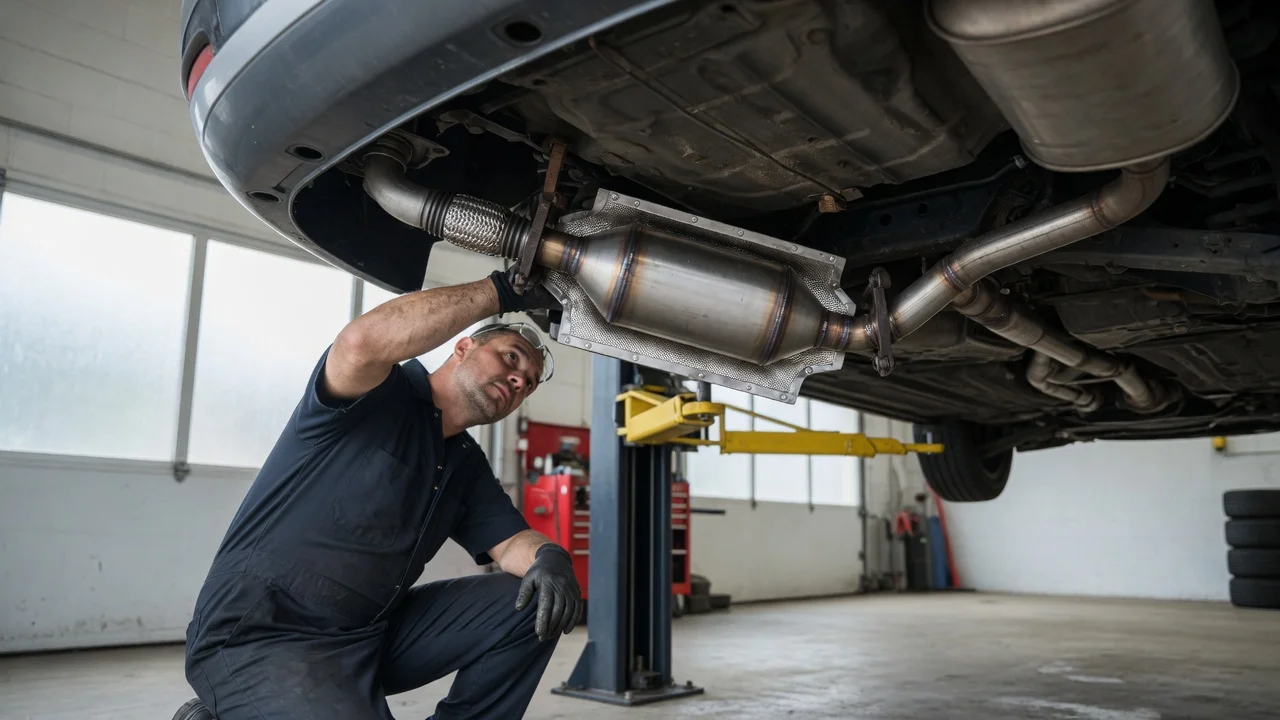
From the side or front of the car, follow the exhaust path away from the engine. The first major section is the front pipe or downpipe, which leads from the exhaust manifold near the engine. The catalytic converter is typically the first large cylindrical section in that path, placed before the smaller resonator or muffler sections.
Identify the converter by shape and position rather than by look alone. Many converters resemble a wide, oval or round metal canister with a heat shield around part or all of the body. Small oxygen sensors are often threaded into the exhaust before and after the converter, but the exact number and placement vary by vehicle.
On vehicles with a front and rear catalytic converter, the front unit is usually near the exhaust manifold or in the downpipe area. The rear unit is farther downstream under the vehicle, still ahead of the main muffler. Checking the position relative to the muffler and resonator is usually the fastest way to avoid confusing those parts.
Check the output
A correct identification is confirmed when the part is in the exhaust line between the engine and the muffler, is shaped like a canister or bulged section, and is not the final muffler. If you are using a photo, make sure the exhaust path is visible rather than hidden by suspension, fuel lines, or the vehicle floor.
Do not treat a photo timestamp, vehicle model name, or visible shield as proof that a specific part belongs to that car without checking its service information. Owner manuals and repair databases describe converter count and location for the exact engine and emissions package. Use them only as reference material for your vehicle; do not rely on an image search result.
Common problems and next steps
A common source of confusion is mistaking the muffler or resonator for the converter. The muffler is normally the last large metal box in the exhaust system, while the resonator is often a smaller cylinder behind the converter. If the first large section you see is close to the rear of the car, you may have identified the muffler; move forward along the exhaust to find the converter.
On some engines the converter is hidden by a large heat shield or mounted high in the engine bay, making it difficult to see from below. In that case, look for the downpipe and follow the shielding toward the next exhaust flange. Do not remove shields unless you have the correct tools and can safely support the vehicle.
Vehicle layout changes by engine option, model year, and emissions specification. A configuration with a certain number of converters is not the same for every version of a model. Confirm against service information for the exact vehicle when the number or position matters before inspection or replacement.