Failing Catalytic Converter: How to Identify the Problem
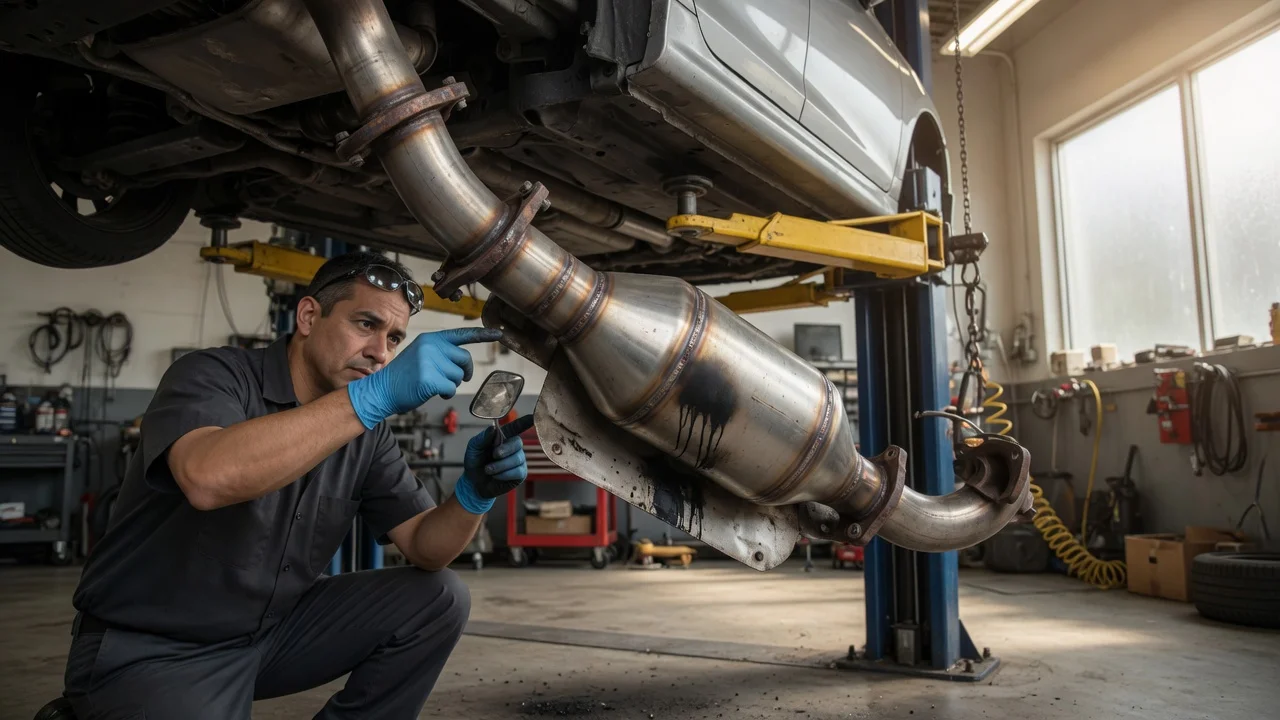
What a failing catalytic converter means
A catalytic converter is an emissions device in the exhaust system. Inside a metal shell, a coated ceramic or metallic honeycomb speeds chemical reactions that turn carbon monoxide, unburned hydrocarbons, and nitrogen oxides into less harmful gases before they leave the tailpipe. A failing converter is one that no longer converts those gases efficiently, is physically damaged, or is so restricted that exhaust cannot flow freely.
You identify the problem by placing the part on the vehicle, matching a pattern of symptoms, and then using checks that separate converter trouble from look-alike faults. A check-engine light or a catalyst-efficiency fault code is a useful clue. It is not, by itself, a confirmed diagnosis. Engine misfires, failed oxygen sensors, exhaust leaks, and fuel or ignition problems can produce the same warnings and some of the same smells, noises, and power loss.
The picture changes with the powertrain. Gasoline engines typically use one or more three-way converters. V-type and some transverse engines often have a converter for each bank. Many vehicles also have a close-coupled converter near the exhaust manifold plus an underfloor unit. Diesel vehicles may use an oxidation catalyst together with a diesel particulate filter and other aftertreatment parts; those housings can look similar from underneath. Hybrid gasoline vehicles still use catalytic converters. Exact layout, heat-shield design, and sensor placement are vehicle-specific, and applicability should be confirmed against the service information for that model year, market, and engine.
Where it sits and how to recognize it
On most cars and light trucks the catalytic converter is in the exhaust pipe under the vehicle, after the exhaust manifold or downpipe and before the muffler and resonator. A close-coupled converter may sit right at the manifold, often tucked near the engine bay rather than in the open underfloor run. Oxygen sensors typically thread into the pipe just before and just after a monitored converter; those sensors are a strong locating cue when the shell itself is hidden by a heat shield.
The converter housing is a swollen, often stainless or aluminized steel canister, usually thicker and more bulbous than a straight pipe. Many units have a welded seam around the middle, mounting bosses or heat-shield brackets, and a warning stamp about emissions equipment. The interior substrate is not visible unless the shell is damaged or the unit has been cut. A rattle from inside the shell when the cold exhaust is gently shaken, with the vehicle safely supported, points to a broken substrate rather than a loose heat shield, which rattles on the outside of the can.
Look-alikes from underneath include the muffler, resonator, flex pipe, and, on diesels, the diesel particulate filter. A muffler is usually farther rearward and often larger, with baffled construction rather than a honeycomb core. A diesel particulate filter is commonly a similar canister in the same underfloor area and may be identified by temperature sensors, a differential-pressure pipe pair, and service labels; treating a filter as a gasoline three-way converter, or the reverse, will mislead both identification and repair. A stolen converter leaves a gap in the exhaust, raw pipe ends, and a sudden loud exhaust note; that is a missing part, not a still-installed unit that has gone inefficient.
Uncertain identification is resolved by tracing the pipe from the manifold rearward, counting canisters, noting oxygen-sensor or temperature-sensor positions, and comparing that layout with the vehicle’s exhaust diagram. If the underbody is covered, damaged, or fitted with non-original exhaust parts, visual ID alone is incomplete until the piping is matched to that vehicle’s configuration.
Signs that point to converter trouble
No single symptom proves the converter has failed. The useful pattern is a combination of emissions, drivability, smell, sound, and heat clues, interpreted against other faults that can create the same observations.
Check-engine light with catalyst-efficiency codes such as P0420 or P0430, or with related oxygen-sensor and misfire codes that often accompany converter damage.
Failed or borderline inspection for tailpipe emissions or on-board diagnostics, after the engine is otherwise in tune.
Sulfur or rotten-egg smell from the exhaust, which can appear when the catalyst is not processing sulfur compounds as intended. Fuel formulation and other exhaust faults can produce a similar odor.
Rattle from the converter shell over bumps or on startup, consistent with a broken ceramic substrate moving inside the can.
Loss of power, hesitation, or a feeling that the engine is choked at higher load, which may indicate a clogged converter restricting exhaust flow.
Unusually high underbody heat, glowing converter housing, or heat-related damage to nearby wiring, plastic, or the cabin floor. A severely restricted converter can overheat.
Hard starting, stalling, or a sudden drop in performance after the engine is already warm, when a plugged converter builds excessive backpressure.
A glowing converter, strong exhaust odor in the cabin, rapid overheating, or a vehicle that will barely rev or move is a stop condition. Continued driving is not established as safe in those states. A quiet efficiency fault with normal power is a different situation and still needs diagnosis; it does not by itself authorize ignoring the warning. Specific temperature, backpressure, or emissions thresholds that confirm failure are vehicle- and test-equipment-specific and are not supplied here; use the manufacturer’s test values for that engine.
Problems that mimic a bad converter
Treat the following as competing explanations until tests separate them. Several of these faults can also destroy a still-good converter if they continue, so the converter and the upstream cause sometimes appear together.
Aging or slow oxygen sensors. Downstream sensor readings are how many control units judge catalyst efficiency. A faulty sensor can set a catalyst code on a converter that is still working.
Exhaust leaks before the downstream sensor. Extra air in the pipe can make the catalyst look inefficient to the computer.
Misfires, leaking fuel injectors, or a rich running condition. Unburned fuel overheats and can melt the substrate. The resulting damage is real, but the root cause started in the engine.
Oil or coolant entering the exhaust from worn rings, valve guides, a failed turbo seal, or a head-gasket leak. Contamination coats the catalyst and shortens its life.
A restricted muffler, crushed pipe, or clogged diesel particulate filter that produces the same power loss as a plugged converter.
Loose heat shields, exhaust hangers, or a broken engine mount that rattle near the converter without any substrate failure.
Aftermarket or incomplete exhaust parts, missing converters, or test pipes. The computer will often report catalyst inefficiency because the monitored brick is absent or the wrong type.
How to narrow the diagnosis
Separate what you observe from what might be causing it. Work from low-risk, high-value checks toward tests that need tools or a hoist. Do not treat a stored code as the verdict. If the procedure requires lifting the vehicle, working on a hot exhaust, or using manufacturer test limits, stop and use qualified service when you cannot do that work safely or to spec.
Read fault codes and freeze-frame data, then note pending and stored codes together. Catalyst-efficiency codes with misfire, fuel-trim, or oxygen-sensor codes point first to the engine and sensors. Clear nothing until you have recorded the set.
Confirm the engine is not misfiring, running rich, or burning oil or coolant. Repair those conditions first. A new converter will fail again if raw fuel or contamination is still entering the exhaust.
Inspect the converter and nearby pipe for dents, impact damage, bluing or heat discoloration, broken mounts, and exhaust leaks at flanges and flex joints. Look at both banks on engines that have two monitored converters.
With the exhaust cold and the vehicle secured, check for an internal rattle versus a heat-shield rattle. An internal rattle supports a broken substrate. An external rattle does not.
Compare upstream and downstream oxygen-sensor activity with a scan tool when that data is available. On many gasoline systems a working three-way catalyst flattens the downstream sensor relative to the switching upstream sensor. Similar switching front and rear supports an inefficient catalyst or a sensor or leak problem and still needs the rest of the test sequence. Exact waveforms and pass-fail rules are model-specific.
Test for exhaust restriction using the method and limits in the vehicle’s service information. Common shop methods include backpressure measurement and comparing converter inlet and outlet temperatures after a defined drive or load. Do not substitute a generic number from another vehicle. If those specifications are not in hand, this step is a gap and belongs with a technician who has the procedure.
On diesels, distinguish oxidation-catalyst faults from diesel particulate filter clogging and from NOx-aftertreatment faults. Filter regeneration history, differential pressure, and temperature-sensor data are the usual separators; gasoline three-way tests do not apply.
Hazards sit at the inspection steps: a hot converter can burn skin and ignite debris; a raised vehicle must be on stands rated for the load; exhaust gases include carbon monoxide, so enclosed running is unsafe. Do not strike, drill, or gut a converter to “test” it. Removing or disabling required emissions equipment is restricted or prohibited in many jurisdictions; the exact rule depends on where the vehicle is registered and inspected, and that legal detail should be checked locally rather than assumed.
What to do once the pattern is clear
If checks show a damaged or restricted converter after the engine is running clean, replacement of the affected unit is the usual repair, using a converter that meets the emissions standard for that vehicle. If checks show a sensor, leak, or misfire with a converter that still flows and has an intact substrate, repair that fault and retest before condemning the converter. If the vehicle lacks power, overheats the exhaust, or fills the cabin with exhaust smell, do not keep driving it to “see if it clears.”
Warranty and inspection rules for catalytic converters vary by market and model year. In some places original converters are covered for a stated emissions-warranty period; aftermarket and theft-related replacements follow different rules. Those periods and parts requirements are not verified in this guide and must be read from the warranty booklet and the inspection authority that applies to the vehicle. Specific backpressure limits, temperature deltas, and legal tampering penalties are also not supplied here; treat them as gaps until you have the manufacturer procedure and the local regulation in front of you.