Brougham Cars: What the Name Means and How It Differs from Other Trims
A Brougham car is not a single make or model. "Brougham" is a name that automakers have attached to vehicles for more than a century, first to describe a specific body style and later, mostly in the United States, to mark an upscale trim level. If you see a car badged Brougham, it usually means a more luxuriously equipped version of an existing model rather than a separate vehicle with its own platform. The exact meaning depends heavily on the maker, the model generation and the model year, so the name tells you the car's intended position in the lineup more than any fixed set of features.
Where the Brougham Name Comes From
The word predates the automobile. A brougham was a light, closed, four-wheeled horse-drawn carriage named after Henry Brougham, the 19th-century British statesman associated with its design. Its defining layout was an enclosed compartment for passengers, with the driver seated outside at the front. The carriage was compact, elegant and meant for private town use rather than long-distance travel.
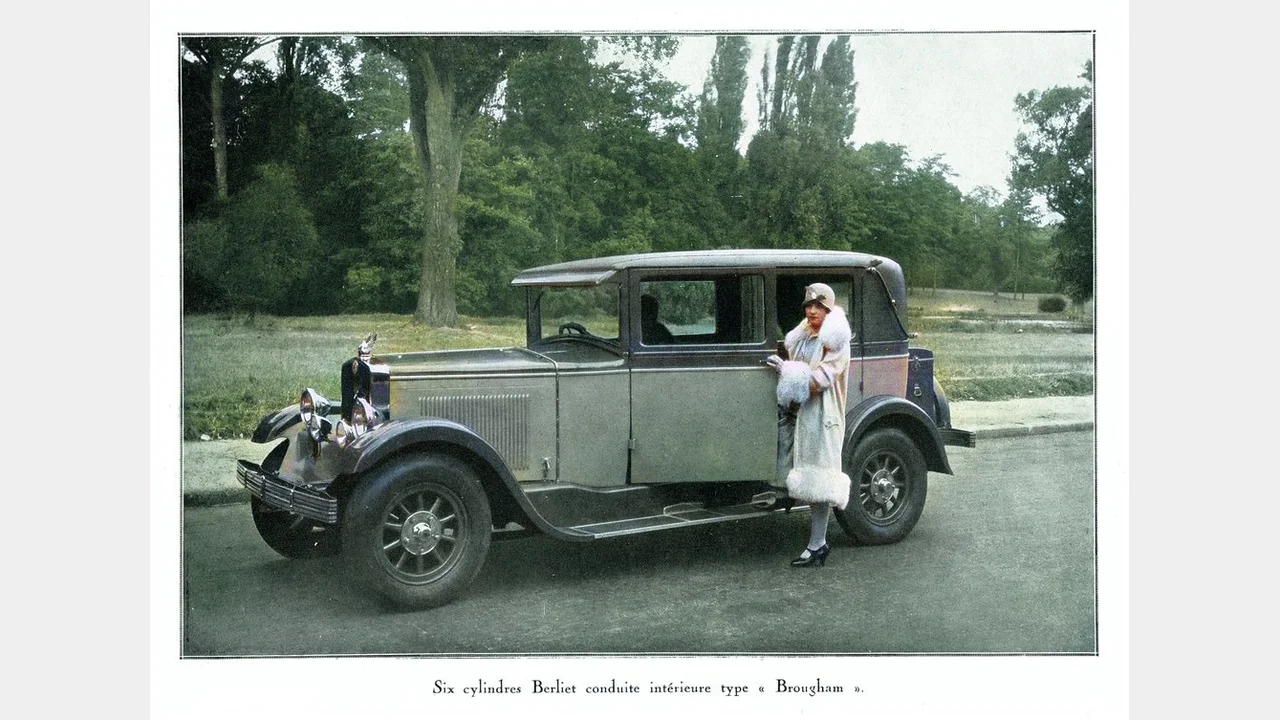
When early coachbuilders began putting bodies on motorcar chassis, they borrowed carriage terminology. A brougham body on an early car generally meant an enclosed rear passenger compartment with an open or partially open position for a chauffeur in front, a layout closely related to what was also called a town car or sedanca de ville. In that era, the name described physical construction, not a level of equipment.
From Body Style to Trim Level
As chauffeur-driven body styles faded and closed steel sedans became the norm, the word Brougham lost its technical meaning. It kept its associations with formality, privacy and wealth, and that is why marketers kept using it. Through the postwar decades, and especially from the 1960s into the 1980s, American manufacturers applied Brougham as a trim level or sub-series name to signal their most comfortable, best-appointed versions of full-size and mid-size cars.
In this later sense, a Brougham was typically built on the same chassis, with the same basic body shell and often the same powertrain variants, as the less expensive versions of the same model. What changed was the trim: upholstery, interior appointments, exterior ornamentation and sometimes standard equipment that was optional on lower trims. Enthusiasts sometimes refer to this period loosely as the "Brougham era," shorthand for the formal-roof, plush-interior style that dominated American luxury cars of the time.
Notable Cars That Used the Brougham Name
Many brands used the name, and the same make sometimes used it in different ways across generations. The following examples illustrate the range; availability, body styles and equipment varied by model year and market specification, so treat this as orientation rather than a complete production record.
Make | Model or series | How Brougham was used; Cadillac | Eldorado Brougham (late 1950s) | A distinct, very limited, hand-finished flagship rather than a trim of another car; later examples had bodies built in Italy; Cadillac | Fleetwood Sixty Special Brougham / Fleetwood Brougham | Top-tier version of the long-running rear-wheel-drive Fleetwood sedan line; Cadillac | Brougham (late 1980s to early 1990s) | Standalone model name for the rear-wheel-drive sedan after Cadillac's front-drive lineup took over other names; Ford | LTD Brougham | Upscale trim of the full-size LTD; Chevrolet | Caprice Classic Brougham | Upper trim of the full-size Caprice sedan; Oldsmobile | Ninety-Eight Regency Brougham, Cutlass Supreme Brougham | Highest-content trims of the full-size and mid-size lines; Pontiac | Bonneville Brougham | Upscale trim of the Bonneville; Chrysler, Dodge, Plymouth | New Yorker Brougham, Monaco Brougham, Gran Fury Brougham | Luxury-oriented trims across several Chrysler Corporation lines; Nissan (Japanese market) | Cedric and Gloria Brougham | Luxury trim of executive sedans, showing the name's influence beyond the US
The Cadillac Eldorado Brougham of the late 1950s is the main exception to the trim-level pattern. It was conceived as an exclusive, low-volume flagship with its own body and an unusually long list of standard luxury features, and it is generally regarded as a collector car distinct from the many later Broughams that were dressed-up versions of volume models.
How a Brougham Typically Differs from the Base Version
Because Brougham was a marketing designation, there is no universal specification. That said, American Brougham trims of the 1970s and 1980s tended to share a recognizable set of upgrades. Not every car had every item, and some features were optional even on the Brougham trim.
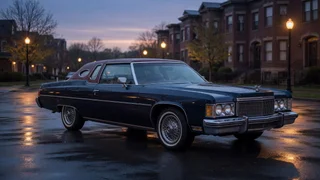
• Interior: plusher upholstery, often crushed velour or soft cloth in a loose "pillow" or button-tufted pattern, with leather offered on some models; upgraded door panels, additional sound insulation and extra courtesy or reading lights; • Seating: split-bench front seats with individual adjustment, center armrests and sometimes power seat functions; • Roof treatment: a full or partial vinyl roof, frequently padded, sometimes paired with small "opera" windows in the rear roof pillar for a formal, private look; • Exterior details: extra brightwork, distinctive badges or script, stand-up hood ornaments, special wheel covers or wire-style wheel covers, and accent striping; • Equipment: features such as power windows, power locks, upgraded audio or automatic climate control might be standard on the Brougham while optional lower in the range; • Ride: some models offered softer suspension tuning aimed at quietness and comfort, though this was not consistent across brands
Mechanically, a Brougham usually did not differ fundamentally from its siblings. Engine and transmission choices were typically drawn from the same powertrain variants offered on the rest of the model line, though some makers bundled a larger engine as standard on the top trim in certain years. If performance or drivetrain matters to you, check the specific car's engine and model year rather than assuming the Brougham badge implies a particular configuration.
Brougham Versus Related Terms
Several carriage-era words survived into automotive marketing, and they are easy to confuse.
• Landau: originally a carriage with a folding rear top. On postwar American cars it usually describes a roof treatment, typically a vinyl covering over the rear portion of the roof, sometimes with a decorative chrome bar. A car could be both a Brougham trim and have a landau-style roof. • Town car: historically similar to the brougham body, with an enclosed rear and an open chauffeur area. Lincoln later used Town Car as a model name for its full-size luxury sedan. • Coupe de ville and sedan de ville: French-derived terms for formal body layouts; Cadillac used de Ville as a long-running model name. • Limousine: a longer formal vehicle, usually with a partition between driver and passengers. A Brougham trim did not make a car a limousine.
How to Identify a Brougham
Badging is the obvious clue, but badges can be added, removed or swapped over a car's life. For a more reliable identification, look at the factory documentation and coding that applies to the specific make and model year. Depending on the manufacturer, the series or trim may be indicated in the vehicle identification number, on a body or trim tag, on the original window sticker or in a build sheet. Interior trim codes can also help confirm whether the upholstery and appointments match what the factory installed. How these codes are structured differs between brands and eras, so a marque-specific decoder or owners' club resource is the usual way to interpret them.
What to Consider If You Are Shopping for One
Most Brougham cars on the market today are older full-size or mid-size American sedans and coupes, bought for their comfort, styling and nostalgia. A few practical points apply broadly:
• Trim condition matters more than usual. Much of a Brougham's appeal lies in its interior and exterior appointments, and original velour, padded vinyl roofs and decorative trim pieces can be difficult to source or restore. • Vinyl roofs can hide problems. Moisture trapped under a vinyl covering may lead to rust on the roof panel or around the rear window, so inspect edges and seams carefully. • Power accessories add complexity. Broughams were often loaded with power features and comfort electronics that can be costly or tedious to repair on an older car. • Parts sharing helps mechanically. Because most Broughams share engines, transmissions and chassis components with the regular versions of the same model, mechanical parts are often easier to find than trim-specific pieces. • Value depends on the specific car. The Brougham name alone does not guarantee collector interest; the model, generation, originality and condition matter more. The late-1950s Cadillac Eldorado Brougham sits in a very different category from a typical 1980s Brougham-trim sedan.
The Bottom Line
"Brougham car" describes a lineage of naming rather than a single vehicle. The term began with a 19th-century closed carriage, became an early automotive body style with an enclosed rear compartment and a chauffeur up front, and eventually turned into a popular American trim level signaling extra comfort and formal styling. To understand any particular Brougham, identify the make, model, generation and model year first; that context determines what the badge actually meant when the car left the factory.