Brake Pad Replacement Tools: Caliper Compressors and Pad Spreaders
What these tools are for
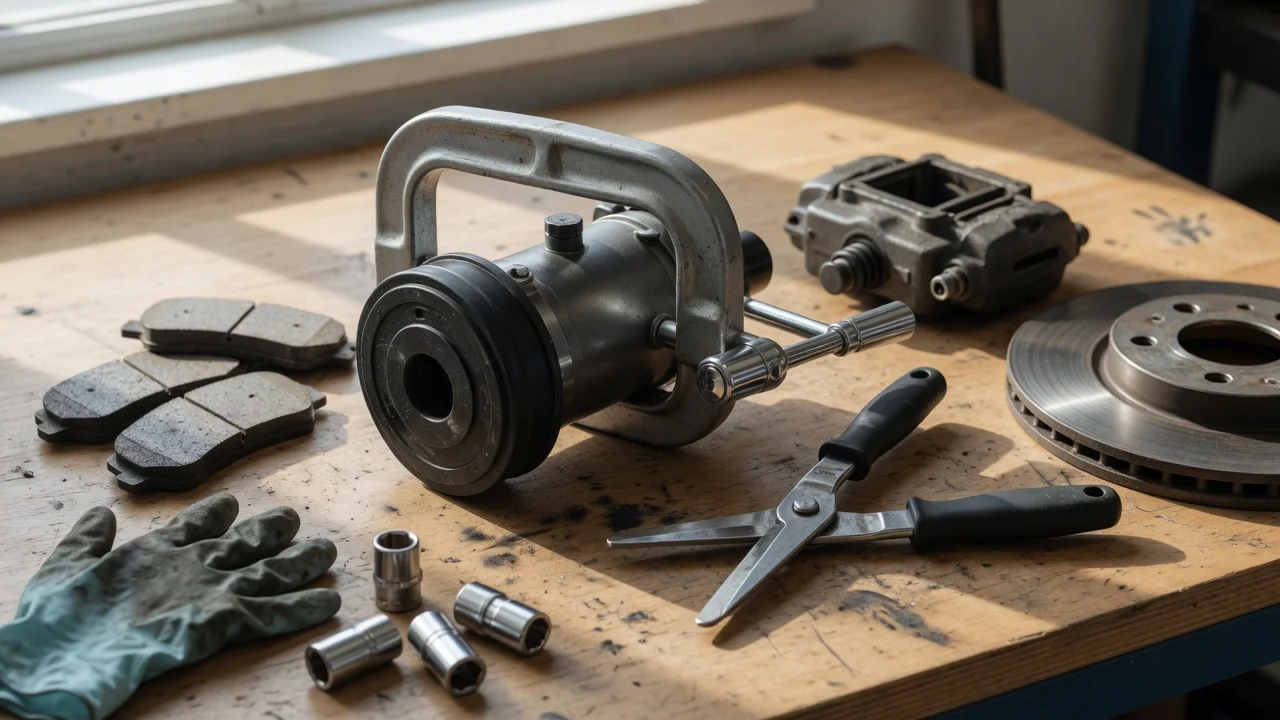
A brake caliper compression tool, often sold as a piston compressor or caliper rewind tool, pushes the caliper piston back into its bore so a new, thicker brake pad can fit. A pad spreader does a related job: it pries or screws the pads apart, which also retracts the piston on many floating-caliper designs. Both belong on a disc-brake pad replacement, not a drum-brake shoe job. The right choice depends on how the caliper is built and whether the piston must be pushed straight in or turned as it goes back.
Why the piston has to go back
As pads wear, the piston walks outward so the lining stays close to the rotor. New pads are thicker, so that piston must be retracted before the caliper will close over the rotor. On a typical single-piston floating caliper, compressing the piston is enough. On many rear calipers that also act as the parking brake, the piston is threaded and must be rotated inward, usually clockwise or counterclockwise depending on the vehicle, while it is pressed. Forcing a screw-in piston straight back can damage the mechanism. Twin-piston or opposed-piston (fixed) calipers need each piston retracted, often one at a time, and may need a spreader or dual-piston adapter rather than a single C-clamp style press.
Caliper compressors
The common shop tool is a ratchet- or screw-driven press that sits between the piston face and the caliper body or the opposite pad. Turning the handle advances a ram or a plate against the piston. Cube and disc kits add interchangeable adapters so the ram contacts a solid piston face, a hollow piston, or a slotted parking-brake piston without chewing the dust boot. Wind-back sets include a two-pin or three-pin plate that engages holes or slots in the piston, plus left- and right-hand threads so the piston can be wound in while pressure is held. A simple C-clamp with an old pad as a buffer can retract a plain floating-caliper piston, but it is a poor match for screw-in rear pistons and for pistons that sit deep or sit behind a square piston face.
Push-only compressor: screw or ratchet ram for floating calipers whose pistons slide, not screw. Wind-back / rewind kit: pin plate plus left- and right-hand drive for parking-brake rear calipers that must be rotated in. Multi-piston adapter: wide plate or dual rams for calipers with two or more pistons on one side. Cube or disc adapter set: faces that match hollow, slotted, or oval pistons so the boot and piston face are not damaged.
Pad spreaders
A pad spreader is a scissor, wedge, or screw jack placed between the inner and outer pads. Opening it forces the pads apart and, on a floating caliper, drives the piston home. Spreaders are handy when the caliper is still on the bracket and you want to create clearance before unbolting, or when you are seating pads on a sliding caliper after the piston has been started back. They are less suitable as the only tool on a screw-in parking-brake piston, because spreading does not rotate the piston. On a fixed, opposed-piston caliper, a spreader can retract pistons on both sides at once if the tool is centered and the pistons move freely; seized pistons still need a dedicated compressor on each bore.
Which tool matches which caliper
Caliper type | Typical piston action | Tool that fits; Single-piston floating (most front, many rear without integrated park brake) | Straight push | Push-type compressor or pad spreader; Rear floating with integrated parking brake | Rotate while pushing (direction is vehicle-specific) | Wind-back kit with the matching pin plate; Twin-piston floating | Straight push on both pistons | Wide plate, dual ram, or careful one-at-a-time compression; Fixed / opposed-piston | Straight push, often both sides | Dual-piston compressor, pad spreader, or a ram on each side; Electronic parking brake (EPB) rear caliper | Motor must retract the piston before mechanical compression; procedure is model-year and make specific | Scan tool or manufacturer service mode first, then the mechanical compressor the caliper requires
Electronic parking brake calipers are the main qualification that changes the job. Many EPB systems must be put into pad-replacement or maintenance mode so the motor winds the piston back. Compressing the piston by hand against a live motor can break the actuator. The exact steps, and whether a dedicated rewind adapter is still needed after the motor retracts, vary by make, model year, and whether the EPB is caliper-mounted or cable-actuated. Confirm the service procedure for that vehicle before using a mechanical compressor.
How to use a compressor without damaging the caliper
Support the caliper so the hose is not stretched. If the pads are still in place, a spreader can make enough room to lift them out. Open the master-cylinder cap so fluid can return, and watch the level: old fluid displaced by the pistons can overflow. Never lever against the dust boot or the piston seal. Seat the adapter fully on the piston face. For a wind-back piston, engage both pins (or the correct three-pin pattern) and turn in the direction specified for that side of the car; some vehicles use opposite thread directions left to right. Stop when the piston is square and just below the boot, not cocked in the bore. After the new pads are in and the caliper is bolted down, pump the pedal until it is firm before moving the vehicle, then check the fluid level and look for leaks at the boots and banjo fittings.
Choosing a kit
If the vehicle uses ordinary sliding front calipers and non-screw rear calipers, a compact ratchet compressor or a stout pad spreader is usually enough. If any rear caliper uses the parking brake inside the piston, buy a rewind set with a range of pin plates rather than a push-only clamp. Universal wind-back kits cover a wide range of passenger cars and light trucks, but they do not list every piston pattern; match the plate to the holes or slots in the piston before applying force. For frequent work on multi-piston performance or truck calipers, a kit with a large thrust plate or dual rams is more useful than a single small disc. Quality differences show up in thread smoothness, whether the ram stays square, and whether adapters are thick enough not to dish under load. Specific load ratings and vehicle coverage lists are kit-dependent and should be read from the tool maker’s application chart rather than assumed.
Limits and what this guide does not replace
This is a tool-identification and selection guide, not a vehicle-specific repair procedure. Piston wind-back direction, EPB service mode, torque figures, pad wear sensors, and whether the caliper bracket hardware is one-time-use are all model-, year-, and market-dependent. A seized piston, a torn boot, or a caliper that will not slide on its pins is a caliper repair or replacement, not a job for more spreading force. If the pedal stays long after the pistons are reset and the system is bled, the problem is elsewhere in the hydraulic circuit.