Brake Master Cylinder Repair: What It Involves and How to Diagnose a Failing Unit
The short answer
A brake master cylinder that is leaking or no longer holding pressure is usually repaired in one of two ways: it is rebuilt with new internal seals, or the whole unit is replaced with a new or remanufactured part. On many modern vehicles replacement is the more common route, because rebuild kits are not always offered and a worn or corroded bore cannot be fixed by new seals alone. Either way, the brake system has to be bled afterwards to remove air, and the work directly affects your ability to stop, so it calls for careful procedure and a thorough brake test before the vehicle goes back on the road.
Before committing to the repair, confirm that the master cylinder is actually the fault. Several other problems, including external leaks, air in the lines and brake booster faults, produce symptoms that look similar.
What the master cylinder does
The master cylinder converts the force on the brake pedal into hydraulic pressure. It is usually mounted on the brake booster, the round vacuum- or hydraulically-assisted unit on the driver's side of the firewall, with the brake fluid reservoir sitting on top. Inside the bore, pistons with rubber seals push fluid into the brake lines when you press the pedal.
Most passenger vehicles use a tandem, or dual-circuit, master cylinder. It feeds two separate hydraulic circuits, so a failure in one circuit leaves partial braking in the other. That redundancy is a safety backup, not a reason to keep driving: braking with one circuit is noticeably weaker and the pedal usually travels much further.
Rebuild or replace?
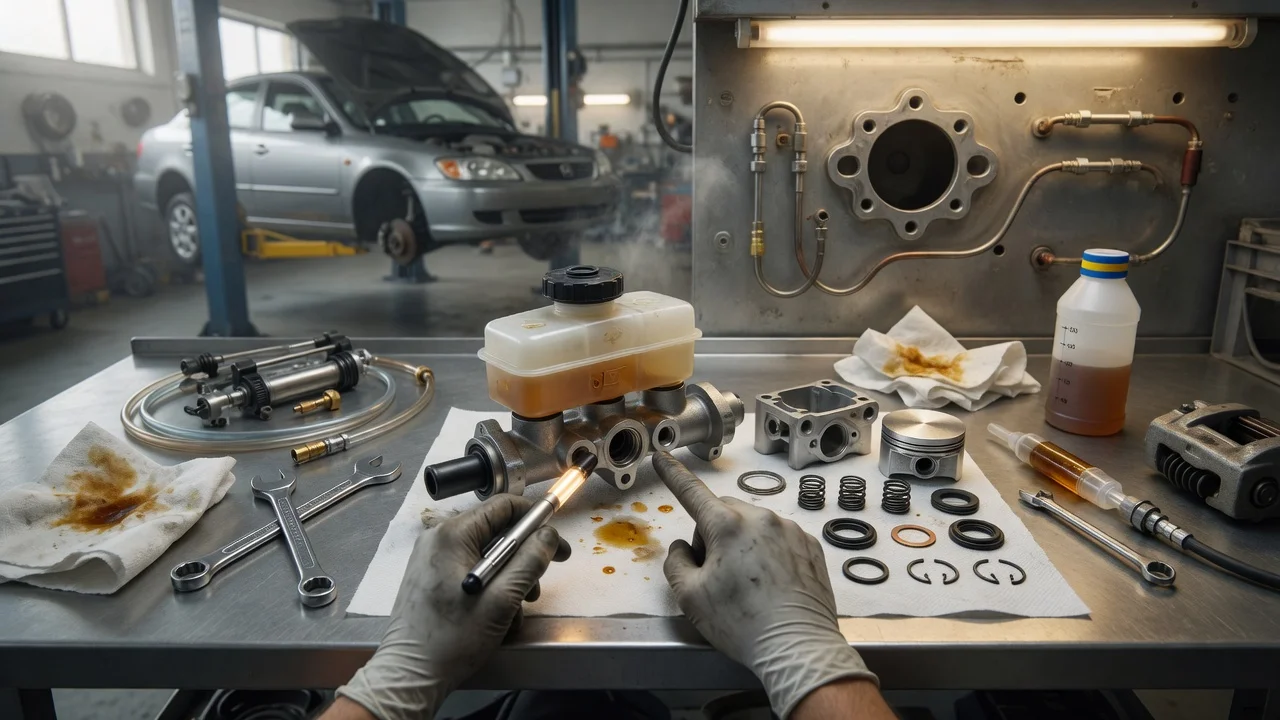
Rebuilding means removing the unit, taking out the pistons, cleaning the bore and fitting new seals from a kit. It can work when the bore is smooth and kits are available for the vehicle. If the bore shows pitting, scoring or corrosion, new seals will not seal reliably and the unit should be replaced.
Replacing the unit avoids uncertainty about bore condition and is the standard approach for many repair shops. Remanufactured units are a lower-cost option on many applications; new units are also widely sold. Whether a rebuild kit exists, and which replacement part fits, depends on the make, model, model year and brake system configuration, including whether the vehicle has ABS or stability control. Check fitment against the specific vehicle rather than assuming parts interchange.
What the repair typically involves
Removing fluid from the reservoir and disconnecting the brake lines, taking care to keep brake fluid off paint, as it damages painted surfaces. Unbolting the master cylinder from the brake booster and checking the booster pushrod. Bench bleeding the new or rebuilt unit, which means filling and cycling it on the bench to purge air before installation. Many replacement units come with fittings for this. Installing the unit, reconnecting the lines and filling with the brake fluid type specified for the vehicle. Bleeding the brake system at the wheels. On some vehicles with ABS, a scan tool is needed to cycle the ABS unit during bleeding; the service procedure for the specific vehicle determines this. Confirming a firm pedal and testing the brakes at low speed in a safe place before normal driving.
The process is within reach of experienced home mechanics, but mistakes such as trapped air, cross-threaded line fittings or the wrong fluid can leave the brakes unsafe. If you are not confident with hydraulic brake work, or if the vehicle needs scan-tool-assisted bleeding, a professional repair is the safer choice. Labour time and parts cost vary by vehicle and were not supplied here, so get a quote specific to your model.
Symptoms and what could explain them
A failing master cylinder usually shows up as a pedal that feels wrong or as fluid that keeps disappearing. The same symptoms can come from other parts of the brake system, so the checks below help separate the likely causes.
Symptom | Possible causes | What points to the master cylinder; Pedal slowly sinks under steady pressure | Internal seal bypass in the master cylinder; external leak; ABS hydraulic unit fault | Pedal sinks with no visible external leak and a steady fluid level; Spongy or soft pedal | Air in the lines; worn or swollen hoses; old fluid; master cylinder fault | Softness remains after a correct bleed with fresh fluid; Falling fluid level | External leak at calipers, wheel cylinders, hoses or lines; leak at rear of master cylinder; normal level drop from pad wear | Wet area or fluid trace where the master cylinder meets the booster; Hard pedal needing heavy effort | Brake booster or vacuum supply fault | Usually not the master cylinder; Brake warning light on | Low fluid level; parking brake engaged; circuit pressure fault on some vehicles | Low fluid with a leak traced to the master cylinder; Brakes drag or will not release fully | Seized caliper or collapsed hose; master cylinder not returning fully; booster pushrod adjustment | Dragging on all wheels that eases after loosening the master cylinder line fittings, a check best left to a professional
Checks to make next
Check the fluid level and condition. Note the level against the reservoir markings. A gradual drop can simply reflect worn brake pads; a noticeable drop over a short period suggests a leak. Dark or contaminated fluid suggests the fluid is overdue for replacement. Look for external leaks. Inspect inside each wheel for wet patches around calipers or drum brake wheel cylinders, follow the brake lines and hoses, and check the ground where the vehicle is parked. Inspect the rear of the master cylinder. Fluid around the joint with the brake booster, or on the booster body below it, points to a leaking rear seal in the master cylinder. Do a steady-pressure pedal test. With the vehicle parked and the engine running, hold firm, steady pressure on the pedal. If it slowly sinks while there is no external leak and the fluid level is not dropping, internal leakage past the master cylinder seals is a likely cause. Compare pedal feel with the engine off and on. A pedal that becomes much harder with the engine off and stays hard with it running points towards the booster or its vacuum supply rather than the master cylinder. Consider recent work. A soft pedal after brake work often means air was introduced and the system needs bleeding, not a new master cylinder.
Warning lights and fault codes
A red brake warning light commonly indicates low fluid or an engaged parking brake, and on some vehicles a hydraulic pressure problem. ABS or stability control fault codes can relate to sensors, the ABS hydraulic unit or wiring as well as to fluid level or pressure. Treat any code as a pointer for investigation rather than proof that the master cylinder has failed, and interpret it with the service information for the specific vehicle.
When to stop driving and get professional help
The pedal goes to the floor or nearly so, or has to be pumped to build pressure. The red brake warning light stays on while driving. Fluid is visibly leaking or the reservoir level is dropping quickly. Stopping distances have noticeably increased or the vehicle pulls hard to one side when braking. The cause is unclear after basic checks, or ABS or stability control warnings are present.
In any of these cases, do not continue driving the vehicle; have it transported or inspected where it stands. Brake faults can worsen without warning, and the dual-circuit design only provides reduced braking as a temporary backup.
Gaps to fill for your vehicle
This guide covers the general principles of master cylinder diagnosis and repair. It does not include vehicle-specific details such as the correct brake fluid specification, torque values for line fittings and mounting nuts, whether a rebuild kit is available, bleeding sequence, ABS bleeding requirements or typical repair costs. Those depend on the make, model, model year and market, and should come from the vehicle's service information or a qualified technician.